
Hair Oil for Extreme Hair Loss & Alopecia in Pakistan (What Actually Helps)
Extreme hair loss and alopecia in Pakistan aren’t fixed by a regular champi. See which oils map to which alopecia type, real timelines, and when to see a dermatologist.
HAIR OIL
Written by Ali Raza, CEO of Ollexo, with over 10 years of experience in the oil industry. Ali writes on practical oil applications, ingredient science, and industry trends.
5/14/202613 min read
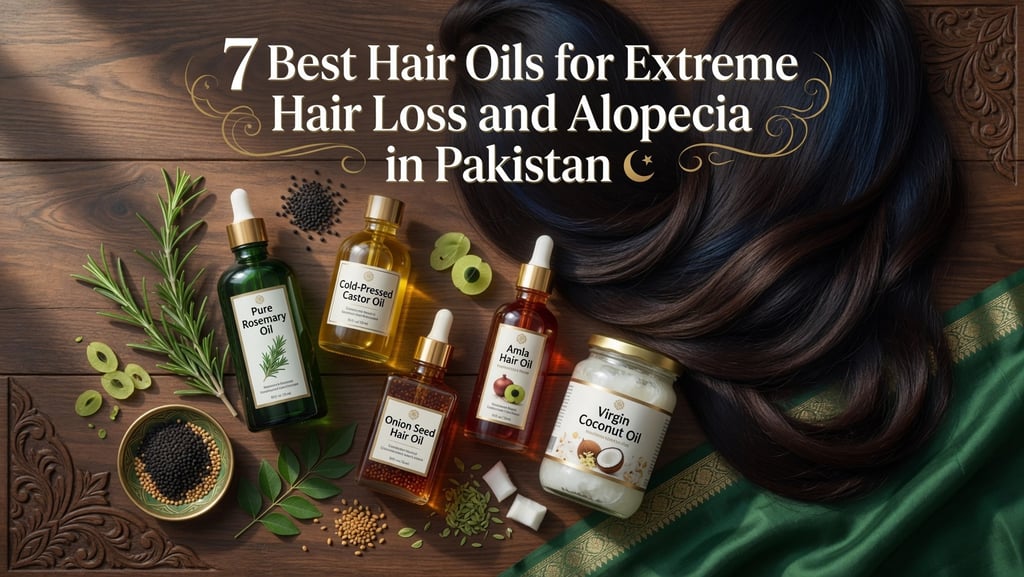
Hair Oil for Extreme Hair Loss & Alopecia in Pakistan (What Actually Helps)
Summarize this blog post with: ChatGPT | Perplexity | Claude | Grok
You've probably already tried coconut oil, maybe even onion juice. If you're reading this, it didn't fix the bald patches or stop the fall the way you hoped. The problem isn't that you chose the wrong oil. Most hair oils are built for maintenance, not recovery. Severe hair loss and alopecia need a completely different approach. Severe hair loss and alopecia need a different oil logic than routine champi. Below: seven oils with clinical or Unani backing, which alopecia type each one fits, and how to apply them on bald areas without wrecking expectations.
For everyday hair fall and a ranked buyer shortlist, start with our guides to the best hair oil for hair fall in Pakistan and best hair oils in Pakistan 2026. This page is narrower: severe loss, alopecia types, and oils that behave differently on each.
Key Takeaways
Severe hair loss means losing more than 100 strands a day or developing visible bald patches, it's medically distinct from normal daily shedding and needs a targeted treatment, not a general hair oil.
Rosemary oil is the most clinically studied natural option for hair regrowth; a 2015 peer-reviewed trial found it matched minoxidil 2% for hair count after six months in androgenetic alopecia patients, with significantly less scalp irritation.
Hair oils cannot regrow hair from completely dead follicles. They work on dormant or weakened follicles in early-to-moderate hair loss, which is why starting early matters.
Pakistan-specific triggers, hard water, PCOS, iron deficiency, and heat stress, are among the most common drivers of severe hair fall and need to be addressed alongside any topical treatment.
Traditional Pakistani oils like kalonji, bhringraj, and jatamansi have both cultural roots and emerging clinical support for scalp health and follicle stimulation.
At least 12 weeks of consistent use is required before judging whether an oil-based treatment is working; most clinical studies measure results at three to six months.
Rapidly expanding bald patches, circular hair loss, or scalp pain require a dermatologist, oil treatment alone is not enough.
What Is Severe Hair Loss, and How Is It Different from Normal Shedding?
Severe hair loss is defined as losing more than 100 hairs per day or developing visible bald patches, and it's medically distinct from normal daily shedding of 50–100 strands. Normal shedding is part of the hair growth cycle. Severe hair loss (whether androgenetic alopecia, alopecia areata, or telogen effluvium) signals a disruption that a regular champi can't fix.
There are three types most relevant to Pakistani readers:
Androgenetic alopecia (pattern baldness) is driven by genetics and the hormone DHT, which shrinks hair follicles over time. In Pakistan, it affects 39.6% of women aged 20–70 and 51.2% of sampled men, Source: Journal of Pakistan Association of Dermatologists, 2010 and PJMHS, 2021. It develops gradually, which is partly why people don't act on it until bald patches appear.
Alopecia areata is an autoimmune condition where the body attacks its own follicles, causing coin-sized circular patches of sudden hair loss. It affects roughly 2% of the global population, Source: PMC/National Library of Medicine, 2022. The patches can appear anywhere on the scalp, and in some cases they expand.
Telogen effluvium is the kind of diffuse shedding that hits after major stress, illness, childbirth, or nutritional crashes. You find handfuls in the shower. It's one of the most common types in Pakistani women and is usually reversible once the underlying trigger is addressed.
Knowing which type you're dealing with matters because the oils that help with androgenetic alopecia (DHT-blocking, circulation) are not the same ones that help with alopecia areata (anti-inflammatory, immune modulation). Using a DHT-blocker on an autoimmune patch won't do much.
Why Is Extreme Hair Loss So Common in Pakistan?
Several environmental and health factors endemic to Pakistan accelerate hair loss in ways that generic hair care advice never accounts for. Understanding your local triggers is the first step toward treating the problem effectively.
Hard water is one of the most underappreciated culprits. Cities like Karachi, Lahore, and Faisalabad have municipal water with high mineral content: calcium and magnesium ions that deposit on the scalp, clog follicles, and weaken hair shafts.
PCOS affects roughly 20% of Pakistani women of reproductive age. The hormonal imbalance it causes, specifically elevated androgens, directly triggers hair follicle miniaturization, producing the kind of diffuse thinning that women in their 20s and 30s often mistake for stress-related shedding.
Iron-deficiency anemia is widespread across Pakistan, particularly among women. Iron is essential for the production of hair matrix cells; without it, the hair growth phase shortens and strands shed before their time. A 2023–2024 cross-sectional study in Karachi found that poor diet was one of the most significant contributing factors to hair loss in the Pakistani population, Source: Karachi Cross-Sectional Study, 2023–2024.
Heat, pollution, and sun exposure, particularly in Karachi and Lahore, strip the scalp's natural sebum barrier, leaving follicles vulnerable to oxidative stress.
Stress and post-Ramadan dietary dips trigger telogen effluvium in cycles. Hair loss queries in Pakistan spike post-summer and in the weeks after Ramadan, when nutritional depletion and exhaustion push hair follicles into the resting phase simultaneously.
Can Hair Oils Actually Regrow Hair on Bald Areas?
Hair oils can stimulate dormant follicles and improve the scalp environment, but they cannot regrow hair from permanently damaged or scarred follicles. This is the honest answer, and it matters because setting the wrong expectation leads to months of wasted effort.
Hair grows in cycles: anagen (active growth), catagen (transition), and telogen (rest/shedding). Follicles that are dormant (weakened but still alive) respond to oils that improve blood flow, reduce inflammation, or block DHT. Follicles that have been permanently scarred or replaced by fibrous tissue don't.
For androgenetic alopecia, oils work best in the early-to-moderate stages when follicles are miniaturized but still functional. For alopecia areata, reducing inflammation around the follicle can help, but more aggressive patches often need medical intervention alongside oils. For telogen effluvium, addressing the root cause (nutrition, stress) is primary; oils support recovery but don't replace it.
If you have thinning or bald areas where you can still see fine vellus hairs, you have follicles worth treating. That window closes over time, which is why early intervention makes a real difference.
The 7 Best Oils for Severe Hair Loss and Alopecia in Pakistan
1. Rosemary Oil, The Most Clinically Proven Natural Oil for Hair Regrowth
Read the full deep-dive: Rosemary Oil for Hair Loss in Pakistan
Rosemary oil promotes hair regrowth by improving scalp microcirculation and inhibiting the 5-alpha-reductase enzyme, which converts testosterone into DHT, the hormone most directly linked to androgenetic alopecia.
A 2015 randomized comparative trial published in Skinmed found rosemary oil matched minoxidil 2% for hair count at six months in androgenetic alopecia patients, with significantly less scalp irritation in the rosemary group, Source: Panahi Y et al., Skinmed, 2015. A more recent double-blind trial in 2024–2025 found a rosemary-lavender combination produced a 57.73% improvement in hair growth rate and nearly 70% improvement in hair thickness, Source: Patel S et al., Cureus, 2025.
Best for: Androgenetic alopecia (male and female pattern baldness). Pakistan availability: Rosemary essential oil is available at herbal stores and online (Rs 400–900 for 10–15ml). How to use: Mix 4–5 drops in 1 tablespoon of carrier oil (coconut or jojoba). Massage into thinning areas for five minutes, leave for 30–45 minutes, then wash out. Use three times per week.
2. Kalonji (Black Seed) Oil, Pakistan's Traditional Powerhouse for Hair Loss
See also: Kalonji Oil Benefits for Hair Growth
Kalonji oil, derived from Nigella sativa, contains thymoquinone, an anti-inflammatory compound studied for its potential to reduce the autoimmune response associated with alopecia areata. It's been used in Unani and Islamic medicine for centuries, and the science is starting to catch up.
Thymoquinone suppresses pro-inflammatory cytokines that are elevated in autoimmune hair loss. It also has antifungal properties that address scalp conditions; fungal infections are an underdiagnosed driver of hair fall in Pakistan due to heat and humidity.
Best for: Alopecia areata, scalp inflammation, PCOS-related hair loss. Pakistan availability: Widely available at kiryana stores and pharmacies (Rs 300–700 for 100ml). How to use: Apply directly to bald patches, massaging in small circles for 3–5 minutes. Leave overnight if possible. Wash with a sulphate-free shampoo in the morning.
3. Castor Oil, The Thickener for Sparse, Thinning Edges
Related: Castor Oil for Hair Growth in Pakistan
Castor oil contains ricinoleic acid, which has demonstrated anti-inflammatory and circulation-enhancing effects that may help sparse or thinning areas, particularly edges and hairlines. It's thick, so use it on targeted areas, not all over the scalp.
There's less randomized clinical data on castor oil than rosemary, but its ricinoleic acid content consistently shows anti-inflammatory activity in cell studies, and its viscosity creates a protective film over damaged follicles.
Best for: Hairline recession, thinning edges, alopecia areata patches. Pakistan availability: Available at most pharmacy chains and online (Rs 200–500 for 100ml). How to use: Apply a small amount directly to sparse patches or edges using fingertips or a cotton swab. Dilute 1:1 with lighter oil (jojoba or almond) to reduce stickiness. Leave for 30 minutes before washing.
4. Bhringraj Oil, The Ayurvedic Standby for Follicle Recovery
Related: Bhringraj Oil for Hair Fall in Pakistan
Bhringraj oil, made from Eclipta alba, has been used in Ayurvedic and Unani medicine for hair regrowth for over a thousand years, and a small number of clinical studies suggest it may promote follicle proliferation and extend the anagen (growth) phase.
A study on mice showed bhringraj extract produced hair growth comparable to minoxidil 2%, though human clinical trials remain limited. In Pakistan, bhringraj-based oils, often sold as "bringha tail", have been part of traditional champi routines for generations. The empirical tradition here is long and consistent.
Best for: General thinning, post-illness hair fall, telogen effluvium recovery. Pakistan availability: Available at Unani/Dawakhana stores, Chiltanpure, and online herbal stores (Rs 400–1,200 for 100ml). How to use: Warm slightly and massage into scalp with fingertips. Cover with a hot towel for 20–30 minutes for deeper penetration. Wash with a mild shampoo. Use twice a week.
5. Pumpkin Seed Oil, The Emerging DHT Blocker
Pumpkin seed oil contains phytosterols and delta-7-sterine that inhibit 5-alpha-reductase, the enzyme that produces DHT, making it a natural alternative to pharmaceutical DHT blockers for androgenetic alopecia.
A 2014 double-blind, placebo-controlled trial found pumpkin seed oil supplementation over 24 weeks increased hair count by 40% in men with androgenetic alopecia, Source: Evid Based Complement Alternat Med, 2014. It's less studied as a topical oil but gaining popularity in Pakistan as awareness grows.
Best for: Male and female androgenetic alopecia, PCOS-related hair loss. Pakistan availability: Available online and at specialty health stores (Rs 800–1,800 for 60–100ml). How to use: Mix with a carrier oil and apply to thinning areas. Can also be taken orally, 1 teaspoon daily is the dose used in clinical trials.
6. Red Onion Oil, For Sulfur-Deficient, Weak, and Shedding Hair
Related: Onion Oil for Hair Fall in Pakistan
Red onion oil is rich in sulfur, a mineral essential for keratin production, and quercetin, an antioxidant that may support hair follicle health. It's one of the most searched hair oils in Pakistan right now, partly due to TikTok and Instagram reels, and the clinical data is more solid than most social media trends.
A 2002 study in the Journal of Dermatology found onion juice applied twice daily for four weeks promoted regrowth in 86.9% of alopecia areata patients, Source: Sharquie KE et al., J Dermatol, 2002. The oil version is less concentrated but far more tolerable for regular use.
Best for: Telogen effluvium (stress/nutritional shedding), alopecia areata, general weakness. Pakistan availability: Widely available from brands like Mama Organic and Pure Nature Pakistan (Rs 400–900 for 100ml). How to use: Apply to scalp and thinning areas, massage for five minutes, leave for 30–45 minutes. The smell is strong, so wash thoroughly with a sulphate-free shampoo. Use 2–3 times per week.
7. Jatamansi (Balchar) Oil, The Unani Remedy for Patchy Alopecia
Jatamansi oil, derived from Nardostachys jatamansi, is a traditional Unani remedy used specifically for patchy hair loss, with emerging research suggesting it may inhibit DHT and reduce scalp inflammation linked to alopecia areata.
It's not widely known outside Unani medicine circles, but several Pakistani herbal brands (notably Chiltanpure) now carry it. Animal studies show jatamansi extract promotes the anagen phase and increases follicle density. Human clinical trials are still limited, but the traditional evidence base is strong.
Best for: Alopecia areata patches, DHT-driven thinning. Pakistan availability: Chiltanpure, herbal/dawakhana stores (Rs 500–1,200 for 100ml). How to use: Apply a few drops directly to patchy areas. Combine with kalonji oil for a synergistic anti-inflammatory blend. Leave overnight, wash in the morning.
Comparison Table: Which Oil for Which Type of Hair Loss?
Oil Best For Expected Timeline Rosemary oil Androgenetic alopecia (pattern baldness) 3–6 months Kalonji (black seed) oil Alopecia areata, scalp inflammation, PCOS 8–16 weeks Castor oil Hairline recession, thinning edges 6–12 weeks Bhringraj oil Telogen effluvium, general thinning 8–12 weeks Pumpkin seed oil Androgenetic alopecia (DHT-driven) 3–6 months Red onion oil Alopecia areata, telogen effluvium 4–8 weeks Jatamansi oil Alopecia areata patches 8–16 weeks
How to Apply Oil to Bald Patches and Severe Hair Loss, Step by Step
This protocol is for bald or significantly thinning areas, it's different from a standard champi because the goal is follicle stimulation, not surface conditioning.
Step 1: Prep your scalp. Wash with a mild sulphate-free shampoo 24 hours before oiling, or the evening before. Applying oil to a dirty, clogged scalp reduces absorption.
Step 2: Warm the oil slightly. Place the bottle in warm water for 2–3 minutes. Warm oil penetrates the scalp faster and the gentle heat slightly dilates scalp blood vessels, improving circulation.
Step 3: Apply to bald or thinning patches first. Use your fingertips or a dropper to apply oil directly to the affected area. Don't start with the rest of the scalp, target the problem areas.
Step 4: Use micro-massage on bald areas. Using your fingertips (not nails), apply slow circular pressure directly on the patch for 3–5 minutes. This micro-massage stimulates microcirculation to the follicle, a technique supported by a 2016 study showing standardized scalp massage increased hair thickness after 24 weeks, Source: Eplasty, 2016.
Step 5: Leave for 30–45 minutes minimum. Overnight is better, particularly for kalonji and castor oil. Cover with a shower cap to retain warmth.
Step 6: Wash with a sulphate-free shampoo. Heavy oils (especially castor) need a second shampoo wash to remove fully. Residue left on the scalp can clog follicles, which is the opposite of what you're trying to achieve.
A few things that actually make hair loss worse when oiling: undiluted essential oils (rosemary, jatamansi) applied directly without a carrier oil will irritate the scalp. Oiling over an already greasy, itchy scalp without cleansing first clogs rather than feeds follicles. And vigorous rubbing breaks hair shafts; circular pressure is the goal, not friction.
DIY Oil Blends for Hair Regrowth Using Pakistani Ingredients
These recipes use ingredients available at any Pakistani grocery or herbal store.
Blend 1: Androgenetic Alopecia Blend (DHT Blocker)
2 tablespoons pumpkin seed oil (base)
1 tablespoon jojoba oil
6 drops rosemary essential oil
4 drops jatamansi essential oil
Mix and store in a dark glass bottle. Apply to thinning areas three times per week using the micro-massage technique above.
Blend 2: Alopecia Areata Support Blend (Anti-Inflammatory)
3 tablespoons kalonji oil (base)
1 tablespoon castor oil
5 drops lavender essential oil
Apply directly to circular patches daily, massaging gently. This combines thymoquinone (kalonji) and ricinoleic acid (castor) for anti-inflammatory coverage.
Blend 3: Telogen Effluvium Recovery Blend (For Stress/Post-Illness Shedding)
3 tablespoons bhringraj oil
1 tablespoon olive oil
3 tablespoons fresh onion juice (added just before use, not stored)
Mix bhringraj and olive oil in advance. Add onion juice immediately before applying. Leave for 30–40 minutes, wash thoroughly. Use twice weekly.
When Should You Stop Using Oil and See a Doctor?
Certain types and patterns of hair loss are beyond the reach of any oil-based treatment and require medical evaluation. Continuing to self-treat when these warning signs are present can delay a diagnosis that changes the outcome.
See a dermatologist if:
Bald patches are expanding rapidly, with new patches forming weekly
You have complete circular bald areas with sharply defined edges (classic alopecia totalis pattern)
The affected areas feel itchy, burning, or painful
Hair loss is accompanied by a scaly, flaking, or crusted scalp
You're losing eyebrows, eyelashes, or body hair alongside scalp hair
The person experiencing hair loss is a child
Affordable dermatology in Pakistan is accessible at government hospitals, the Aga Khan University Hospital (Karachi), Shaukat Khanum, and LUMHS Hyderabad. A single consultation can distinguish between alopecia areata (often treated with corticosteroid injections) and androgenetic alopecia (treated with minoxidil or finasteride), which changes the treatment path entirely.
There's a cultural hesitation around medications like minoxidil in Pakistan. That's understandable. But using only oils when bald patches are spreading fast means the follicles lose viability during the delay. Oils and medical treatment are not opposites. They can work together.
Your 90-Day Hair Oil Routine for Severe Hair Loss
A structured routine over 90 days gives you enough data to judge whether your chosen oil is actually working.
Weeks 1–4 (Scalp Prep and Consistency): Pick one or two oils from the list above based on your hair loss type. Apply three times per week using the micro-massage protocol. Take a baseline photo of the most affected area under the same lighting. Don't judge results yet. Inflammation and scalp health need time to stabilize before new growth begins.
Weeks 5–8 (Assess the Scalp Environment): Look for early signals, not full regrowth. Reduced shedding in the shower, less scalp irritation, and fine baby hairs at the edges of bald patches are positive signs. If you're still losing at the same rate with no change, consider switching to a DHT-blocking oil or adding a scalp massage tool (a silicone scalp massager costs Rs 200–400 online).
Weeks 9–12 (Decide and Adjust): Compare your current photos with your baseline. Visible fine regrowth (even vellus hairs) at the patch edge indicates active follicles responding. If there's no change in 12 weeks and hair loss is continuing, this is the point to consult a dermatologist, not as a failure, but as the logical next step.
FAQs
Q: Can hair oil cure alopecia areata in Pakistan?
A: No oil is a cure for alopecia areata. Some oils (kalonji, diluted rosemary blends, onion-based preparations) may support the scalp environment on small non-scarring patches, but expanding circular loss, scalp pain, or loss of eyebrows needs a dermatologist — often corticosteroid treatment, not oil alone.
Q: How long before I judge an oil for extreme hair loss?
A: Plan on at least 12 weeks of consistent use, with baseline photos. Most clinical hair studies report at three to six months. If patches grow weekly before that, stop waiting on oil and get medical care.
Q: Which oil should I start with for pattern baldness vs circular patches?
A: For gradual pattern thinning (androgenetic), rosemary or pumpkin-seed–leaning DHT-aware options are the usual starting point. For sudden coin-shaped patches (alopecia areata), anti-inflammatory choices like kalonji are more logical — and medical review still comes first if patches multiply.
Related guides
Hair Regrowth Takes Longer Than Anyone Wants to Hear
Hair regrowth from severe hair loss is slow. Not as a disclaimer. That's just how the hair cycle works. Most clinical trials measure results at three to six months because that's how long it takes for follicles to respond, produce vellus hairs, and thicken them into visible strands.
The oils in this guide aren't shortcuts. Rosemary has the best clinical evidence for pattern baldness, it's the one I'd start with. Kalonji is the most sensible choice if your patches are circular or autoimmune in nature. The Unani oils (bhringraj, jatamansi) are underrated and genuinely worth trying, particularly if you want something rooted in regional tradition and backed by some science.
None of them will work without consistency. And none of them replace a dermatologist if your patches are expanding week by week. That's not defeatist. It's just what the evidence says. Use the oil, follow the 90-day protocol, take photos, and treat a consultation not as a last resort but as the logical next move if things aren't shifting after three months.