
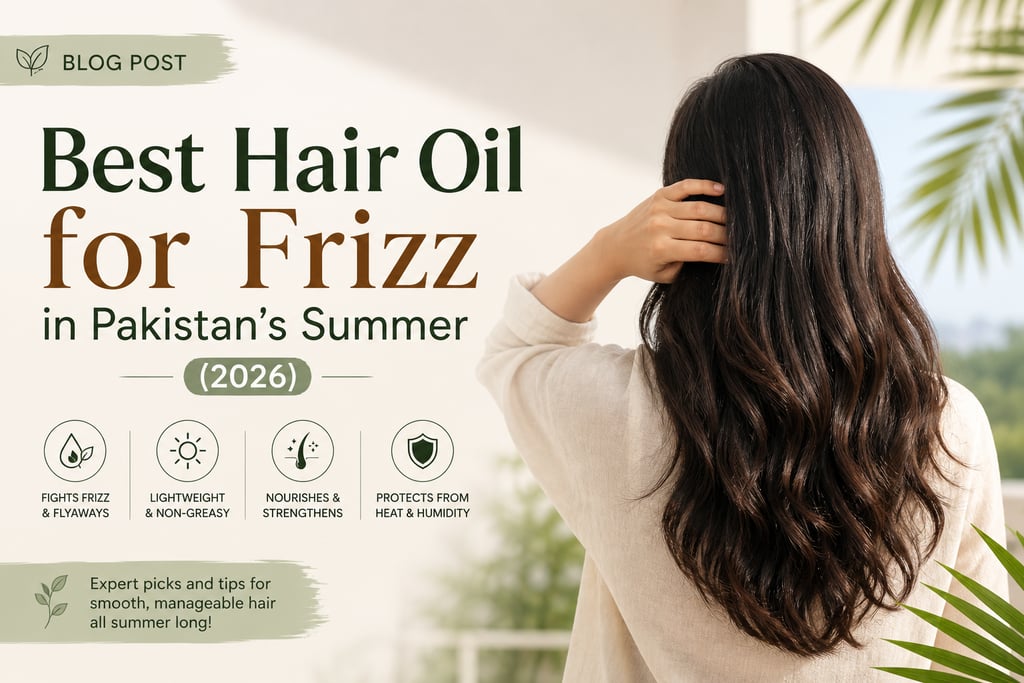
Best Hair Oil for Frizz in Pakistan's Summer (2026)
Karachi humidity, Lahore heat, Multan dust — frizz in Pakistan isn't one problem. These oils are matched to your city's climate, starting from Rs 790 at ollexo.pk.
HAIR OIL
Written by Ali Raza, the CEO of Ollexo, a Pakistani natural oils brand in the hair care space. With over 10 years of experience in the oil industry, he writes about practical hair care guidance, ingredient science, and product choices suited to Pakistani consumers.
5/5/202613 min read
Best Hair Oil for Frizz in Pakistan's Summer (2026): Ranked by Humidity Performance
You probably already know that oiling your hair is good for it. Most Pakistani women grew up with a bottle on the dressing table. But here is what most routines miss: the oil that worked perfectly in winter can actively worsen frizz when Pakistan's summer humidity hits 80%. This guide covers which lightweight oils actually beat the heat, how to apply them correctly for frizz control, and which products are worth buying in 2026.
Key Takeaways
Frizz happens when humidity forces moisture into the hair shaft through lifted cuticle scales, causing the hair to swell and puff. The right oil creates a physical barrier that stops this from happening.
Lightweight oils like argan and sweet almond perform far better in Pakistan's summer than heavy oils like pure castor, which trap heat at the scalp and weigh hair down.
Ollexo Hair Oil is formulated for Pakistan's climate, giving you frizz control without the greasy residue that heavier oils leave behind.
Pre-wash oiling, applied two to three hours before shampooing, gives the best frizz protection without leaving buildup on already sweaty summer hair.
Coastal cities like Karachi need lighter oil quantities than drier inland cities. Adjusting how much you use based on your city's humidity makes a real difference.
Hard water in cities like Karachi and Lahore strips the hair's natural oils over time. A regular frizz-control oil compensates for that ongoing damage.
A consistent weekly oiling routine builds frizz resistance gradually. One application every two weeks will not get you through Pakistan's summer.
Why Does Hair Get Frizzier in Pakistan's Summer Humidity?
Frizz is what happens when the outer layer of your hair, called the cuticle, lifts up and lets humid air in. Each strand is coated in overlapping scales, like roof tiles. When those scales lie flat, hair looks smooth. When they lift, the hair absorbs moisture from the surrounding air, swells unevenly, and loses its shape.
Pakistan's summer creates a triple threat for this. Humidity in coastal cities like Karachi regularly sits between 70 and 90% from June through September. Temperatures exceed 38°C in Lahore and Karachi for weeks at a stretch. And tap water in most Pakistani cities is hard water, meaning it carries high mineral content that gradually strips the hair's natural protective layer. None of these factors alone would be devastating. Together, they create near-perfect conditions for maximum frizz.
Frizz is caused by humidity entering the hair shaft through raised cuticle scales, forcing the hair to swell and lose its smoothness. This process worsens significantly during Pakistan's summer months when humidity regularly exceeds 70%. It is not a hair type issue. Even naturally straight hair becomes unpredictable in Pakistani summer humidity when the cuticle is unprotected.
A 2021 study in the Journal of Cosmetic Science found that hair exposed to relative humidity above 65% showed measurable increases in strand diameter within minutes, with the most significant swelling occurring in hair that had already sustained cuticle damage from heat or chemical processing. Pakistan's summer months routinely push well past that threshold.
Can Hard Water Make Frizz Worse in Pakistani Cities?
Hard water worsens frizz more than most people realise. The minerals in hard water, mainly calcium and magnesium, accumulate on the hair shaft over time and roughen the cuticle surface. A rough cuticle catches humid air more easily and holds onto it longer.
Cities like Lahore, Karachi, and Faisalabad have water hardness levels that exceed the WHO's recommended threshold of 200 mg/L of calcium carbonate for household use. Research published in the International Journal of Trichology (2016) confirmed that women washing their hair in hard water had significantly more surface roughness and breakage compared to those using soft water. If your frizz seems particularly bad given your hair type, your tap water is likely contributing.
Pakistan's hard water, common in cities like Karachi and Lahore, strips the hair's natural lipid layer over time, making regular use of a nourishing frizz-control oil essential for maintaining cuticle integrity during summer. Using a dedicated frizz-control oil compensates for some of this damage by replenishing the lipids that hard water strips away.
Can You Use Hair Oil on Frizzy Hair in Summer Without Making It Greasy?
Yes, and the difference comes down to choosing an oil light enough to absorb rather than sit on top of the hair shaft. The belief that oiling in summer always makes hair greasy comes from using the wrong oils in the wrong amounts.
Heavy oils like pure coconut or castor oil have larger molecular weights. They do not penetrate the hair shaft easily and sit on the surface instead. In summer heat, that means trapping sweat and heat close to the scalp. In winter, that insulation is useful. In June in Karachi, it is not.
Lightweight hair oils such as sweet almond, argan, and jojoba create an occlusive seal over the hair cuticle that reduces moisture absorption from the air. They fill gaps in the cuticle rather than coating the outside, which gives you frizz control without the film. These are among the most effective natural tools for frizz control in humid climates precisely because they work with the hair structure rather than just over it.
The application method matters as much as the oil itself. Post-wash application on damp hair, using just a few drops on the mid-lengths and ends, delivers frizz control without the greasy buildup at the roots. This matters especially in summer when the scalp is already producing more sebum from the heat.
What to Look for in a Summer Anti-Frizz Hair Oil
Picking the wrong oil is the most common reason women end up with hair that is simultaneously frizzy and greasy in the same summer afternoon. There are specific things to look for, and specific things to avoid.
Ingredients That Actually Fight Humidity-Induced Frizz
Argan oil is the standard-bearer for humid-climate frizz control. Rich in oleic and linoleic fatty acids, it forms a flexible, breathable seal over the cuticle. It absorbs quickly and does not feel heavy on fine or medium hair.
Sweet almond oil is lighter than argan and absorbs even faster. It works particularly well for fine or thin hair that would feel weighed down by heavier formulas. For more on what sweet almond specifically does at the fatty acid level, the sweet almond oil benefits for hair post on the Ollexo blog covers that in detail.
Jojoba oil is technically a liquid wax, not an oil, which partly explains why it behaves so differently from heavier options. It closely mimics the scalp's natural sebum and is one of the few oils genuinely suitable for oily-scalp types in summer.
Rosemary-infused oils have earned real interest in Pakistan for good reason. Rosemary extract has shown measurable benefits for hair density in clinical research, and when infused into a lightweight base oil, it delivers frizz protection alongside scalp support. The how to use rosemary oil for hair growth post on Ollexo covers the usage specifics if you want to work it into your summer routine.
What to Avoid in a Summer Frizz Oil
Pure castor oil is one of the most common summer oiling mistakes in Pakistan. Castor oil is thick, slow-absorbing, and heavy. In winter, that thickness helps with moisture retention. In summer humidity, it traps heat and sweat at the scalp and worsens oiliness and buildup. If you want the scalp benefits of castor, use a small amount within a blend rather than as a standalone treatment. The castor oil for hair growth in Pakistan guide explains where it fits in a summer-adjusted routine.
Mineral oil forms a completely occlusive seal that does not allow moisture exchange in either direction. In hot and humid conditions, this leads to scalp discomfort and product buildup.
Coconut oil in large quantities is also worth watching. In smaller amounts as part of a blend, it is fine. As the primary frizz treatment in high humidity, it tends to be too slow-absorbing for most hair types and can leave the same surface residue problem as castor.
Best Hair Oils for Frizz in Pakistan's Summer, Ranked
The ranking below reflects lightweight texture, frizz-control performance in humid conditions, and availability for buyers in Pakistan.
1. Ollexo Hair Oil
Ollexo Hair Oil is a Pakistan-formulated lightweight hair oil designed to combat humidity-induced frizz without the heavy, greasy texture associated with traditional oil treatments, making it suitable for daily or pre-wash use in summer.
Most international hair oils are formulated for Western or East Asian humidity levels, which are both lower and shorter in duration than what you deal with in Lahore or Karachi between May and September. Ollexo was built with Pakistan's climate in mind, which changes what the formula needs to do.
The lightweight base absorbs quickly and leaves no residue, which means you can use it pre-wash or as a serum on damp hair after washing. That flexibility matters for adapting to Pakistan's shifting summer conditions, from the dry heat of May to the full monsoon humidity of August. Ollexo is available on Daraz in a mid-tier price range that makes weekly use realistic rather than occasional. For women managing both frizz and hair fall simultaneously, which is common when summer heat and humidity stress the scalp, the best hair oil for hair fall in Pakistan post covers how Ollexo addresses both concerns together.
2. Argan Oil (Pure or Blended)
Pure argan oil is a strong second choice, particularly for medium to thick hair. It handles humidity well, absorbs fully within 20 to 30 minutes, and does not leave a visible film on the hair shaft. The drawback is price. Pure, high-quality argan in Pakistan can get expensive for regular use, and diluted versions at lower price points are common in the market.
3. Sweet Almond Oil (Standalone or Blended)
Sweet almond oil is the best lightweight option for fine or thin hair. It is one of the most affordable oils that genuinely delivers on frizz control in humid conditions. The trade-off is that it provides less intensive conditioning than argan, so women with very dry or damaged hair may find it underwhelming on its own. Women with fine hair who find Ollexo slightly too rich for daily use might prefer sweet almond as an alternative. The best hair oil for thin and fine hair post covers this pairing in more detail.
4. Jojoba Oil
Jojoba is the safest choice for oily-scalp types who need frizz control on the lengths and ends without triggering more scalp oiliness. Its sebum-like structure means it balances rather than overwhelms. It is harder to find in pure form in Pakistan compared to argan or almond, but it is available through specialty retailers and online.
5. Mixed Herbal Hair Oils With a Lightweight Base
Traditional herbal oils containing kalonji, amla, or bhringraj can work in summer, but only if the base oil is lightweight. Many traditional Pakistani hair oil formulas use a thick mineral or sesame base, which makes them better suited for winter. If you are attached to a herbal oil, check the base. If it is heavy, diluting it with a teaspoon of sweet almond or jojoba before applying in summer is a practical fix.
How Should You Apply Hair Oil for Frizz Control in Hot and Humid Weather?
Application method is where most people lose results that a good oil should deliver. Getting this right matters as much as which oil you choose.
Pre-Wash Oiling (Best for Pakistan's Summer)
Pre-wash oiling, applying oil to dry hair two to three hours before shampooing, is considered more effective for summer frizz control than post-wash application. It conditions the hair without leaving surface residue that can attract heat and sweat throughout the day.
Apply the oil from the mid-lengths down to the ends. In summer, avoid heavy application at the scalp, which already deals with excess sebum and heat. A thin pass on the scalp is fine if you want the scalp benefits, but the mid-lengths and ends are where frizz control actually happens. Leave the oil on for at least two hours. A quick 15-minute application before washing does not give the oil enough time to condition the cuticle properly. Overnight works even better, but two to three hours is sufficient for meaningful protection.
The hair oiling frequency guide on Ollexo covers how often to repeat this across Pakistan's different seasons, which changes more than most people account for.
Post-Wash Serum Application (For Daily Maintenance)
Post-wash application means using a very small amount of oil on towel-dried damp hair before it finishes drying. Use no more than two to three drops for fine hair, and up to five drops for thick or coarse hair. Apply only on the mid-lengths and ends. Avoid the scalp and roots entirely for post-wash application in summer. This keeps the scalp feeling fresh while protecting the parts of the hair most exposed to humidity throughout the day.
City-by-City Summer Hair Guide: Which Hair Oil Works for Where You Live?
Pakistan's summer is not one climate. What works in Islamabad in June is different from what your hair needs in Karachi in August.
Karachi: Coastal Humidity and the Case for the Lightest Oils
Karachi's humidity between June and September frequently sits above 75%, and during monsoon it pushes past 90% on certain days. The air is genuinely moisture-saturated. Your hair is absorbing it constantly, which means the oil's only real job is to act as a barrier.
For Karachi, use the lightest oils you can. Jojoba and sweet almond are ideal. Ollexo Hair Oil's lightweight formula also holds up well here. Apply conservatively, roughly half the amount you would use in winter. Post-wash serum application works well in Karachi because the humidity itself provides enough environmental moisture; your hair does not need additional conditioning from the oil, just protection against absorbing the wrong kind.
Hard water in Karachi's supply compounds this. If your hair has been getting rougher and harder to manage over the years despite a consistent routine, the water is likely part of the explanation.
Lahore: Two Summers in One
Lahore's summer has two distinct phases. From April through June, the heat is dry, with humidity often sitting between 30 and 50%. Your hair needs more moisture during this phase, so slightly heavier application and overnight oiling work well.
From July through August, monsoon arrives and Lahore's humidity climbs sharply, sometimes hitting 70 to 80% during rain. At that point you need to cut your quantity and move to lighter oils. Women who do not adjust for that transition often end up with the worst frizz in August because they are still using their May quantities in full monsoon conditions. Adjusting at the start of July, before the monsoon fully settles in, is the move.
Islamabad: The Most Forgiving Summer Climate
Islamabad's elevation keeps summer temperatures lower and humidity more moderate than the other two cities, typically between 40 and 65% during most of summer. You have more flexibility here. Medium-weight oils like argan work well through the whole summer without major quantity adjustment. Standard pre-wash oiling two to three times per week gives good frizz control without the seasonal recalibration Karachi and Lahore require.
What Are the Most Common Hair Oiling Mistakes That Make Summer Frizz Worse?
Using Your Winter Oil Straight Through Summer
This is the most widespread mistake, and it is understandable. Switching your hair routine takes effort. But oils like pure coconut or thick mustard that work well in October become a problem in July. The heat makes heavy oils run toward the scalp, where they mix with sweat and create buildup that clogs follicles and makes hair look greasy hours after oiling.
If you have noticed more dandruff in summer, the oil formula is often the culprit, not some new scalp condition that appeared out of nowhere. The how to deal with dandruff in summer Pakistan post covers this crossover in more detail, because the two issues are more connected than most people realise.
Using Too Much
The amount that felt manageable in winter will be too much in summer. Heat reduces the time it takes for oil to spread and travel toward the scalp, so a quantity that stayed put in cooler months will migrate in June. Start with about half your usual winter quantity and adjust based on how your hair responds.
Oiling Right Before Going Outside
Applying oil shortly before stepping out in summer heat is a setup for problems. The oil heats up, spreads toward the scalp quickly, and if you are sweating, it mixes with sweat and creates a texture that attracts dust. Pre-wash oiling done at home when you know you will be washing it out is the safer approach. It gets the conditioning benefits without any of the on-scalp buildup that comes from oil sitting in heat all day.
Skipping Heat Protection Before Blow-Drying
Hair oil is not a heat protectant. The fatty acids in most oils begin to degrade at temperatures above 180°C, which most blow-dryers reach easily. If you are blow-drying in summer, use a proper heat protectant spray first, then apply a small amount of oil on the ends once the hair has cooled. Relying on oil alone for heat protection is a gap that shows up as increased breakage over time.
Your Weekly Summer Hair Oiling Routine (Monday to Sunday)
A consistent schedule builds more frizz resistance than any single heavy application. Here is a straightforward weekly framework for Pakistan's summer:
Monday: Rest day. No oil. Let the scalp breathe after the weekend and recover from any product from the previous wash cycle.
Tuesday: Pre-wash oil day. Apply lightweight oil, Ollexo or sweet almond, two to three hours before washing. Focus on the mid-lengths and ends. Wash thoroughly with a mild, sulfate-free shampoo.
Wednesday: Post-wash serum day. Apply two to three drops of oil on damp ends after washing. Air-dry or blow-dry with a heat protectant before styling.
Thursday and Friday: Dry hair days. No oil application needed. A very small amount on the ends is fine if the air is extremely dry, but in monsoon-season Karachi or Lahore this is rarely necessary.
Saturday: Second pre-wash oil day. Repeat Tuesday's routine. Two proper conditioning treatments per week is enough to build cumulative frizz resistance through summer.
Sunday: Rest day, or a very light end application if your ends are particularly dry.
This schedule works for most hair types through Pakistan's summer. Women with particularly dry or coarse hair can add a third oiling on Thursday. Those with fine or oily scalps may find two treatments per week more than sufficient. The hair oiling frequency guide on Ollexo covers adjustments for specific hair types and seasonal transitions.
Conclusion: Frizz in Pakistan's Summer Is a Solvable Problem
Frizz is not your hair being difficult. It is your hair responding logically to humidity, heat, and hard water without adequate protection. Once you understand the mechanism, addressing it is straightforward: choose a lightweight oil matched to your city's humidity level, apply it at the right time, and adjust your quantity when the season shifts from dry heat to full monsoon.
Ollexo Hair Oil was developed with Pakistan's climate in mind. Most international hair care products are formulated for different humidity ranges and different water conditions. A formula that does not account for Karachi's coastal moisture or Lahore's mineral-heavy tap water will give you results that do not quite add up, regardless of how faithfully you follow the routine.
Start with the Tuesday and Saturday pre-wash routine from the schedule above. Give it three to four weeks. The change in your hair's baseline texture through humidity builds over time, and it does compound as the cuticle maintains better integrity between washes. Frizz is not a permanent condition. It is a gap in the routine, and now you have a way to close it.
Written by Ali Raza, the CEO of Ollexo, a Pakistani natural oils brand in the hair care space. With over 10 years of experience in the oil industry, he writes about practical hair care guidance, ingredient science, and product choices suited to Pakistani consumers.
Reviewed by the Ollexo Editorial Team