
Coconut & Castor Oil for Hair Fall: Ratios & How to Use
Castor oil stimulates the scalp but is too thick to use alone. Learn the exact 2:1 coconut blend ratio, application steps, and regional climate tips.
HAIR OIL
Ali Raza CEO, Ollexo | 10+ Years of Experience in the Oil Industry Ali Raza is the CEO of Ollexo with over a decade of hands-on experience in the oil industry. He is passionate about sharing practical insights, industry trends, and real-world lessons from years of leadership and deep product knowledge in natural and commercial oils.
3/31/202612 min read
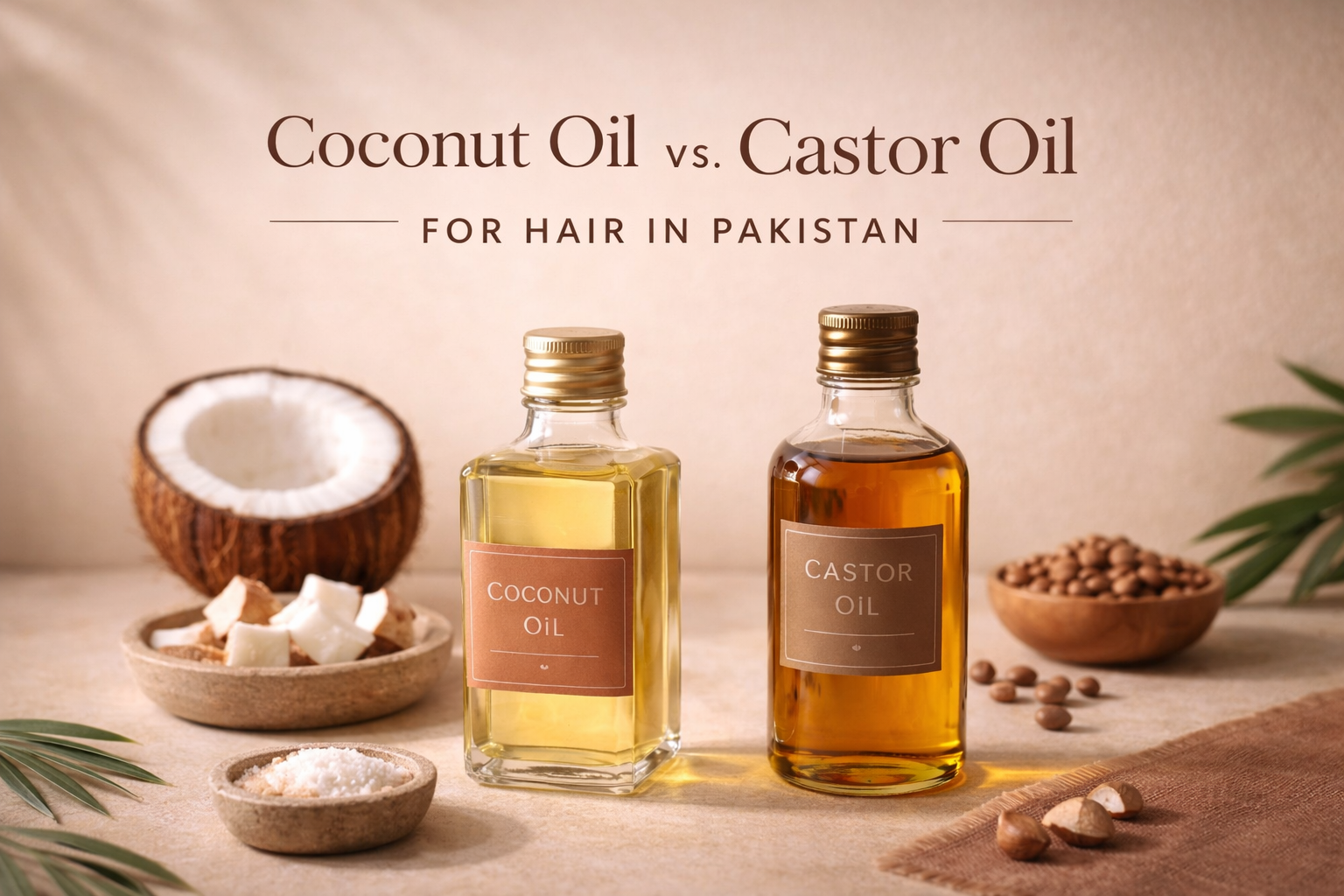
Coconut Oil vs. Castor Oil for Hair in Pakistan: The Complete Guide to Choosing the Right Oil for Your Hair
You already know that oiling your hair is one of the best things you can do for it — generations of Pakistani women have sworn by this ritual. But here's what most people get wrong: not all oils work the same way, and using the wrong one for your hair concern can leave you with greasy roots and zero results. In this guide, you'll discover exactly how coconut oil and castor oil differ, which one your hair actually needs, and how to use both for the best results, with Pakistan-specific product recommendations included.
Key Takeaways
Coconut oil penetrates the hair shaft deeply due to its lauric acid content, making it ideal for moisturizing dry, brittle, or protein-damaged hair.
Castor oil is rich in ricinoleic acid, a fatty acid known to improve scalp circulation and support hair growth, making it effective for hair fall (baalon ka girna) and thinning hair.
Coconut oil suits most hair types for regular use, while castor oil is best used as a targeted scalp treatment due to its thick, heavy consistency.
Both oils are widely available in Pakistan through brands like Hemani, Dabur, and local cold-pressed suppliers, making them accessible and affordable options.
Mixing coconut oil and castor oil in a 2:1 ratio is a popular and effective DIY hair treatment that combines moisturization with scalp stimulation.
Pakistan's varied climate, from Karachi's humidity to Lahore's dry winters, affects how each oil performs on hair, and understanding this helps you choose the right oil for your region and season.
Neither oil is universally superior; the best choice depends on your specific hair concern, hair type, and how frequently you oil your hair.
What Is Hair Oiling and Why Do Pakistanis Swear By It?
Hair oiling is a traditional South Asian practice, known as tel malish, in which natural plant-based oils are massaged into the scalp and hair to nourish, strengthen, and promote growth. This ritual is deeply embedded in Pakistani households, passed down from grandmothers to mothers to daughters as a non-negotiable part of weekly self-care. For millions of Pakistani women and men, oiling isn't a trend; it's a tradition.
The science supports the tradition, too. Regular oil application reduces hygral fatigue, which is the swelling and shrinking of hair strands due to water absorption, prevents protein loss, and keeps the scalp moisturized. A study published in the Journal of Cosmetic Science found that coconut oil significantly reduced protein loss in both damaged and undamaged hair. Source: Journal of Cosmetic Science, 2003. This is why tel malish has survived for centuries — it genuinely works.
That said, the two oils most commonly used in Pakistani homes, coconut oil and castor oil, serve very different functions. Understanding those differences is the first step to getting real results from your hair oiling routine.
Why Choosing the Right Hair Oil Matters for Pakistani Hair Types
Choosing the wrong hair oil is one of the most overlooked contributors to hair fall, and Pakistan's environment makes this choice especially critical. Pakistan spans vastly different climate zones, from Karachi's coastal humidity and salt-laden air to Lahore and Islamabad's dry, dusty winters. Each environment affects your scalp and hair differently.
Hard water is a major concern across Pakistani cities. Hard water is water with a high mineral content, specifically calcium and magnesium, that coats the hair shaft and causes dryness, breakage, and dullness. Source: International Journal of Trichology, 2016. Understanding how hard water affects your hair can help you see why certain oils work better in your city than others.
On top of that, excessive sun exposure, dust pollution, and dietary factors contribute to high rates of hair fall and scalp dryness in the region. Using an oil that doesn't match your specific concern, whether it's baalon ka girna, dandruff, or frizz, can waste both your time and money. The good news is that two affordable, widely available oils address almost every major hair concern Pakistanis face: coconut oil and castor oil.
What Is Coconut Oil and How Does It Benefit Hair Health?
Coconut oil is a lightweight, deeply penetrating hair oil rich in lauric acid that bonds with hair proteins to prevent moisture loss and reduce breakage. It is extracted from the meat of mature coconuts and has been used in South Asian hair care for centuries. Unlike many other oils, coconut oil has a unique molecular structure. Its medium-chain fatty acids are small enough to penetrate the hair shaft itself, not just coat the outer surface.
The primary active compound in coconut oil, lauric acid, has a high affinity for hair proteins. This means it physically enters the hair strand and binds to the keratin inside, reducing the protein loss that causes weak, brittle hair. A clinical study found that coconut oil was the only oil, compared to mineral oil and sunflower oil, that reduced protein loss for both damaged and undamaged hair. Source: Journal of Cosmetic Science, 2003.
Key Benefits of Coconut Oil for Hair
First, moisture retention. Coconut oil seals moisture into the hair shaft, making it ideal for dry, frizzy, or chemically treated hair, which is a common concern in Pakistan where heat styling and harsh chemical treatments are widely used.
Second, anti-breakage protection. By reducing protein loss, coconut oil strengthens fragile hair and decreases split ends over time. This is especially valuable during Pakistan's winter months when cold, dry air strips hair of its natural oils.
Third, scalp hydration. Coconut oil has mild antifungal and antibacterial properties that can soothe a dry, flaky scalp. It works well for those dealing with dandruff caused by dryness rather than excess oil production.
For the best results, always choose cold-pressed over refined coconut oil. Cold-pressed retains more nutrients and is significantly more effective than refined varieties. Cold-pressed coconut oil is now widely available from local vendors and organic stores across Pakistan.
What Is Castor Oil and Why Is It Recommended for Hair Fall?
Castor oil is a thick, viscous plant-based oil containing ricinoleic acid, a fatty acid that promotes scalp circulation and is widely used to address hair thinning and hair fall (baalon ka girna). It is derived from the seeds of the Ricinus communis plant and has one of the highest concentrations of ricinoleic acid of any plant oil, approximately 90%. Source: Industrial Crops and Products, 2012.
Ricinoleic acid is what makes castor oil uniquely effective for scalp health. It improves blood circulation to the scalp, which in turn delivers more oxygen and nutrients to hair follicles. Healthier follicles produce stronger, thicker hair strands and are less likely to enter premature shedding cycles.
Key Benefits of Castor Oil for Hair
Moreover, hair growth stimulation. Castor oil's ability to increase scalp circulation makes it a powerful tool for those experiencing thinning hair or slow hair growth. Many Pakistani users report visible improvement in hair density after 8 to 12 weeks of consistent use.
In addition, antibacterial and antifungal properties. Castor oil has demonstrated antimicrobial activity that can address scalp infections, fungal dandruff (seborrheic dermatitis), and follicle-clogging buildup. Source: African Journal of Microbiology Research, 2009. This makes it particularly useful in dusty, polluted urban environments like Karachi and Lahore.
That said, castor oil's biggest drawback is its texture. It is extremely thick and sticky, making it difficult to apply evenly and even harder to wash out. This is why most hair care experts recommend diluting it with a lighter oil before use.
Coconut Oil vs. Castor Oil: Side-by-Side Comparison Across 5 Dimensions
The primary difference between coconut oil and castor oil for hair is function: coconut oil primarily moisturizes and strengthens the hair shaft, while castor oil primarily stimulates and nourishes the scalp to support hair growth. Here's how they compare across the dimensions that matter most for Pakistani hair care.
Dimension Coconut Oil Castor Oil Texture and Absorption Light to medium; absorbs into hair shaft Very thick and viscous; sits on scalp surface Hair Growth Indirect (reduces breakage) Direct (stimulates scalp circulation) Scalp Health Mild antifungal; best for dry scalp Strong antimicrobial; best for oily or infected scalp Best Hair Types Dry, fine, normal, color-treated Thinning, oily scalp, hair-fall prone Ease of Use Easy to apply and wash out Difficult; must be diluted or mixed Climate Suitability Excellent in all climates Better suited to dry climates; heavy in humidity
Texture and Absorption: Which Oil Actually Enters Your Hair?
Texture is one of the most practical differences between these two oils. Coconut oil has a medium viscosity. It melts at body temperature and spreads easily across both the scalp and hair lengths. It absorbs into the hair shaft itself due to its small molecular size, making it effective from root to tip.
Castor oil, by contrast, is one of the thickest natural oils available. Its high viscosity means it stays primarily on the scalp surface and the outermost layer of the hair strand rather than penetrating deep into the shaft. This isn't a flaw. It's actually the mechanism by which it works. The oil creates a protective coating on the scalp and seals in moisture at the follicle level.
Which Oil Is Better for Hair Growth — Coconut Oil or Castor Oil?
For direct hair growth stimulation, castor oil has the edge. Its ricinoleic acid content actively improves scalp blood flow and can reduce DHT (dihydrotestosterone) accumulation, a hormone linked to hair follicle miniaturization and hair loss. Source: Journal of Drugs in Dermatology, 2018.
Coconut oil, however, supports growth indirectly. By preventing protein loss and reducing breakage, it ensures that new hair growth is retained rather than lost to snapping and splitting. Both mechanisms are genuinely valuable. They just work at different stages of the hair growth cycle.
Is Coconut Oil or Castor Oil Better for a Dry and Itchy Scalp?
For a dry and flaky scalp, coconut oil is typically the better first choice. It hydrates the scalp effectively and its mild antifungal properties address dryness-related dandruff without over-stripping sebum.
For a scalp that is itchy due to fungal overgrowth, buildup, or seborrheic dermatitis, castor oil's stronger antimicrobial profile makes it more appropriate. For the most effective results, applying either oil with a proper scalp massage using small circular motions can significantly enhance absorption and circulation benefits.
Which Hair Types Benefit Most from Coconut Oil vs. Castor Oil?
Coconut oil suits fine, dry, normal, and color-treated hair best. Its lightweight penetration doesn't weigh down thin strands, and it restores moisture lost through chemical processes.
Castor oil is most effective for those with hair fall, thinning hair, or oily scalp concerns. Its thickness can weigh down fine hair if applied all the way to the ends, so it is best confined to the scalp area in most cases.
When Should You Use Coconut Oil vs. Castor Oil?
Understanding when to use each oil helps you get targeted results rather than random outcomes. Use coconut oil when your primary concern is dryness, frizz, brittleness, or general hair nourishment. It works beautifully as a pre-wash treatment, an overnight mask, or a light finishing oil on dry hair ends.
Use castor oil when your primary concern is hair fall, slow growth, or scalp health. Apply it directly to the scalp, not the lengths, and massage it in using circular motions to stimulate blood flow. Leave it on for at least 2 to 3 hours or overnight before washing out.
For maximum results, use both together. Mixing the two oils gives you the moisturizing depth of coconut oil and the scalp-stimulating power of castor oil in a single treatment. This is one of the most popular DIY trends in Pakistan's beauty community right now and it's backed by logic, not just Instagram trends.
What Are the Best Coconut Oil and Castor Oil Products Available in Pakistan?
Both oils are widely available across Pakistan through pharmacies, beauty stores, and online platforms like Daraz. Here are the most trusted options.
Best Coconut Oil Products in Pakistan
Hemani Cold-Pressed Coconut Oil is available at most pharmacies and on Daraz. It is cold-pressed, unrefined, and retains its full nutrient profile, making it one of the most accessible options nationwide.
Nurpur Pure Coconut Oil is a locally trusted brand with good purity standards and is widely available in supermarkets across the country.
Organic Nation Cold-Pressed Coconut Oil is available through specialty health stores and online. It carries a higher price point but offers excellent quality for those with sensitive scalps.
Local cold-pressed vendors in cities like Lahore and Karachi now sell freshly cold-pressed coconut oil at competitive prices. These can be found on Daraz or local Facebook and Instagram marketplaces and are worth exploring for freshness and value.
Best Castor Oil Products in Pakistan
Hemani Castor Oil is the most widely available castor oil in Pakistan. It is reasonably priced, pure, and effective for scalp treatments, available at pharmacies, general stores, and Daraz.
Dabur Castor Oil is a trusted South Asian brand with strong quality assurance and is available in most medium to large cities.
Bajaj Kailash Parbat Castor Oil is another widely available option with good user reviews specifically for hair fall treatment.
Cold-pressed castor oil from organic vendors is now available in Pakistan's larger cities and on e-commerce platforms for those seeking maximum potency.
[Insert image: Side-by-side product photos of Hemani Coconut Oil and Hemani Castor Oil on a wooden surface | Alt text: "Best coconut oil and castor oil products for hair available in Pakistan"]
How Should You Apply Each Oil to Hair for Maximum Results?
Correct application dramatically increases the effectiveness of both oils. Most people apply them incorrectly and then wonder why they're not seeing results. Here's a step-by-step method for each.
How to Apply Coconut Oil
First, warm the oil slightly by placing the container in warm water for 2 to 3 minutes. Warm oil penetrates the hair shaft more effectively than cold oil.
Second, section your hair into 4 to 6 parts and apply the oil from roots to ends using your fingertips. Massage the scalp gently for 5 to 10 minutes using circular motions.
Third, leave it on for at least 30 minutes, ideally 2 hours or overnight covered with a shower cap. Wash out using a gentle sulfate-free shampoo. A clarifying shampoo used once weekly works well to remove oil buildup without stripping moisture.
How to Apply Castor Oil Without Making It Too Greasy
Castor oil's high viscosity makes it difficult to apply and wash out on its own, which is why hair care experts recommend diluting it with a lighter carrier oil such as coconut oil before application. Never apply castor oil straight from the bottle to your entire hair. It will be nearly impossible to wash out and can cause tangles.
Instead, mix it with coconut oil first, then use a dropper or your fingertips to apply it only to the scalp in sections. Massage in small circular motions for 5 to 7 minutes. Leave on for a minimum of 2 to 3 hours, or overnight. To wash out, apply shampoo directly to dry hair first, before wetting, to cut through the oil, then rinse and shampoo again normally.
[Insert image: Step-by-step scalp application of castor oil blend using fingertips | Alt text: "How to apply castor oil to scalp for hair fall treatment in Pakistan"]
Can You Mix Coconut Oil and Castor Oil for Better Hair Results?
Yes. Mixing coconut oil and castor oil in a 2:1 ratio combines the moisturizing properties of coconut oil with the scalp-stimulating benefits of castor oil, making it a popular DIY treatment for hair fall in Pakistan. This blend is arguably the most effective entry-level hair oil treatment available, and it costs a fraction of most commercial hair fall products.
The Ideal Mixing Ratio and Method
For a single treatment, use 2 tablespoons of coconut oil and 1 tablespoon of castor oil. Warm the coconut oil until liquid, then mix in the castor oil. The castor oil will thin slightly when blended with warm coconut oil, making it far easier to apply and distribute evenly.
For added benefits, consider adding 2 to 3 drops of vitamin E oil into your blend. Vitamin E is an antioxidant that supports scalp health and enhances the absorption of both oils.
This mixture can be stored in a small glass jar for up to 4 to 6 weeks at room temperature. Apply this blend 1 to 2 times per week as a pre-wash treatment for best results.
Does Pakistan's Climate Affect How These Oils Perform on Hair?
Yes, Pakistan's climate significantly affects how coconut oil and castor oil perform, and adjusting your oil choice by season and region can noticeably improve your results. This is a nuance that most generic hair care guides completely ignore, but it matters enormously for Pakistani users.
Karachi: Humid Coastal Climate
In Karachi's high humidity, lighter oils are preferable to avoid the heavy, greasy buildup that humidity intensifies. Coconut oil works well here because it absorbs relatively quickly. Castor oil, however, can feel suffocating in humid conditions and may clog pores if not washed out thoroughly. If you use castor oil in Karachi, keep application confined strictly to the scalp and don't leave it on for more than 2 to 3 hours.
Lahore and Islamabad: Dry Winter Climate
In Lahore and Islamabad's dry winters, heavier, more occlusive treatments work better because the dry air strips moisture rapidly from both scalp and hair. The 2:1 coconut-castor blend performs exceptionally well in these cities during winter months. An overnight treatment 1 to 2 times per week can significantly reduce the seasonal dryness and breakage that many residents experience between November and February.
What Is the Ideal Weekly Hair Oiling Routine for Pakistani Hair?
A practical weekly hair oiling routine for Pakistani hair combines both oils strategically, using coconut oil for general nourishment and castor oil for targeted scalp treatment. Here's a simple routine that works across most hair types and climate zones.
On Day 1, apply the 2:1 coconut-castor oil blend to the scalp and hair lengths as a pre-wash treatment. Leave on for 2 to 3 hours or overnight, then wash out with shampoo.
On Days 2 and 3, allow the hair to rest and avoid heat styling if possible.
On Day 4, apply a small amount of pure coconut oil to dry hair ends only, with no scalp application. This addresses mid-length and tip dryness without adding scalp buildup.
On Days 5 through 7, rest and let your scalp regulate its natural sebum production.
For most Pakistani hair types, oiling 1 to 2 times per week is the sweet spot. Over-oiling can clog follicles, especially in humid climates, while under-oiling defeats the purpose of the routine entirely.
Conclusion: Coconut Oil and Castor Oil Aren't Rivals — They're a Team
Coconut oil and castor oil are two of the most powerful, evidence-supported hair care ingredients available, and the best part is that you don't have to choose between them. Coconut oil is your everyday moisturizer and hair strengthener; castor oil is your targeted scalp treatment and growth stimulator. Used together in the right ratio and applied correctly, they address nearly every major hair concern Pakistani women and men face.
Start with the 2:1 blend and use it consistently for 8 to 12 weeks before evaluating results. Hair growth and health improvements are never overnight. They are the cumulative result of consistent, correct care. Your nani was right about tel malish. She just didn't have the science to back it up — now you do.
Experiment, observe, and adjust based on your hair's response. These two oils are your most affordable, most accessible, and most effective starting point for a genuine hair care transformation.
Written by Ali Raza CEO, Ollexo | 10+ Years of Experience in the Oil Industry Ali Raza is the CEO of Ollexo with over a decade of hands-on experience in the oil industry. He is passionate about sharing practical insights, industry trends, and real-world lessons from years of leadership and deep product knowledge in natural and commercial oils.