
Hair Oil for Color-Treated Hair in Pakistan (2026)
Discover the specialized guide to preserving color vibrancy and repairing chemical damage with premium hair oils tailored for Pakistan’s 2026 beauty standards
HAIR OIL
Written by Ali Raza CEO, Ollexo | 10+ years of experience in the natural oils industry. Ali is passionate about sharing practical haircare insights grounded in real-world formulation knowledge and hands-on industry experience.
4/28/202614 min read
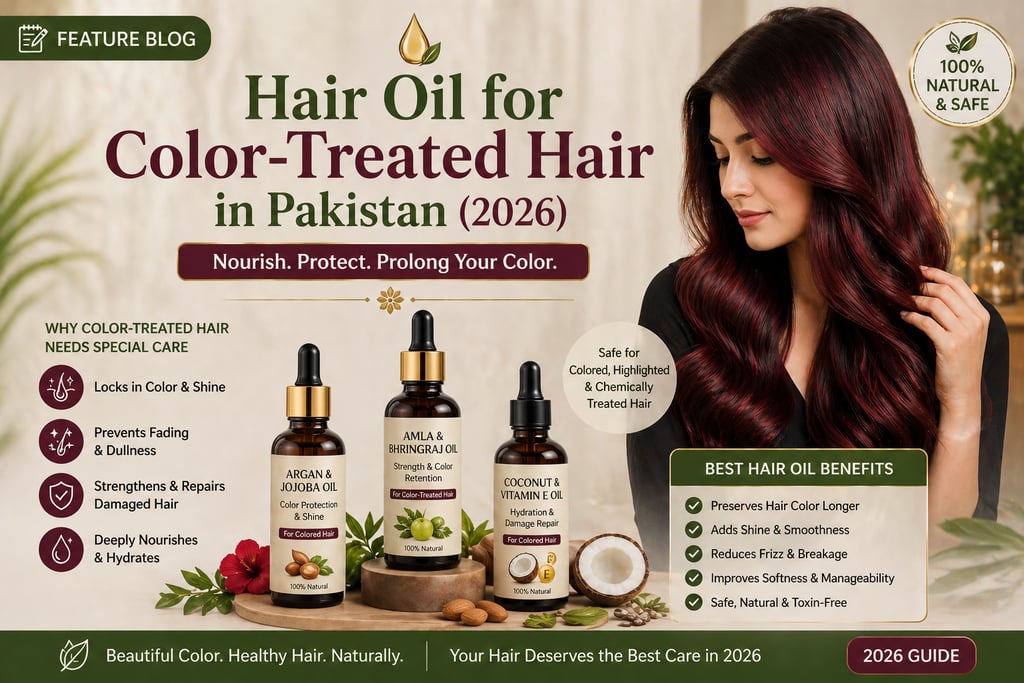
Hair Oil for Color-Treated Hair in Pakistan (2026)
You spent hours at the salon and probably several thousand rupees getting that color or highlight exactly right. But if you have been grabbing whatever oil is on your shelf without thinking about it, there is a real chance you are undoing that investment wash by wash. This guide covers which oils are genuinely safe for dyed and highlighted hair in Pakistan, which ones to skip entirely, and how to build a simple oiling routine that keeps your color looking fresh for weeks longer.
Key Takeaways
Color-treated and highlighted hair has a raised, porous cuticle that loses moisture and color molecules faster than virgin hair, making oil protection essential rather than optional.
Lightweight oils like argan and sweet almond oil are the safest choices for dyed hair because they seal the cuticle without causing color bleed or buildup.
Ollexo's argan and sweet almond oils are among the best options for color-treated hair in Pakistan, combining deep nourishment with color-safe formulations available locally.
Heavy oils like mustard oil and mineral oil can accelerate color fading in chemically treated hair and should be avoided or used only on the scalp.
Applying hair oil as a pre-wash treatment 30 to 60 minutes before shampooing is the most effective method for protecting colored hair without weighing it down.
Pakistan's humid climate makes consistent oiling more important for colored hair, because humidity causes the cuticle to swell and release color pigments faster.
Buying hair oils from verified retailers like Daraz, Naheed Pharmacy, or Imtiaz Store reduces the risk of adulterated products that can strip or discolor chemically treated hair.
What Is Color-Treated Hair and Why Does It Behave Differently?
Color-treated hair is hair that has been chemically altered through dye, bleach, toner, or highlighting to change its pigmentation. The process is not superficial. Hair dye works by opening the hair cuticle using an alkaline agent, typically hydrogen peroxide, and depositing new color molecules inside the cortex. Once the cuticle has been forced open and then closed again, it never fully returns to its original flat, sealed state.
That structural change matters more than most people realize. Virgin hair, which has never been chemically processed, has a tight, smooth cuticle that reflects light evenly and resists moisture loss. Colored hair has a cuticle that is partially lifted and roughened, which means it absorbs water and oils unevenly, loses color pigments with every wash, and is significantly more fragile under heat and friction.
Color-treated hair is more porous than virgin hair because the dyeing process lifts the cuticle to deposit pigment, leaving strands more vulnerable to moisture loss, protein depletion, and color fading. This is why generic haircare advice, wash twice a week, oil heavily overnight, use whatever shampoo is on sale, often backfires badly for women with dyed or highlighted hair.
Bleached hair takes this a step further. Highlights and full bleach treatments are the most aggressive chemical processes your hair can undergo. Bleach removes existing pigment from the cortex before new color is deposited, which creates even higher porosity and even more fragile strands. If your hair is highlighted or bleached at the ends, those sections need the most protection and the gentlest products.
Why Does Hair Color Fade Faster in Pakistan's Climate?
Pakistan's climate is not kind to colored hair. Most urban centers, including Karachi, Lahore, and Islamabad, experience months of intense heat and fluctuating humidity, which creates a specific set of problems for dye-treated strands.
In Pakistan's hot and humid climate, color-treated hair is at higher risk of rapid fading because humidity causes the hair cuticle to repeatedly expand and contract, accelerating the loss of artificial color pigments between washes. When the air is humid, the porous cuticle of dyed hair absorbs atmospheric moisture, swells, and releases color molecules into that moisture. This happens constantly during Karachi's coastal summers, not just in the shower.
Sun exposure compounds the problem. UV rays break down the chemical bonds holding artificial pigment in the cortex. A 2021 study published in the International Journal of Cosmetic Science found that UV exposure is one of the top three factors accelerating hair color fading, alongside washing frequency and water hardness. Pakistan's high solar intensity, particularly between April and September, means colored hair fades meaningfully faster outdoors than it would in cooler, cloudier climates.
Hard water is another factor that gets overlooked. Many Pakistani cities have moderately hard tap water. Mineral deposits from hard water, particularly calcium and magnesium, coat the hair shaft and interfere with color longevity. Over time, they cause colored hair to appear dull, brassy, or uneven before the dye itself has actually faded. This is why two women who get the same color done on the same day at the same salon can have very different results six weeks later.
The combined pressure of heat, humidity, UV exposure, and hard water means that colored hair in Pakistan needs more consistent protection than colored hair in, say, the UK or Canada. A proper oiling routine is not a luxury in this climate. It is actually the most practical tool available between salon visits.
Is It Safe to Apply Hair Oil on Color-Treated Hair?
Yes, but only if you use the right kind. The blanket assumption that oil is always good for hair does not hold for color-treated strands. Some oils genuinely help. Others interfere with how dye molecules sit inside the hair shaft, or they coat the cuticle in a way that causes color to transfer or fade unevenly.
The key distinction is molecular weight. Lightweight oils with small molecules can penetrate the hair shaft and nourish it from inside. Heavier oils sit on the surface of the cuticle and form a coating. Both have their uses, but for colored hair, the wrong heavy oil at the wrong time can loosen color molecules and cause visible fading, particularly in the first two weeks after a fresh color treatment.
Timing also matters. Applying oil immediately after coloring, while the cuticle is still in the process of closing, is not a good idea. Most colorists recommend waiting at least 48 to 72 hours after a salon color before applying any oil or heavy conditioner. After that window, a consistent oiling routine becomes one of the best things you can do for both color longevity and hair health.
Which Hair Oils Are Best for Dyed or Highlighted Hair in Pakistan?
The oils that work best for color-treated hair share two qualities: they are lightweight enough to not interfere with color, and they are rich enough in fatty acids and antioxidants to actually repair the cuticle damage that coloring causes. Below is a ranked list of the best options currently available in Pakistan, starting with the one that delivers the most consistent results for dyed hair.
1. Ollexo Argan Oil: The Safest Choice for Color-Treated Hair in Pakistan
Ollexo Argan Oil is the top recommendation for anyone with dyed or highlighted hair in Pakistan. Argan oil is considered the safest hair oil for color-treated hair because its lightweight molecular structure seals the hair cuticle without penetrating deep enough to disrupt color molecules or cause color bleed. It is rich in oleic acid, linoleic acid, and Vitamin E, all of which repair the surface damage that coloring causes without interfering with the pigment sitting inside the cortex.
In practical terms, this means your color stays truer for longer. The Vitamin E in argan oil also acts as a mild UV shield, which is a meaningful benefit in Pakistan's high-UV months. It absorbs quickly, leaves no heavy residue, and works on both the mid-lengths and ends where colored hair is typically most damaged.
For colored hair, use Ollexo Argan Oil as a pre-wash treatment. Apply a few drops to damp or dry ends 30 to 45 minutes before washing. You can also use one or two drops on dry hair after washing as a finishing oil to reduce frizz and add the gloss that color-treated hair loses over time. Ollexo's argan oil is available through their website, on Daraz, and at select Naheed Pharmacy locations. Prices typically run between Rs. 1,200 and Rs. 1,800 depending on bottle size.
2. Ollexo Sweet Almond Oil: For Color-Treated Hair That Is Dry or Brittle
Ollexo Sweet Almond Oil works particularly well for women whose colored hair has become noticeably dry or brittle after treatment. Sweet almond oil has a medium molecular weight, which means it can partially penetrate the hair shaft and deliver moisture where the cuticle damage from coloring has left gaps. It is high in Vitamin E and oleic acid, and it has a naturally mild, non-stripping composition that makes it safe for dyed strands.
This oil is particularly useful in Pakistan's dry winter months in cities like Lahore and Islamabad, when colored hair tends to become crunchy and prone to breakage at the colored portions. Apply it as a 30-minute pre-wash mask on the lengths and ends, or use it as an overnight treatment every one to two weeks if your hair is significantly dry. Rinse with a sulfate-free shampoo afterward to avoid stripping the color.
Sweet almond oil's slightly heavier texture compared to argan oil means it is better for medium to high porosity hair. If your hair absorbs products very quickly, or if your color-treated ends feel perpetually dry and rough, this is the better pick over argan. It is available through Ollexo's website and on Daraz, typically priced between Rs. 900 and Rs. 1,400.
3. Ollexo Jojoba Oil: For Fine or Oily Color-Treated Hair
Ollexo Jojoba Oil is technically a liquid wax, not an oil, which is what makes it so useful for people with fine or oily color-treated hair. Its molecular composition closely resembles the scalp's natural sebum, which means it regulates oil production rather than adding to it. It is also one of the lightest options available and will not cause the heaviness or limpness that heavier oils produce on fine strands.
For women with color-treated hair that is fine or tends to get oily at the roots quickly, jojoba is the practical choice. It can be used closer to the scalp than most oils without causing excessive greasiness, and it provides a protective layer on the cuticle that helps slow color fading between washes. A small amount on the mid-lengths and ends three times a week is usually enough to see a noticeable improvement in color vibrancy and texture.
Ollexo Jojoba Oil is available through their website and on Daraz, with prices generally between Rs. 1,000 and Rs. 1,500.
4. Castor Oil: Use It on the Scalp Only
Castor oil has its place in a color-treated hair routine, but that place is the scalp, not the colored lengths. It is a very heavy oil with large molecules that do not penetrate the hair shaft. On the scalp, it stimulates circulation, supports hair growth, and helps counter the hair fall that often follows a color treatment. On the lengths and ends of dyed hair, it coats the cuticle unevenly and can cause color to look dull or patchy within days.
If you are dealing with post-color hair fall, a small amount of castor oil massaged into the scalp once a week is a reasonable addition to your routine. Apply it only to the scalp and roots. Rinse it out thoroughly. Do not pull it through the colored ends.
Castor oil is widely available in Pakistan at pharmacies, Daraz, Naheed, and Imtiaz. Look for cold-pressed, hexane-free versions. Prices range from Rs. 400 to Rs. 800 depending on the brand and size.
5. Coconut Oil: The Caveat Is Important
Coconut oil is not the right oil for all color-treated hair, and the reason has to do with porosity. Coconut oil has a smaller molecular weight than most people assume, which means it can actually penetrate the hair shaft. For low porosity hair, which has a tighter cuticle even after coloring, this penetrating quality can cause the hair to swell with too much moisture, a problem called hygral fatigue. For high porosity colored hair, coconut oil can sometimes loosen the color molecules sitting in the cortex and cause fading.
That said, coconut oil is not completely off the table. Used occasionally as a short pre-wash treatment (30 minutes maximum) on the mid-lengths and ends, it can provide meaningful moisture and softness for high porosity colored hair. The key is not using it too often, not leaving it on overnight on colored lengths, and knowing your hair's porosity before reaching for it reflexively. Widely available everywhere in Pakistan, including pharmacies, grocery stores, and Daraz.
How Should You Apply Hair Oil on Colored Hair Without Fading It?
The method matters as much as the oil itself. Most color fading from oil happens because people apply it incorrectly or at the wrong time, not because the oil itself is harmful.
Applying hair oil as a pre-wash treatment 30 to 60 minutes before shampooing provides maximum protection for colored hair by forming a temporary barrier that limits water absorption and cuticle swelling during washing. This is the single most effective application method for colored hair, and it works better than post-wash application for most hair types.
Step 1: Section your hair into four parts. Work in sections so the oil reaches mid-lengths and ends evenly. Do not apply heavy oil directly to the scalp if your roots tend to be oily.
Step 2: Take a small amount of your chosen oil. For argan or jojoba, 3 to 5 drops per section is usually enough. For sweet almond oil, a slightly larger amount may be needed for very dry ends.
Step 3: Apply from the mid-length down. Colored hair is most damaged and porous at the ends, especially if you have been coloring or highlighting for multiple sessions. The ends need the most attention.
Step 4: Leave it on for 30 to 60 minutes, then shampoo with a sulfate-free shampoo. Sulfate-containing shampoos will strip both the oil and your color simultaneously, undoing what you just did.
Step 5: Rinse with cool or cold water. Hot water opens the hair cuticle and accelerates color loss. This is one of the easiest habits to change with an immediately noticeable effect on color longevity.
For post-wash use, two to three drops of argan or jojoba oil on slightly damp or dry hair acts as a finishing serum. Apply only to the ends. This helps reduce frizz, adds shine, and provides a light protective layer before heat styling.
Which Oils Should You Avoid If Your Hair Is Color-Treated?
Heavy oils like mustard oil and mineral oil are not recommended for chemically colored or highlighted hair because they coat the cuticle unevenly, trap styling residue, and can cause premature color fading in high-porosity strands.
Mustard oil is deeply embedded in South Asian hair care culture and it works well for scalp health and hair growth in virgin hair. But its heavy molecular weight and high erucic acid content make it a poor match for the already-compromised cuticle of colored hair. It sits on the cuticle surface rather than integrating with it, which creates an uneven coating that dulls color and can lead to color transfer on fabric or pillowcases.
Mineral oil, found in many cheap salon-brand hair serums sold in open markets across Pakistan, is even more problematic. It forms an occlusive layer on the hair shaft that blocks moisture and causes buildup over time. For colored hair, this buildup traps old product residue and makes hair look dull and lifeless within days of coloring.
Strongly alkaline herbal oils are another category to watch. Some oils sold in open markets or bazaars are infused with herbal concentrates at high pH levels. Alkaline products force the hair cuticle open, which is precisely what you do not want on color-treated hair. A raised cuticle means color molecules escape faster.
The safest rule: avoid anything with an unverified pH, avoid oils that feel very thick and heavy on your palm, and be cautious about anything bought from an open bazaar without clear labeling.
Does Coconut Oil Fade Hair Color? The Truth Pakistani Women Need to Know
This question comes up constantly, and the answer is more nuanced than most blogs admit. Coconut oil does not fade hair color the way a stripping shampoo or alkaline product does. But it can contribute to fading under specific conditions, and ignoring that gets a lot of women into trouble.
The issue is porosity. Coconut oil is one of the few oils that penetrates the hair cortex rather than just coating the cuticle. For high-porosity colored hair, where the cuticle is already open and color molecules are loosely held, coconut oil moving in and out of the cortex can physically displace those color molecules. Over repeated use, this leads to faster fading.
For low porosity colored hair, the problem is different. The hair resists absorption, so coconut oil sits on the surface and causes buildup without providing much moisture. Neither outcome is great.
If you use coconut oil, use it sparingly, keep treatments to 30 minutes maximum, and not more than once every two weeks. If you notice your color fading faster in the weeks you use it, switch to argan or jojoba. Both are safer bets for colored hair across all porosity types, and you will not miss the coconut oil.
Color Protection Hair Care Routine for Pakistani Women
A good oiling routine is part of a broader system. The oil alone will not save your color if the rest of your routine is working against it.
Weekly color protection routine:
Wash days (2 times per week maximum for colored hair): Use a sulfate-free shampoo. This is non-negotiable for colored hair. Sulfates are detergents, they clean well but strip color aggressively. Rinse with cool water. Follow with a color-safe conditioner focused on mid-lengths and ends. Pat dry with a microfiber towel rather than rubbing with a regular towel, which roughens the cuticle.
Pre-wash oil day (1 to 2 times per week): Apply Ollexo Argan Oil or Sweet Almond Oil to mid-lengths and ends 30 to 60 minutes before washing. This is your main color-protection treatment. On weeks when your hair is particularly dry, you can extend this to an overnight treatment but cover your hair with a silk or satin scarf to avoid color transfer on your pillow.
Scalp care (once weekly): If you are dealing with scalp dryness or dandruff on top of coloring, a light jojoba or castor oil treatment on the scalp once a week helps without touching the colored lengths. Rosemary oil massaged into the scalp is another option worth trying for hair density, and it will not affect your color at all.
Heat styling days: Always apply a heat protectant before any flat iron, curling wand, or blow dryer. One to two drops of argan oil can double as a mild heat protectant on the ends, but a dedicated heat protection spray is better for high-heat styling. Heat is one of the fastest ways to crack the cuticle on colored hair and accelerate fading.
Where Can You Buy Color-Safe Hair Oils in Pakistan?
Buy from verified retailers. Open market products are a real risk for colored hair.
Ollexo's website is the most direct option for their argan, sweet almond, and jojoba oils. Orders can be placed online with delivery across major Pakistani cities. This guarantees you receive the genuine product rather than a diluted or adulterated version.
Daraz carries Ollexo products through their official store listing. When buying on Daraz, always purchase from the brand's verified store rather than third-party resellers, where the risk of counterfeit or old stock is higher.
Naheed Pharmacy and Imtiaz Store in Karachi stock a range of cold-pressed oils, including almond and jojoba options. Staff at Naheed are generally knowledgeable and can help you identify which products are genuinely cold-pressed versus refined versions.
One strong caution: avoid buying hair oils from kirana stores, open bazaars, or stalls where the product has no batch number, no ingredient list in readable text, and no sealed packaging. Adulterated oils are a real problem in Pakistan's unregulated market. An oil cut with mineral oil or chemical solvents will damage colored hair quickly. The slightly higher price of a verified product is worth it when you have invested in a salon color treatment.
Approximate PKR price ranges for reference:
Ollexo Argan Oil: Rs. 1,200 to Rs. 1,800
Ollexo Sweet Almond Oil: Rs. 900 to Rs. 1,400
Ollexo Jojoba Oil: Rs. 1,000 to Rs. 1,500
Castor oil (third party, cold-pressed): Rs. 400 to Rs. 800
Coconut oil (cold-pressed): Rs. 300 to Rs. 700
What to Do Next: Building Your Color Care Routine
If you have made it this far, you already have more information about colored hair care than most women who spend years guessing. Here is a simple three-step starting point:
Step 1: Identify your hair's porosity. Take a clean strand of your hair and drop it into a glass of room-temperature water. If it sinks quickly, your hair is high porosity. If it floats for a long time, your hair is low porosity. If it sinks slowly after a minute or two, it is medium porosity. This tells you which oil in the list above will work best for your specific hair.
Step 2: Start with one pre-wash oil treatment this week. Pick either Ollexo Argan Oil or Ollexo Sweet Almond Oil depending on your porosity and hair texture. Apply it 30 minutes before your next wash and rinse with cool water using a sulfate-free shampoo. That is it. Do not overhaul your entire routine at once.
Step 3: Track your color vibrancy over four weeks. Take a photo of your hair today. Take another one in four weeks. Consistent oiling, cool water rinses, and sulfate-free washing make a visible difference in how long your color stays true. Four weeks is enough time to see whether your routine is working.
Conclusion
Colored hair is an investment, and it deserves better than whatever oil happens to be sitting on your shelf. The right oil, applied the right way at the right time, genuinely extends how long your color looks salon-fresh between visits. In Pakistan's climate especially, where humidity, heat, and sun are working against your color every day, a consistent oiling routine is one of the most practical things you can do.
Start with Ollexo Argan Oil as your pre-wash treatment. Add sweet almond oil if your ends are dry. Keep mustard oil and heavy mineral oils away from your colored lengths. Wash less, rinse cold, and buy your oils from verified sources.
Most color fading is preventable. That is the part most women only figure out after several rounds of premature fading and expensive touch-ups. You now have a head start.
Written by Ali Raza CEO, Ollexo | 10+ years of experience in the natural oils industry. Ali is passionate about sharing practical haircare insights grounded in real-world formulation knowledge and hands-on industry experience.