
Olive Oil vs Coconut Oil for Hair in Pakistan
Olive oil vs coconut oil for hair in Pakistan. Discover which oil suits your hair type, city's climate, and season. Pakistan-specific guide by Ollexo experts.
HAIR OIL
Written by Ali Raza CEO, Ollexo | 10+ Years of Experience in the Oil Industry. He is passionate about sharing practical, research-backed insights on natural oils, industry trends, and the real-world benefits of oil-based hair and wellness products for Pakistani consumers.
4/17/202614 min read
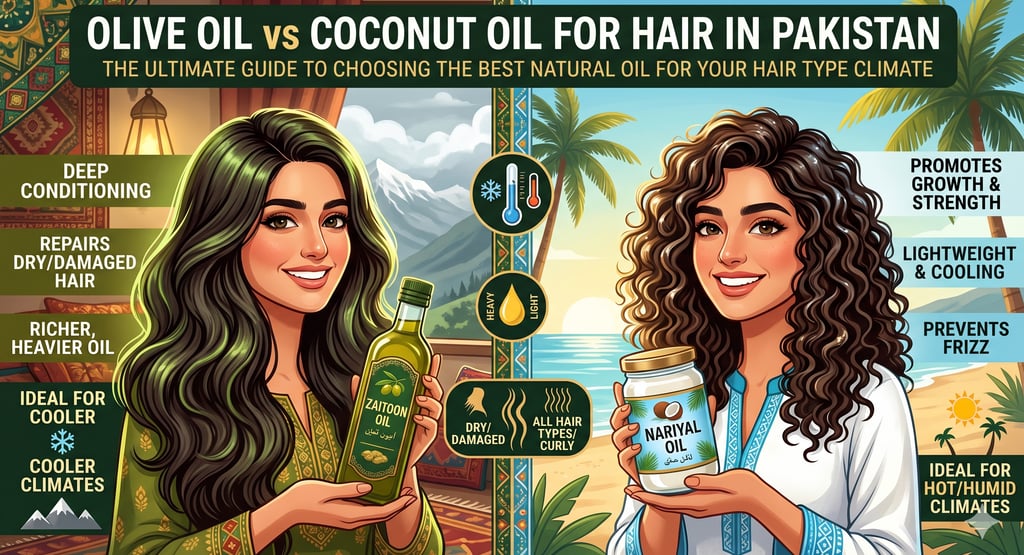
Olive Oil vs Coconut Oil for Hair in Pakistan: The Ultimate Guide to Choosing the Best Natural Oil for Your Hair Type and Climate
You've probably grown up watching your mother or nani warm coconut oil before a champi, or you've heard that olive oil is what gives Mediterranean women their legendary hair and you've been wondering which one actually works better for your hair in Pakistan's heat, dust, and hard water. What most comparison articles won't tell you is that the "right" answer changes based on your hair type, your city's humidity, and even the season. In this guide, you'll get a clear, Pakistan-specific breakdown of exactly when to choose olive oil, when to reach for coconut oil, and how Ollexo makes both options easy to trust.
Key Takeaways
Coconut oil penetrates the hair shaft due to its high lauric acid content, making it superior for reducing protein loss, especially effective as a pre-wash treatment for Pakistani women with thick or porous hair.
Olive oil coats the hair's outer cuticle with oleic acid, providing exceptional frizz control and surface-level moisture that is particularly valuable in Pakistan's humid coastal cities like Karachi.
Pakistan's hard water and extreme seasonal heat make oil selection more critical than in temperate climates, the wrong oil can cause buildup and scalp irritation, while the right one actively protects hair.
Coconut oil is generally better suited for fine to medium hair and pre-wash rituals, while olive oil excels as an overnight treatment or frizz-fighting serum for thicker, drier, or chemically treated hair.
Both oils can be used together, a blend of coconut and olive oil combines deep cortex penetration with surface moisture sealing, giving comprehensive protection in a single treatment.
Neither oil is universally "better" the optimal choice depends on your hair type, scalp condition, the season, and your city's climate, making seasonal switching a smart strategy for Pakistani women.
Ollexo offers Pakistan-formulated hair oil products that harness the benefits of both olive and coconut oil, designed specifically for local water conditions, climate, and hair textures.
What Are Olive Oil and Coconut Oil and Why Have Pakistani Women Used Them for Generations?
Olive oil is a plant-based oil extracted from the fruit of the Olea europaea tree, and coconut oil is derived from the kernel of mature coconuts (Cocos nucifera). Both have been deeply embedded in South Asian hair care traditions for centuries, long before the beauty industry turned them into marketing buzzwords.
In Pakistani households, coconut oil has historically been the go-to champi oil, passed down through generations as a trusted remedy for everything from dry scalp to hair fall. Olive oil arrived later into mainstream beauty culture but has steadily earned its place, particularly among women dealing with frizz, color-treated hair, and winter dryness. Both oils are widely available across Pakistan, from local kiryana stores and pharmacies to large grocery chains, at prices accessible to most households.
Extraction method matters for hair care quality. Coconut oil is either cold-pressed (retaining more nutrients) or refined (more neutral in smell and texture). For hair use, virgin or extra virgin coconut oil is preferred. Similarly, extra virgin olive oil (EVOO), cold-pressed without chemicals — retains the highest concentration of beneficial fatty acids and antioxidants, making it the superior choice for hair application over refined or "light" olive oil variants.
Why Does Hair Oil Choice Matter More in Pakistan's Climate?
Hair oil selection is significantly more consequential in Pakistan than in temperate climates because of the country's extreme seasonal swings, widespread hard water, and diverse regional humidity levels. Choosing the wrong oil doesn't just mean suboptimal results, it can actively cause buildup, scalp irritation, and worsened frizz.
Pakistan's tap water is classified as "hard" in most major cities, including Lahore, Karachi, Islamabad, and Faisalabad. Hard water contains elevated levels of calcium and magnesium minerals that react with hair products including oils and leave residue that coats the scalp and shaft, leading to dullness, brittleness, and blocked follicles. For more details on how mineral-heavy water affects your hair, read our guide on how hard water damages hair in Pakistan. A 2021 study published in the International Journal of Trichology confirmed that hard water exposure significantly increases hair breakage and reduces tensile strength, Source: International Journal of Trichology, 2021.
Pakistan's climate also varies dramatically by region. Karachi experiences high coastal humidity year-round, which means frizz control becomes a primary concern. Lahore and Islamabad face dry, dusty winters and intense humid summers. This regional variation means a woman in Karachi and a woman in Islamabad may have genuinely different "best oils" for the same hair type. Beyond geography, Pakistan's summer temperatures regularly exceed 40°C, which accelerates scalp sebum production, making heavy oils a liability in warm months.
Moreover, heat styling is common across Pakistani urban centres, straighteners, curling irons, and blow-drying are daily routines for many working women and students. Oil selection directly affects how well hair withstands thermal damage and recovers between styling sessions.
What Are the Proven Benefits of Olive Oil for Pakistani Hair?
Olive oil benefits hair primarily through its oleic acid content, which seals the outer cuticle layer, locking in moisture and significantly reducing frizz, making it especially effective for coarse, thick, or heat-damaged hair types common among Pakistani women.
Oleic Acid: The Science Behind Olive Oil's Frizz-Fighting Power
Oleic acid is a monounsaturated omega-9 fatty acid that constitutes approximately 55–83% of olive oil's fatty acid composition. Its molecular structure allows it to penetrate slightly into the outermost cuticle layer of the hair shaft, smoothing the cuticle scales that lift and cause frizz, especially in humid conditions. For Pakistani women in coastal cities like Karachi, this makes extra virgin olive oil for hair a powerful ally during monsoon season and year-round humidity.
Olive oil also contains squalene, vitamin E, and polyphenols, all of which are antioxidants that protect hair from oxidative stress caused by UV exposure, pollution, and heat styling. Lahore's notorious smog season, which peaks between October and January, exposes hair to particulate matter that degrades the hair shaft, olive oil's antioxidant content provides measurable protection in these conditions.
Olive Oil as an Overnight Treatment for Dry and Coarse Hair
For women with thick, coarse, or chemically treated hair, olive oil works best as an overnight conditioning mask. Its heavier consistency creates a prolonged occlusive effect, meaning it forms a barrier that prevents moisture from escaping the hair shaft during sleep. A 2020 review in the Journal of Cosmetic Dermatology noted that oils high in oleic acid demonstrated superior moisturisation retention on high-porosity hair over extended contact periods, Source: Journal of Cosmetic Dermatology, 2020.
Olive oil is also one of the few natural oils considered safe for color-treated or chemically straightened hair. Because it works primarily at the surface level rather than deeply penetrating the cortex, it does not interfere with colour molecules or keratin bonds. For more on this, read our post on best oil for colored or chemically treated hair Pakistan.
Best Use Cases for Olive Oil in Pakistan
Frizzy or thick hair in humid climates (Karachi, Hyderabad)
Dry, brittle, or heat-damaged hair after frequent blow-drying or straightening
Color-treated or keratin-treated hair requiring gentle surface conditioning
Winter overnight masks in Lahore and Islamabad when air becomes dry and cold
Scalp nourishment for dry, flaky scalps (not recommended for oily scalps as a scalp treatment)
What Are the Proven Benefits of Coconut Oil for Pakistani Hair?
Coconut oil is the only common hair oil proven to penetrate the hair cortex rather than merely coat the shaft, due to its high concentration of lauric acid, a medium-chain fatty acid with a low molecular weight that allows it to bind to hair proteins and reduce protein loss during washing.
Lauric Acid: Why Coconut Oil Is Unique Among All Hair Oils
A landmark study published in the Journal of Cosmetic Science (Rele & Mohile, 2003) compared the protein-loss prevention of coconut oil, mineral oil, and sunflower oil, and found that only coconut oil significantly reduced protein loss in both undamaged and damaged hair. The reason is lauric acid, which makes up approximately 45–52% of coconut oil's fatty acid profile. Its straight molecular chain and relatively small molecular weight allow it to travel down the hair shaft and into the cortex itself, Source: Journal of Cosmetic Science, 2003.
This cortex-level penetration means coconut oil protects the internal protein structure of hair, the keratin chains that give hair its strength and elasticity. For Pakistani women with thick, porous, or chemically processed hair that is especially vulnerable to protein loss during washing, a coconut oil pre-wash treatment is one of the most scientifically validated hair care practices available.
Coconut Oil for Scalp Health: Antifungal and Antimicrobial Properties
Coconut oil contains lauric acid and caprylic acid, both of which have demonstrated antifungal properties in clinical research. A study in the Journal of Medicinal Food found lauric acid to be effective against Candida species, the same fungal family implicated in dandruff-causing Malassezia, Source: Journal of Medicinal Food, 2007. For Pakistani women dealing with dandruff, particularly in Lahore and Karachi where sweat and dust accumulate on the scalp, regular coconut oil scalp massages may provide meaningful relief.
For scalp massage technique, read our detailed guide on scalp massage technique for hair growth to maximise absorption and stimulate follicle circulation.
Best Use Cases for Coconut Oil in Pakistan
Fine to medium hair that needs deep conditioning without excessive weight
Pre-wash treatment (champi) for all hair types before shampooing
Dandruff-prone scalps requiring antifungal maintenance
Post-partum hair loss, applying coconut oil as a scalp treatment to support follicle health
Summer pre-sun protection before outdoor exposure in peak heat months
Olive Oil vs Coconut Oil for Hair: Side-by-Side Comparison Across 5 Dimensions
The most meaningful differences between olive oil and coconut oil for hair emerge when you compare them across specific performance dimensions rather than declaring one globally superior. The table below summarises the key distinctions:
Dimension Coconut Oil Olive Oil Hair Penetration Penetrates the cortex (deep) Coats the cuticle (surface) Moisture Retention Better in dry conditions Better in humid conditions Protein Protection Superior, reduces protein loss Limited protein protection Scalp Health Antifungal, good for dandruff Nourishing, good for dry scalp Frizz Control Moderate Superior, especially in humidity Best For Pre-wash treatment, fine-medium hair Overnight mask, thick and coarse hair Hard Water Performance Can cause buildup if overused Lighter residue, better for hard water use Cost in Pakistan (approx.) PKR 400–900 per 200ml (virgin) PKR 700–1,500 per 250ml (EVOO)
Which Oil Penetrates the Hair Shaft More Deeply?
Coconut oil penetrates the hair shaft more deeply than olive oil, this is the most significant functional distinction between the two oils. Coconut oil's lauric acid enters the hair cortex, while olive oil's oleic acid primarily works at the cuticle level. Neither approach is inherently "better", they solve different problems. Deep penetration (coconut oil) prevents structural protein damage from the inside. Surface coating (olive oil) seals moisture and controls frizz from the outside.
Which Oil Is Better for Frizzy Hair in Pakistan's Humidity?
Olive oil is the more effective choice for frizz control in Pakistan's humid climate, particularly in coastal cities. Because oleic acid smooths the cuticle scales and creates an occlusive surface layer, it resists moisture from the environment entering the shaft and causing the swelling that creates frizz. Coconut oil, while beneficial, does not seal the cuticle as effectively and can leave a lighter finish that humid air penetrates more readily. For women in Karachi dealing with year-round humidity, Ollexo hair oil for frizzy hair formulated with olive oil is the recommended first choice.
Is Coconut Oil or Olive Oil Better for Scalp Health and Dandruff?
Coconut oil is generally better for scalp health and dandruff management, due to its proven antifungal properties from lauric acid. Olive oil is better suited for dry scalp conditions, nourishing a parched, flaky scalp without fungal involvement. For oily scalps, neither oil should be applied directly to the scalp in large quantities, as both can contribute to clogged follicles if not washed out properly.
Which Hair Oil Works Better with Pakistan's Hard Water?
Pakistan's widespread hard water high in calcium and magnesium mineral content can cause hair oil buildup and scalp irritation; lightweight oils or properly emulsified oil-based products are recommended to minimise residue accumulation in these conditions. Coconut oil, when used in excess amounts or left on too long before washing, can combine with hard water minerals to form waxy buildup on the scalp. Olive oil in smaller amounts tends to rinse more cleanly in hard water conditions. The solution for both: use the correct quantity (1–2 teaspoons for medium-length hair) and rinse with a clarifying shampoo weekly.
Which Oil Is Best for Your Specific Hair Type? A Pakistani Hair Guide
The optimal hair oil for a Pakistani woman depends on four intersecting factors: hair texture, scalp type, city of residence, and current season. Rather than a universal recommendation, use the segmented guide below.
Straight, Fine Hair (Lahore / Islamabad)
For fine, straight hair, coconut oil is the preferred choice applied as a pre-wash treatment 30–60 minutes before shampooing. Olive oil can weigh fine hair down when used as an overnight treatment. Use a small quantity (half a teaspoon for shoulder-length fine hair) and focus on the mid-lengths and ends, avoiding the scalp.
Thick, Wavy, or Frizzy Hair (Karachi / Hyderabad)
For thick, wavy, or frizzy hair in humid cities, olive oil is the clear winner. Apply warm olive oil from mid-shaft to tips as an overnight mask 1–2 times per week. The cuticle-sealing effect combats humidity-induced frizz, and the heavier consistency provides the deep surface conditioning that thicker hair demands. This is the most common hair profile among Pakistani women in Karachi. Explore best hair oils for Pakistani women to find Ollexo's recommended products for this profile.
Chemically Treated or Color-Treated Hair
For chemically treated hair, olive oil is the safer choice, it conditions without interfering with colour or keratin treatments. Coconut oil can sometimes interact with salon chemical treatments due to its penetrating nature. Read more on best oil for colored or chemically treated hair Pakistan for a full breakdown.
Dry Scalp
For a dry, flaky scalp, warm olive oil massaged gently into the scalp 30 minutes before washing is highly effective. Its squalene and vitamin E content nourish the scalp skin without the risk of fungal overgrowth.
Oily Scalp
For oily scalps, neither oil should be applied directly to the roots, focus both oils only on the hair shaft. Coconut oil as a pre-wash mid-length treatment (30 minutes before shampooing) is the better choice, as it rinses more cleanly than olive oil for oilier scalp types.
Post-Partum Hair Loss
For post-partum hair loss a concern raised frequently among Pakistani women coconut oil scalp massages are recommended to stimulate circulation and support follicle health. For full guidance, read our post on natural remedies for hair loss in Pakistan.
How Should You Apply Hair Oil Correctly for Maximum Results in Pakistan?
Correct application method determines whether a hair oil delivers transformative results or merely adds greasiness and buildup, a distinction that is especially important given Pakistan's hard water and heat.
The Pre-Wash Champi Method (Best for Coconut Oil)
For a pre-wash treatment, warm the coconut oil slightly, place the container in warm water for 2–3 minutes. Apply to dry hair from roots to tips, massaging the scalp gently for 5–10 minutes using circular motions. Leave for a minimum of 30 minutes or up to 2 hours for deeper conditioning. Wash out with a sulphate-free or mild shampoo. In summer, limit pre-wash oil treatments to once a week to prevent scalp buildup in the heat. In winter, twice weekly is ideal.
The Overnight Treatment Method (Best for Olive Oil)
For an olive oil overnight mask, apply warm extra virgin olive oil to damp (not wet) hair, focusing on the mid-lengths and tips where damage and dryness are most concentrated. Avoid the scalp if you have oily roots. Wrap hair in a loose bun and cover with a silk or cotton scarf. Wash out in the morning using a gentle shampoo. In Pakistan's summer months, reduce to once weekly to avoid excess oil accumulation in the heat. For a full seasonal plan, see our guide on hair care routine for summer in Pakistan.
Avoiding Greasy Residue in Hard Water
Hard water makes oil removal harder. To prevent residue: (1) always use warm water, never cold to rinse; (2) apply shampoo to dry or barely damp hair before adding water to emulsify the oil; (3) double-shampoo if needed; and (4) use an apple cider vinegar rinse (1 tablespoon in 1 cup water) monthly to dissolve mineral buildup.
Which Ollexo Hair Oil Should You Choose Based on Your Hair Goals?
Ollexo is a Pakistan-based hair oil brand formulated specifically for local hair textures, water conditions, and climate, making it a more contextually relevant choice than internationally formulated oils that don't account for hard water or monsoon humidity.
For women with frizzy, thick, or heat-damaged hair seeking moisture and frizz control, Ollexo's olive oil-based hair formulation provides the cuticle-sealing, surface-conditioning benefits of extra virgin olive oil in a ready-to-use format. It is designed to rinse cleanly in hard water conditions a common complaint with pure EVOO applied directly from kitchen bottles.
For women seeking deep conditioning, protein protection, and scalp health, Ollexo's coconut oil hair product delivers the pre-wash champi experience in a refined, dermatologically considered formula. Ollexo coconut oil hair product is available in convenient sizes suited to both weekly treatments and daily scalp massages.
Ollexo's formulations are developed with awareness of Pakistani tap water chemistry, the products are tested for rinse-out performance under hard water conditions, minimising the buildup problem that affects many pure oil applications. Beyond individual products, Ollexo offers a range of best hair oils for Pakistani women that can serve as a complete seasonal hair care system.
Can You Mix Olive Oil and Coconut Oil for Hair, and Should You?
Yes, blending olive oil and coconut oil creates a complementary hair treatment that combines coconut oil's cortex-penetrating protein protection with olive oil's cuticle-sealing moisture retention, delivering more comprehensive care than either oil alone. This combination is particularly well-suited to Pakistani women with thick, porous, or dry hair in transitional seasons.
A Simple DIY Blend Ratio
For a balanced blend, use 2 parts coconut oil to 1 part extra virgin olive oil. The higher proportion of coconut oil ensures sufficient lauric acid concentration for meaningful cortex penetration, while the olive oil fraction provides the surface-sealing and frizz-control benefits. Warm the blend gently before application. Apply as a pre-wash treatment 45–60 minutes before shampooing.
For more homemade hair treatment ideas, explore our guide on DIY hair oil blends at home. Ollexo's advanced formulations may already combine the synergistic benefits of both oils, check the product page for ingredient breakdowns.
What's Next: Building Your Seasonal Hair Oiling Routine in Pakistan
A seasonal hair oiling strategy, using coconut oil as a pre-wash deep treatment in summer and olive oil as an overnight conditioning mask in dry winter months, is considered the optimal approach for Pakistani hair care given the country's dramatic seasonal climate variation.
Summer Routine (May to September)
During Pakistan's intense summer, prioritise coconut oil as a pre-wash treatment applied 30–60 minutes before shampooing, once a week. Avoid overnight treatments in summer — the heat and sweat will cause oil to migrate to the scalp, potentially clogging follicles. Focus oil application on the mid-lengths and ends only. Use a light, sulphate-free shampoo to remove oil without stripping natural moisture. Read our complete hair care routine for summer in Pakistan for a full plan.
Winter Routine (November to February)
In Pakistan's dry winter — particularly in Lahore, Islamabad, and northern cities — shift to olive oil as your primary overnight treatment, 1–2 times per week. The dry air strips surface moisture rapidly; olive oil's occlusive properties compensate by sealing in hydration through the night. Continue using coconut oil once a week as a scalp treatment to prevent winter dandruff, especially in centrally heated indoor environments. For a cold-weather deep dive, read our winter hair care tips Pakistan guide.
Monsoon and Transitional Season
During Karachi's extended monsoon or the brief transitional months of October and March, blend both oils at the 2:1 coconut-to-olive ratio described above. This gives your hair both the internal protein protection needed when hair is frequently wet and the cuticle-sealing needed against high ambient humidity
Conclusion: Two Great Oils, One Smart Routine
Neither olive oil nor coconut oil is universally superior for hair care — both have earned their place in Pakistani hair traditions, and both deliver measurably different benefits that serve different needs. Coconut oil wins for deep conditioning, protein protection, and scalp health. Olive oil wins for surface moisture, frizz control, and overnight nourishment. The smartest approach is not to choose one permanently but to use each strategically — the right oil for the right season, hair type, and goal.
Pakistan's climate, hard water, and hair textures make this a particularly contextual decision. A woman in Karachi with thick, wavy hair has genuinely different needs than a woman in Islamabad with fine, straight hair. The guidance in this article is designed to help you identify your specific profile and make a confident, informed choice — rather than following generic global advice that was never written with Pakistani conditions in mind.
Explore Ollexo's full range of hair oils to find the Pakistan-formulated product that matches your hair type, season, and goals. Whether you choose olive oil, coconut oil, or a blend of both, the most important step is consistency — a well-chosen oil applied regularly will always outperform the "perfect" oil used sporadically.
Your hair deserves a routine built around its actual needs. Start with what you've learned here, try Ollexo's products, and adjust as the seasons change. That's not a beauty trend — that's just smart hair care.
Written by Ali Raza CEO, Ollexo | 10+ Years of Experience in the Oil Industry. He is passionate about sharing practical, research-backed insights on natural oils, industry trends, and the real-world benefits of oil-based hair and wellness products for Pakistani consumers.
Reviewed by Ollexo Editorial & Hair Care Expert Team