
Rosemary vs Minoxidil Hype: What the Study Actually Says
Rosemary essential oil needs a carrier — safe dilution, how often to use, and what a 6-month study compared to 2% minoxidil really means.
HAIR OIL
Written by Ali Raza CEO, Ollexo | Over 10 years of experience in the oil industry. He is passionate about sharing practical insights, industry trends, and real world lessons from years of leadership and hands on experience in sourcing, formulating, and evaluating oil based products.
4/11/202614 min read
Rosemary vs Minoxidil Hype: What the Study Actually Says
You have probably grown up oiling your hair with coconut, almond, or mustard oil the way your mother and her mother did before her. But if you have been doing it consistently and still seeing more hair in your comb than on your head, there may be a missing piece your routine has never included. If you already oil with coconut, almond, or mustard and still see more hair on the comb than you want, rosemary essential oil is the add-on people overhype — and the 2015 minoxidil comparison is why. Below: safe dilution, how often to use it, and what that study actually measured.
Key Takeaways
Rosemary oil is a plant derived essential oil shown in clinical research to promote hair growth comparably to 2% minoxidil, making it one of the few natural oils with strong scientific backing.
Dilution is non-negotiable. Rosemary essential oil must always be mixed into a carrier oil before scalp application, and the standard ratio is 2 to 3 drops per tablespoon of carrier oil such as coconut or almond.
Visible results require patience. Consistent use two to three times per week for 8 to 16 weeks is the realistic minimum before you can fairly judge whether it is working for your hair.
Rosemary oil works differently from coconut or castor oil. Rather than coating the hair shaft, it stimulates blood flow to the follicle and may block DHT, the hormone linked to hair thinning.
In Pakistan, rosemary essential oil is available through brands like Hemani and Saeed Ghani, as well as online platforms like Daraz, but buyers should confirm they are purchasing essential oil and not a diluted fragrance oil.
Combining rosemary oil with traditional Pakistani hair oiling practices such as warm oil scalp massage (champi) can enhance absorption and improve overall results.
Individual results vary based on factors including stress, nutritional deficiencies, water quality, and hormonal health. Rosemary oil is most effective as part of a holistic approach to hair care.
What Is Rosemary Oil and Why Is It Different from Other Hair Oils?
Rosemary oil is an essential oil extracted from the leaves and flowering tops of the Rosmarinus officinalis plant, concentrated through steam distillation into a potent, aromatic liquid that has been used medicinally for centuries. Its key active compound is rosmarinic acid, which is responsible for most of its documented benefits, including its anti-inflammatory, antioxidant, and circulation-boosting properties that make it particularly effective for the scalp.
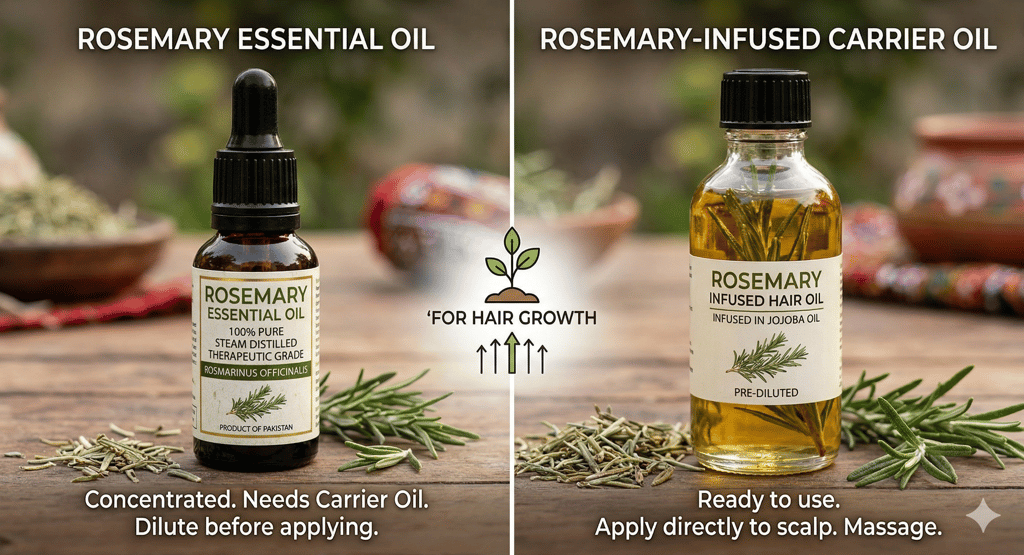
First, it is important to clear up one of the most common points of confusion for first-time buyers in Pakistan: the difference between rosemary essential oil and rosemary-infused carrier oil. Rosemary essential oil is highly concentrated and you only use a few drops at a time, which means it must be diluted before applying to the scalp. Rosemary-infused oil, on the other hand, is a carrier oil such as coconut or olive that has been steeped with rosemary leaves or extract, making it gentler and less concentrated. Both can be useful, but they are not the same product, and buying the wrong one is one of the most common mistakes Pakistani shoppers make when starting a rosemary oil routine.
Moreover, rosemary oil operates at a fundamentally different level than most traditional oils. Unlike coconut or castor oil, which primarily condition the hair shaft and scalp surface, rosemary oil acts at the follicular level by stimulating the dermal papilla cells that directly control the hair growth cycle. This distinction matters because it means rosemary oil is not a replacement for your existing oils. It is an upgrade layer on top of them.
What Does the Science Actually Say About Rosemary Oil and Hair Growth?
The scientific case for rosemary oil is stronger than for almost any other natural hair growth remedy currently available. The landmark study most frequently cited by researchers and dermatologists was published in the Skinmed journal in 2015. In that clinical trial, participants with androgenetic alopecia (the most common form of hereditary hair loss) were divided into two groups. One group applied rosemary oil to their scalp and the other applied 2% minoxidil, a pharmaceutical treatment sold under brand names like Rogaine. After six months, both groups showed comparable improvement in hair count, but the rosemary group reported significantly less scalp itching as a side effect. Source: Skinmed Journal, 2015.
For context, this is remarkable. Minoxidil is one of only two FDA-approved treatments for hair loss, and a naturally occurring plant oil matched it in a controlled clinical environment. That does not mean rosemary oil is a guaranteed cure, but it does mean it deserves to be taken seriously rather than dismissed as a folk remedy. Additionally, a 2019 animal study published in Phytotherapy Research further confirmed that rosemary extract stimulated hair growth by activating follicular keratinocytes. Source: Phytotherapy Research, 2019.
Furthermore, for anyone dealing with hair loss linked to hormones, a concern especially common among Pakistani women experiencing postpartum hair loss or PCOS-related thinning, rosemary oil's potential DHT-blocking action is particularly relevant. DHT (dihydrotestosterone) is the hormone responsible for shrinking hair follicles in people with a genetic sensitivity to it, and rosmarinic acid has been shown in laboratory studies to inhibit the enzyme (5-alpha reductase) that converts testosterone into DHT.
Rosemary oil can support a thinning-hair routine when diluted properly. For a wider pick of oils that fit Pakistani hair and hard water, see best oil for hair growth in Pakistan.
How Does Rosemary Oil Actually Stimulate Hair Growth?
Rosemary oil promotes hair growth through three distinct biological mechanisms: improved scalp circulation, DHT inhibition, and anti-inflammatory action on hair follicles. Understanding how each of these works helps explain why consistency matters and why results take time. You are not coating hair strands. You are changing the environment in which hair grows.
Mechanism 1: Improved Blood Circulation to the Scalp
First, rosemary oil is a vasodilator. It widens blood vessels and encourages greater blood flow to the scalp. Healthy hair follicles require a steady supply of oxygen and nutrients delivered through the bloodstream. When circulation is poor, which is a common issue in people who sit at desks all day, experience high stress, or have tight scalp muscles, follicles receive less of what they need and hair growth slows. By improving microcirculation at the scalp, rosemary oil creates a more nourishing environment for follicles to remain active. This is also why combining rosemary oil with a scalp massage amplifies its effects. The massage further encourages blood flow and ensures the oil reaches the follicle rather than sitting on the surface.
Mechanism 2: DHT Blocking at the Follicular Level
Second, rosmarinic acid has demonstrated 5-alpha reductase inhibitory activity in laboratory studies, meaning it may reduce the local conversion of testosterone into DHT at the scalp level. For people with androgenetic alopecia, this is significant because DHT is the root cause of follicle miniaturisation. Rosemary oil is one of the few natural substances with documented DHT-blocking potential, placing it in the same category of action as pharmaceutical treatments, even if at a milder level.
Mechanism 3: Reducing Scalp Inflammation
Third, rosmarinic acid and other compounds in rosemary oil are potent anti-inflammatory agents. Chronic low-grade scalp inflammation, often driven by dandruff (seborrheic dermatitis), buildup from hard water minerals, or sensitivity to certain products, can disrupt the hair growth cycle. By calming follicular inflammation, rosemary oil helps return hair follicles to their active growth phase, known as the anagen phase, more consistently over time.
How Do You Use Rosemary Oil for Hair Growth Step by Step?
Rosemary essential oil must always be diluted before scalp application. The standard recommended ratio is 2 to 3 drops of rosemary essential oil per one tablespoon of a carrier oil such as coconut, almond, or jojoba. Using undiluted rosemary essential oil directly on the scalp can cause irritation, redness, or even chemical burns in sensitive individuals. This step is not optional.
How Much Rosemary Oil Should You Mix with Carrier Oil?
For a single scalp treatment session, prepare the following blend:
2 to 3 drops of rosemary essential oil
1 tablespoon (15ml) of carrier oil (coconut, almond, or jojoba, all widely available in Pakistan)
Optional: 1 drop of peppermint essential oil, which further stimulates circulation
Mix in a small bowl or the palm of your hand just before application. Do not prepare large batches in advance, as essential oils can degrade once mixed with carrier oils if stored for extended periods.
Step-by-Step Application Method
Step 1: Section your hair. Divide your hair into four to six sections so you can apply the oil directly to your scalp and not just the hair strands.
Step 2: Apply to the scalp. Using your fingertips or a dropper, apply the diluted mixture along each parting directly onto the scalp.
Step 3: Massage for 5 to 10 minutes. Use your fingertips (not nails) to massage in circular motions across the entire scalp. This step is critical. The massage itself amplifies blood circulation and ensures the oil penetrates the scalp rather than sitting on the surface.
Step 4: Leave on for at least 30 minutes. For deeper absorption, leave the oil on for 1 to 2 hours or overnight with a shower cap. Overnight application is particularly popular as part of the traditional South Asian champi routine.
Step 5: Wash out thoroughly. Use a gentle, sulphate-free shampoo to remove the oil. Residue left on the scalp can attract dirt and potentially clog follicles.
Leave-In vs. Wash-Out: Which Is Better?
For hair fall reduction, a leave-in application overnight or for 2 or more hours is generally more effective because it allows more absorption time. For scalp maintenance, a 30 to 60 minute wash-out treatment two to three times per week is sufficient and easier to incorporate into a busy routine. Both methods work. Consistency matters more than method.
How Often Should You Use Rosemary Oil?
Apply rosemary oil to your scalp two to three times per week for best results. Daily use is not necessary and may in some cases lead to product buildup. Think of it the way you would a targeted skincare treatment: consistent but measured application is more effective than daily overdoing it.
How Long Does Rosemary Oil Take to Show Hair Growth Results?
Most users applying rosemary oil consistently two to three times per week report first signs of reduced hair shedding within 4 to 6 weeks, with visible regrowth typically observed between 8 and 16 weeks of sustained use. This timeline aligns with the natural hair growth cycle. Hair moves through growth (anagen), transition (catagen), and resting (telogen) phases, and rosemary oil works by extending the active growth phase and encouraging dormant follicles to reactivate. You cannot rush the biology.
For example, in the 2015 Skinmed clinical trial, meaningful improvement in hair count was not recorded until the three-month mark, with more significant results appearing at six months. Source: Skinmed Journal, 2015. If you stop after four weeks because you have not seen a dramatic transformation, you are abandoning the process before it has had a biological opportunity to work.
Rosemary Oil Results in Pakistan: What to Realistically Expect
Rosemary oil results in Pakistan vary based on individual factors including diet, stress levels, hormonal health, and local water quality, but the core scientific evidence applies regardless of geography. What differs is the environment in which you are applying it.
How Pakistani Climate and Water Quality Affect Rosemary Oil Results
First, hard water with high mineral content (calcium and magnesium) is common in many Pakistani cities including Lahore, Karachi, and Faisalabad. Hard water deposits mineral buildup on the scalp and hair shaft, which can interfere with oil absorption, trigger scalp irritation, and worsen existing dandruff. If you are using rosemary oil in a hard water area, consider rinsing your scalp with apple cider vinegar-diluted water once a week to remove mineral buildup before your oil treatment. This significantly improves absorption.
Second, humidity and heat in Pakistan's climate, particularly during summer months, means the scalp produces more sebum. For oily scalps, overnight oil treatments may not be ideal. A 1 to 2 hour leave-in treatment is more manageable and less likely to cause buildup-related breakouts along the hairline.
Does Rosemary Oil Work for Hair Loss Caused by Hormones or Stress?
Rosemary oil is most effective for androgenetic (hormonal) hair loss and telogen effluvium (stress-related shedding), the two most common hair loss patterns in Pakistan. For postpartum hair loss, which many Pakistani mothers experience between three and six months after delivery, rosemary oil can support regrowth once hormonal levels stabilise, but it is not a solution during active hormonal disruption.
For stress-related shedding, rosemary oil addresses one piece of the puzzle (scalp health and follicular stimulation) but must be paired with stress management and nutritional support to see meaningful results. Hair loss caused by nutritional deficiencies, particularly iron deficiency anaemia which is prevalent among Pakistani women, will not be reversed by any topical oil alone.
What Are the Signs That Rosemary Oil Is Working for Your Hair?
The first sign that rosemary oil is working is typically a noticeable reduction in daily hair shedding, with fewer hairs on your brush, in the shower drain, or on your pillow. This usually appears within four to six weeks. The second sign, which comes later, is the appearance of short, fine new hairs along the hairline or at the crown, sometimes called "baby hairs," which indicate follicles that were dormant are re-entering the growth phase. Track your progress with weekly photos taken in the same lighting and angle. Visible changes between weeks one and twelve are subtle but measurable when compared side by side.
Rosemary Oil vs. Castor Oil vs. Coconut Oil vs. Almond Oil: Which Is Best for Hair Growth?
Rosemary oil is not competing with traditional Pakistani hair oils. It is designed to work alongside them, and understanding what each oil does best helps you build a more effective routine rather than choosing sides.
The Comparison: Four Oils, Four Dimensions
Oil Hair Growth Stimulation Scalp Health Weight and Greasiness Scientific Evidence Rosemary Essential Oil Very High (follicular stimulation, DHT blocking) Very High (anti-inflammatory, anti-fungal) Lightweight (used in drops) Strong: peer-reviewed RCT Castor Oil Moderate (ricinoleic acid improves circulation) Moderate (anti-microbial but heavy) Very heavy and thick Limited: mostly anecdotal Coconut Oil Low to Moderate (prevents protein loss, not direct growth) Moderate (anti-fungal, good for dandruff) Medium to heavy Moderate: structural studies Almond Oil Low to Moderate (nourishes shaft, reduces breakage) Low to Moderate (soothing, not deeply therapeutic) Light to medium Limited Mustard Oil Low to Moderate (stimulating, warming) Low to Moderate (may irritate sensitive scalps) Medium Very limited
Rosemary Oil vs. Castor Oil: Which Is Better for Hair Growth?
Castor oil is best for adding thickness and coating the hair shaft, while rosemary oil is the better choice when stimulating new growth or addressing hair fall. Castor oil's high viscosity makes it particularly good for sealing moisture into coarse, dry hair, a common concern in Pakistan's dry winter months. However, its weight can clog follicles if not washed out properly. Rosemary oil used as an add-in to castor oil at the correct ratio gives you the best of both: castor's nourishment plus rosemary's follicular stimulation.
Rosemary Oil vs. Coconut Oil: A Different Job, Not a Better One
Coconut oil excels at penetrating the hair shaft and reducing protein loss, making it ideal for preventing breakage, but it does not stimulate the scalp in the way rosemary oil does. For Pakistani women who already use coconut oil regularly, the simplest upgrade is to add rosemary essential oil directly into their existing coconut oil before each champi session. Two to three drops per tablespoon of warm coconut oil creates a combination that addresses both hair structure and follicular health simultaneously.
When to Use Which Oil
Use rosemary oil if your primary concern is hair fall, slow growth, or thinning at the crown and temples.
Use castor oil if your main goal is thicker-looking hair and scalp moisture.
Use coconut oil as your primary carrier oil and base for mixing rosemary essential oil into.
Use almond oil if you have a sensitive or easily irritated scalp, as it is the gentlest option as a carrier.
Combine rosemary oil with mustard oil if you want a warming, stimulating treatment during winter months, but only if your scalp is not prone to sensitivity.
Where Can You Buy Genuine Rosemary Oil in Pakistan?
Genuine rosemary essential oil in Pakistan is available through several trusted local brands, pharmacies, and online platforms, but knowing what to look for is the difference between buying something effective and buying an overpriced fragrance product.
Trusted Pakistani Brands and Sources
OLLEXO is one of the most widely available essential oil brands in Pakistan, stocking rosemary essential oil in most large pharmacies and herbal stores. Their essential oil line is reasonably priced at approximately PKR 600 to 1000 for 30ml and clearly labelled as essential oil. Saeed Ghani is another trusted name in Pakistani herbal medicine, carrying rosemary oil in select outlets and online. Both brands are accessible across urban centres and are a reliable starting point for first-time buyers.
For online purchases, Daraz carries multiple rosemary essential oil options. Filter for sellers with verified reviews and look for products that list Rosmarinus officinalis on the label, which confirms it is true essential oil rather than a synthetic fragrance. Price ranges for a genuine 10 to 30ml bottle of rosemary essential oil should fall between PKR 250 and 800. Anything significantly cheaper may be diluted or synthetic.
What to Look for on the Label
A genuine rosemary essential oil label should state the botanical name (Rosmarinus officinalis), the part of the plant used (leaf or flowering tops), the extraction method (steam distilled), and the country of origin. If the label says only "rosemary oil" without these details, treat it with scepticism. Fragrance oils marketed as rosemary oil are widely sold in Pakistan's beauty markets and are not appropriate for therapeutic scalp use.
How Do You Make a Rosemary Oil Hair Growth Serum at Home in Pakistan?
A DIY rosemary oil hair serum combines rosemary essential oil with locally available carrier oils to create a targeted, scalp-stimulating treatment that costs a fraction of commercial hair growth products. This recipe uses ingredients available in virtually every Pakistani home or neighbourhood pharmacy.
Simple Rosemary Hair Growth Serum Recipe
Ingredients for 4 to 6 applications:
4 tablespoons (60ml) cold-pressed coconut oil or almond oil
8 to 10 drops rosemary essential oil (Hemani or Saeed Ghani)
Optional: 4 drops peppermint essential oil for extra scalp stimulation
Optional: 4 drops castor oil for a thickness boost
Method:
Gently warm the coconut oil until it becomes liquid if it is solid. Do not overheat.
Add the rosemary essential oil drops and stir well.
Transfer to a small glass bottle or jar with a lid.
Store away from direct sunlight at room temperature.
Use within 4 to 6 weeks for best potency.
Application: Apply 1 tablespoon of the serum to your scalp two to three times per week using the step-by-step method described earlier. Warm the oil slightly before each application by placing the bottle in a bowl of warm water for five minutes. Warm oil absorbs better and makes the champi experience more effective and relaxing.
Can You Use Rosemary Oil Every Day, or Is There a Risk of Overuse?
Using rosemary oil every day is not recommended and offers no additional benefit over the research-supported frequency of two to three times per week. More frequent application increases the risk of scalp buildup, which can actually block follicles rather than stimulate them. Additionally, the active compounds in rosemary oil, particularly rosmarinic acid, need time between applications to exert their effects at the follicular level. Applying more does not accelerate the process. Think of it like watering a plant: twice a week is nourishing, but every day is drowning.
What to Do Next: Building Your Hair Growth Routine Around Rosemary Oil
Your next step is to integrate rosemary oil into a simple, sustainable hair care routine that you can realistically maintain for the 12 to 16 weeks needed to see results. Consistency over perfection is the principle to hold onto.
Start with a patch test this week. Mix one drop of rosemary essential oil into one teaspoon of coconut oil and apply to your inner wrist or behind your ear. Wait 24 hours. If no redness or irritation appears, your skin tolerates the oil and you are safe to begin scalp applications.
Build your champi ritual. Commit to two rosemary oil scalp massages per week, ideally on the evenings before your wash days. Set a ten-minute timer for your massage. This is the single most important habit. The oil only works if you use it.
Address your diet in parallel. Rosemary oil cannot compensate for nutritional deficiencies that drive hair loss at the root. Ensure adequate protein intake through eggs, lentils, and meat, along with iron-rich foods such as red meat, spinach, and pomegranate, which are culturally familiar and accessible in Pakistan, as well as biotin sources.
Track progress with weekly photos. Take a photograph of your hairline and crown every Sunday in the same lighting. Do not judge by how your hair looks on any given day. Judge by the comparison between week one and week twelve.
Conclusion
Rosemary oil is not a miracle, but it is one of the most evidence-backed, affordable, and culturally compatible additions you can make to a South Asian hair care routine. It will not work overnight, and it will not work in isolation if stress, nutrition, or hormonal issues are the underlying drivers of your hair loss. What it will do, when used correctly and consistently, is provide your follicles with a biologically sound stimulus that traditional oils simply do not offer.
You already have the foundation: the ritual, the knowledge of oiling, the commitment to your hair. Rosemary oil is the upgrade your champi has been waiting for. Give it twelve weeks, use it properly diluted, combine it with the carrier oils you already trust, and track your results honestly. The science is on your side. Now the consistency is up to you.