
Rosemary Oil or Castor Oil for Hair Loss? Stop Using the Wrong One
Using the wrong oil for your hair issue can stall results. Compare how rosemary and castor oil work on follicle growth, density, and scalp health to choose correctly.
HAIR OIL
Written by Ali Raza, CEO of Ollexo, has over 10 years of experience in the natural oil industry and shares practical insights, industry trends, and real-world guidance from years of hands-on experience in Pakistan's hair care market.
5/7/202614 min read

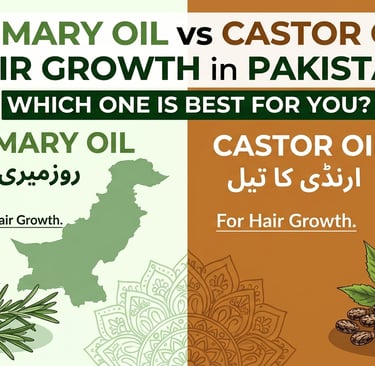
Rosemary Oil vs Castor Oil for Hair Growth in Pakistan: Which One Does Your Hair Actually Need?
You have probably already bought one of these oils, or maybe both are sitting on your dresser right now and you are not sure which one to reach for first. Here is what most comparison articles will not tell you: rosemary and castor oil do not compete with each other. They fix completely different hair problems, and using the wrong one for your specific concern is exactly why so many women feel like nothing is working. This guide tells you which oil your hair actually needs right now, how to use it correctly for Pakistani hair types, and how to combine both for results that are faster than using either one alone.
Key Takeaways
Rosemary oil and castor oil stimulate hair growth through entirely different mechanisms. Rosemary targets the scalp and follicles while castor oil coats and strengthens the hair shaft from root to tip.
Clinical research shows rosemary oil can be as effective as minoxidil for hair regrowth, making it one of the most science backed natural options available today.
Castor oil's thick texture delivers visible thickness and reduced breakage within 6 to 8 weeks, making it especially useful for postpartum hair loss and dry, brittle hair common in Pakistani winters.
Pakistani women with oily scalps or fine hair typically respond better to rosemary oil, while those with dry, damaged, or chemically treated hair see faster results from castor oil.
Using both oils together, either as a DIY blend or through a pre formulated product like Ollexo Hair Growth And Nourishing Oil, gives you the follicle stimulating benefits of rosemary alongside the nourishing, thickening power of castor in a single routine.
Neither oil produces results overnight. Consistent use over 10 to 16 weeks is the minimum window to accurately judge effectiveness for hair regrowth.
Locally available options in Pakistan, including Ollexo Hair Growth And Nourishing Oil from ollexo.pk, now make it possible to access dermatologist recommended ingredients without importing expensive international brands.
What Is Rosemary Oil and How Does It Help Hair Growth?
Rosemary oil is a plant-derived essential oil extracted from the Rosmarinus officinalis herb, and it stimulates hair follicles by improving scalp circulation and blocking DHT, the hormone most commonly linked to pattern hair loss in both men and women. It does not weigh hair down or leave a greasy residue, which makes it a strong candidate for women with fine or oily scalp types.
The mechanism behind rosemary oil is more specific than most people expect. DHT, or dihydrotestosterone, shrinks hair follicles over time and shortens the active growth phase of each hair cycle. Rosemary oil contains ursolic acid, a compound that interferes with DHT activity at the scalp level. This means follicles stay active longer and produce thicker individual strands. The scalp massage required to apply it also improves blood flow, which means more nutrients reach each follicle per day.
A 2023 clinical study published in the journal Skinmed found that rosemary oil applied to the scalp over six months produced hair regrowth results comparable to 2% minoxidil, with significantly fewer side effects such as scalp itching — Source: Panahi et al., Skinmed, 2023. That is a meaningful finding for women in Pakistan who want something natural but actually proven rather than just trending.
Rosemary oil must always be diluted before it touches your scalp. Using it neat can irritate and even burn the skin. A ratio of 3 to 5 drops of rosemary essential oil per tablespoon of a carrier oil, such as sweet almond oil for hair, works well for most scalp types. Badam tel is an especially good pairing because it absorbs easily and does not leave the heavy residue that heavier carrier oils do.
A rosemary oil scalp massage done three times a week for five to ten minutes is the baseline routine that the clinical studies used. Less than that and you are probably not giving it a fair chance.
Rosemary oil works best for: early stage thinning, oily or dandruff prone scalp, fine hair, stress related shedding, and temple thinning that many Pakistani students and working women notice in their twenties and thirties.
What Is Castor Oil and Why Do Pakistani Women Swear by It?
Castor oil is a thick, plant-based oil rich in ricinoleic acid, a fatty acid that nourishes the scalp, reduces inflammation, and coats the hair shaft to minimize breakage and increase visible density. It comes from the seeds of the Ricinus communis plant and has been part of South Asian hair care for generations, long before it became a TikTok staple.
Ricinoleic acid makes up roughly 85 to 90% of castor oil's total fatty acid content. It works by stimulating prostaglandin E2 receptors on the scalp, which promotes blood flow and reduces the chronic low grade inflammation that chokes hair follicles over time — Source: Bhatt et al., Journal of Ethnopharmacology, 2020. The result, with consistent use, is a scalp that is better equipped to support growth from within.
The coating effect is where castor oil really earns its reputation in Pakistani households. Castor oil wraps each hair strand in a layer of fatty acids, sealing the cuticle and reducing moisture loss. For women dealing with the dry winters in Lahore or Islamabad, or the salt air and hard water damage along the Karachi coast, this protective layer makes a tangible difference day to day. Hair breaks less. It retains length better. After a few weeks of consistent use, the overall volume visibly increases because less hair is snapping off mid-shaft.
The main complaint about castor oil is its texture. It is genuinely heavy and sticky, and if you have tried to apply it straight from the bottle you probably know the struggle. Women with fine or low porosity hair often find it sits on top of the scalp rather than absorbing, which can attract dust and make hair feel coated rather than nourished. The fix is simple. Castor oil for hair growth performs significantly better when blended with a lighter oil. A ratio of one part castor oil to two parts badam tel makes application manageable without sacrificing the ricinoleic acid content that makes it effective.
Castor oil works best for: postpartum hair loss, severely dry or damaged hair, brittle ends from heat styling or chemical treatments, slow growth caused by breakage rather than follicle problems, and women who also want to grow out their eyebrows and lashes.
Why Pakistani Women Are Comparing These Two Oils Right Now
The surge in interest around these two oils in Pakistan is not random. Both rosemary oil and castor oil have been pushed repeatedly by dermatologists, skin care creators, and hair care accounts across TikTok, Instagram Reels, and YouTube over the past two years. The search volume for "rosemary oil for hair growth Pakistan" tripled between 2023 and 2026 — Source: Google Trends Pakistan, 2026.
But the reason Pakistani women are genuinely paying attention goes beyond trends. Baalon ka girna is one of the most common complaints in the country, and it comes from several directions at once. Hard water high in calcium and magnesium is the everyday reality in Karachi and many other Pakistani cities. Heat styling happens daily for many women. Protein gaps from low protein diets are widespread. And postpartum shedding, which can last four to six months after delivery, affects nearly every new mother.
Women are done with expensive imported products that were never formulated for desi hair types. They are looking for solutions that fit their actual lives, budgets, and hair realities. According to a 2024 consumer survey by Mintel, 62% of Pakistani women aged 18 to 35 prefer natural or herbal hair oils over synthetic formulas — Source: Mintel Pakistan Beauty Report, 2024. Rosemary and castor oil fit that preference because they are recognizable, affordable, and have real research supporting them.
Hair fall causes in Pakistan are layered and often overlap, which is part of why a single-oil approach often disappoints. Understanding which cause applies to your specific situation is what makes the difference between results and frustration.
Rosemary Oil vs Castor Oil: Which One Actually Grows Hair Faster?
Rosemary oil and castor oil are not interchangeable. Rosemary works primarily at the follicle level to encourage new growth, while castor oil works at the shaft level to strengthen and thicken existing hair strands. Asking which one grows hair faster is a bit like asking whether sleep or nutrition matters more for your health. The honest answer depends on what is causing the problem in the first place.
If your hair is thinning because follicles are shrinking due to DHT or poor scalp circulation, rosemary oil will show faster visible regrowth. Studies show measurable changes in 3 to 4 months with consistent application — Source: Panahi et al., Skinmed, 2023. If your hair looks thin because it keeps breaking before it gets long enough to retain length, castor oil shows results faster, with thickening and reduced breakage visible within 6 to 8 weeks.
For women managing scalp concerns alongside hair fall, an anti dandruff hair oil approach that includes rosemary oil is worth considering, since rosemary also has antifungal properties that help manage dandruff at the root level.
Which Oil Is Better for Hair Thickness and Density?
Castor oil is the stronger short-term choice for increasing visible hair thickness and density because its ricinoleic acid content reduces breakage, and most thinning in Pakistani women is driven by breakage rather than follicle death. Hair is growing. It is just not staying on your head long enough to show volume. Castor oil breaks that cycle within weeks.
Rosemary oil builds density too, but through a slower route. By reactivating dormant follicles and extending the growth phase of each hair cycle, it increases the number of hairs in the active growth phase over time. This kind of structural density improvement takes 4 to 6 months to become visible, but it is longer lasting because it addresses the root cause rather than just the surface effect.
For women looking for the best hair oil for thin hair in Pakistan, a combination approach produces the most consistent outcomes. Castor oil handles retention while rosemary oil works on stimulation, and together they cover both causes of visible thinning.
Is Rosemary Oil or Castor Oil Better for Oily Scalps in Pakistan?
Rosemary oil is significantly better suited for oily scalps because it is lightweight, absorbed quickly, and does not add any additional oil to an already congested scalp environment. Castor oil is so thick that applying it to an oily scalp can block pores and worsen dandruff, which compounds the original problem rather than solving it.
This matters a lot for women in Karachi and other humid cities where heat and moisture already push the scalp toward overproduction of sebum. If your hair gets greasy within a day of washing, or if you deal with an itchy scalp regularly, rosemary oil applied through a targeted scalp massage is the right starting point. You do not need to coat the lengths at all in this case. Focus the oil on the scalp only.
Women with dry scalps, especially during the cold dry winters in Lahore, Islamabad, or Peshawar, will generally do better with castor oil blended into a lighter base. The air in those months strips moisture from both skin and hair, and castor oil's sealing effect is genuinely useful in that environment. The key is reading your own scalp condition first rather than picking an oil based on what is trending.
When to Use Rosemary Oil vs When to Use Castor Oil: Pakistan-Specific Situations
These are real-life scenarios where one oil clearly outperforms the other for Pakistani women specifically.
Use rosemary oil if:
You are a student or working woman who has noticed her temples thinning or her hairline slowly shifting backward
Your scalp is oily but your hair is fine and flat with no volume
You have been under prolonged stress and your hair feels like it has stalled or stopped growing
Dupatta friction along the hairline is causing recurring breakage and you want follicle support in those areas
You want a best hair oil for hair fall that is lightweight enough for regular use on an oily scalp
Use castor oil if:
You have recently had a baby and your hair is falling in clumps, which is a recognized postpartum pattern that a postpartum hair fall solution should directly address through strand strengthening and scalp support
Your hair is dry, brittle, or has been bleached or chemically relaxed
You live somewhere with hard water and your ends feel rough, dull, and straw-like no matter how often you condition
You want to grow out your eyebrows or lashes as a side benefit while treating your scalp
Use both together if:
You live in Karachi, deal with hard water damage and scalp related thinning at the same time, and need both oils working for you
Your hair falls at the root and breaks at the ends simultaneously, which is more common than most women realize
You want to simplify a multi-step routine into one product
Can You Mix Rosemary Oil and Castor Oil Together for Hair Growth?
Yes. For most Pakistani women dealing with overlapping hair concerns, combining both oils is the most practical approach. Rosemary oil and castor oil complement each other because they target different parts of the hair growth system at the same time. Rosemary activates the follicle from below. Castor oil protects and strengthens what grows out of it above the surface.
A simple DIY blend that works for most hair types:
1 tablespoon castor oil
1 tablespoon sweet almond oil for hair (badam tel, which thins the castor oil and aids absorption)
5 drops rosemary essential oil
Warm the blend slightly between your palms and massage it into the scalp for 5 to 10 minutes. Leave it on for at least an hour, or overnight for deeper conditioning. Wash out with a gentle shampoo and follow with conditioner on the lengths only.
The practical challenge with DIY blends is consistency. Getting the ratio right takes trial and error. Essential oils degrade if stored improperly. And the prep time adds friction to a routine that many busy Pakistani women cannot sustain long term. If you want the combination without the guesswork, Ollexo Hair Growth And Nourishing Oil is pre formulated to balance both ingredients at the right concentrations for Pakistani hair types. One bottle, one step, consistent results.
How Long Does It Take to See Results from Rosemary Oil vs Castor Oil?
Realistic results from rosemary oil become visible between 3 and 4 months of consistent use, based on the clinical literature comparing rosemary to minoxidil for androgenetic alopecia. Castor oil shows its primary benefit, reduced breakage and increased thickness, within 6 to 8 weeks. Neither oil is a quick fix, and most social media content skips this part entirely.
The 10 to 16 week minimum that dermatologists recommend before evaluating any topical hair treatment applies here too. The human hair growth cycle runs on a roughly 3 to 6 month timeline, which means any treatment working at the follicle level needs at least one full cycle to show measurable change.
How often should you oil your hair also affects the speed of results more than most people realize. Oiling once a week is the minimum for therapeutic benefit. Two to three times a week, combined with a proper scalp massage, produces noticeably faster results in both clinical and real-world settings.
Tracking progress is simple: take a photograph of your hairline and part width at the start of each month under consistent lighting. Do not rely on memory or feel alone. The change is gradual enough that you can easily miss it day to day, but monthly photos make it visible.
Which Hair Oils for Regrowth Are Available in Pakistan and at What Price?
The following are the top recommended options currently available in Pakistan for hair regrowth, evaluated on ingredient quality, local availability, and value for money.
1. Ollexo Hair Growth And Nourishing Oil — Rs. 1,200 to Rs. 1,800 Ollexo Hair Growth And Nourishing Oil combines rosemary and castor oil with additional nourishing botanicals formulated specifically for Pakistani hair types and scalp conditions. Available directly from ollexo.pk with nationwide delivery. No need to dilute or blend. This is the ready-made solution for women who want both oils working together without managing multiple products or measuring out DIY ratios.
2. Pure Cold Pressed Castor Oil Available from Imtiaz, Naheed Pharmacy, and Daraz for Rs. 350 to Rs. 900. Cold pressed or hexane free options retain more ricinoleic acid content than refined versions. Check the label before buying.
3. Rosemary Essential Oil (100% Pure) Available from Daraz, Naheed, and specialty cosmetic stores in Karachi and Lahore for Rs. 800 to Rs. 2,500 depending on brand and bottle size. Always confirm it is a pure essential oil and not a fragrance oil. Fragrance oils smell like rosemary but have no therapeutic benefit at the scalp level.
4. Herbal Combination Oils (Local Brands) Several Pakistani brands have started including rosemary extract in their general hair oil formulations, but concentrations vary widely and are rarely disclosed on the packaging. Ollexo is among the few local brands that is transparent about its formulation approach, which matters when you are trying to judge whether a product will actually work.
Is Rosemary Oil Safe for Daily Scalp Massage?
Rosemary essential oil is safe for daily scalp massage when properly diluted in a carrier oil, but daily use is not necessary and is unlikely to produce faster results than three applications per week. The clinical studies that showed comparable efficacy to minoxidil used a twice daily protocol, but real-world compliance at that frequency is low, and three times per week still produces meaningful results.
The non negotiable rule is dilution. Three to five drops per tablespoon of carrier oil is the safe concentration range. Going above this can cause scalp irritation, redness, or in sensitive cases, contact dermatitis.
People with fragrance sensitivities or known allergies should do a patch test first. Apply a small amount of the diluted blend to the inside of the wrist and wait 24 hours. If there is no redness, itching, or swelling, scalp use is safe to proceed with.
What Is the Best Hair Oil Routine for Postpartum Hair Fall in Pakistan?
For postpartum hair fall, a castor oil led routine with rosemary oil as a secondary ingredient is the most practical approach during the first three to six months after delivery. Postpartum shedding is driven primarily by the drop in estrogen after childbirth, not by a scalp deficiency, so the goal during this period is reducing breakage and supporting the follicles that are already attempting to recover on their own hormonal timeline.
A structured hair oiling routine for Pakistani women dealing with postpartum hair fall:
Week 1 and 2: Apply a castor oil and badam tel blend two to three times a week. Focus on the scalp and mid-lengths. This reduces the visible shedding in the shower, which at this stage is mostly breakage rather than root loss.
Week 3 and 4: Add a rosemary oil scalp massage on alternate days between castor oil applications. This stimulates circulation and begins addressing follicle activation at the scalp level.
Month 2 onward: Transition to a combined routine three times a week, or use a pre formulated blend like Ollexo Hair Growth And Nourishing Oil for consistent results without managing two separate products.
Track your shed count weekly in the shower. Postpartum shedding typically peaks at three to four months post delivery and begins slowing naturally around month six. The oils support recovery but cannot accelerate the hormonal timeline. Patience here is not optional; it is part of the treatment.
Your 4-Week Starter Plan: What to Do Right Now
If you are feeling overwhelmed by the choice, this is the simplest place to begin based on the most common Pakistani hair concerns.
Week 1 and 2: Rosemary Scalp Massage Three times a week, massage a diluted rosemary oil blend into your scalp for 5 minutes. Use 4 to 5 drops of rosemary essential oil mixed with one tablespoon of badam tel. Focus on areas of visible thinning or at the temples.
Week 3 and 4: Castor Oil Treatment Twice a week, apply a castor oil blend to your scalp and along the length of your hair. Mix castor oil with badam tel in a 1:2 ratio for easier application. Leave it on for at least two hours, or overnight if your hair is very dry. For a deeper warm treatment, you can also try a hot oil treatment at home. Wash out thoroughly with a gentle shampoo.
Ongoing: Evaluate and Adjust At the one-month mark, look at your monthly progress photos and evaluate which application is showing more impact for your specific concern. Increase its frequency accordingly. If you want to simplify the entire routine, Ollexo Hair Growth And Nourishing Oil combines both steps into one product.
For ongoing guidance on how often should you oil your hair, two to three times per week is the sweet spot for most hair types in Pakistan. Daily oiling is not necessary and can sometimes cause buildup, especially for oily scalp types. Natural oils for hair regrowth work best when applied consistently at the right frequency rather than heavily at irregular intervals.
Conclusion
Rosemary oil and castor oil are not competing products. They solve different problems within the same hair growth system, and the best results come from understanding which problem is actually yours.
Rosemary oil is for women with fine hair, oily scalps, thinning temples, or follicle level hair fall related to DHT or poor circulation. It works at the root of the problem and takes 3 to 4 months to show full results.
Castor oil is for women dealing with postpartum shedding, breakage, heat damage, or thinning driven by length retention failure rather than follicle problems. Visible thickening happens within 6 to 8 weeks.
For Pakistani women who want both benefits without managing multiple products or measuring DIY ratios, Ollexo Hair Growth And Nourishing Oil from ollexo.pk brings both oils together in a pre formulated blend built for desi hair. Visit ollexo.pk to order with nationwide delivery across Pakistan.
The real variable is consistency. Oil your hair two to three times a week, give it 10 to 16 weeks, and track with monthly photos. That single commitment will matter more than which specific oil you choose.