
Rosemary Oil vs Onion Oil for Hair Loss: Which Works?
Rosemary blocks DHT for pattern thinning, while onion targets shedding and circulation. See which oil fits your hair loss type before buying.
HAIR OIL
Written by: Ali Raza, CEO of Ollexo, with over 10 years of experience in the oil industry. Ali shares practical insights into oil sourcing, quality assessment, and evidence-based guidance on natural oil use in everyday and clinical contexts.
6/7/202614 min read
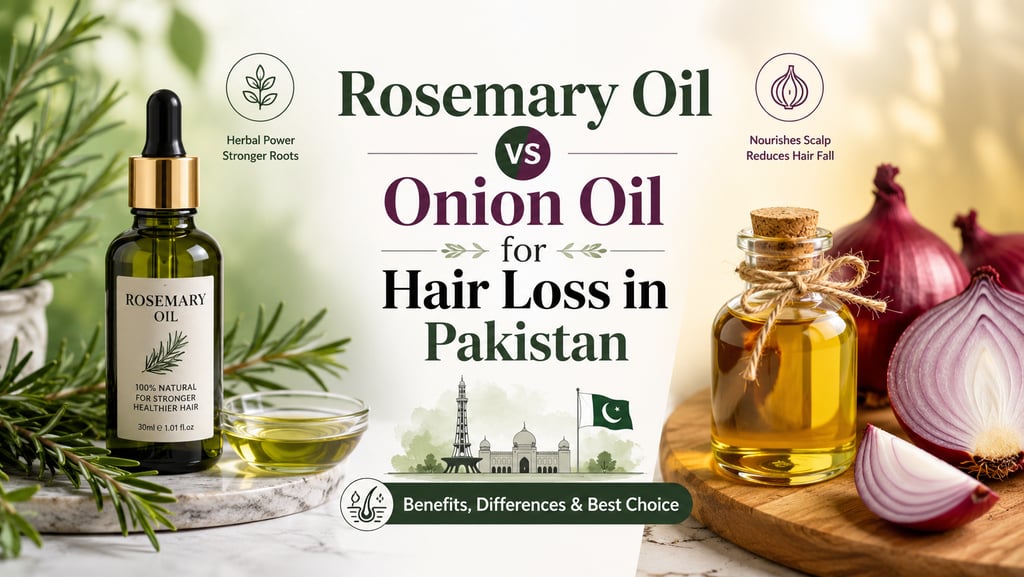
Rosemary Oil vs Onion Oil for Hair Loss in Pakistan: The Complete, Science-Backed Comparison
Summarize this blog post with: ChatGPT | Perplexity | Claude | Grok
You've probably already tried one of these oils, or you're standing at the pharmacist right now trying to decide between them. The problem is that most content tells you both rosemary oil and onion oil "work for hair loss" without explaining that they target completely different causes of hair loss. That distinction matters: one could be almost useless for your specific situation while the other could genuinely change your results. This guide covers the science behind each oil, realistic result timelines, how to identify which type of hair loss you're dealing with, and whether using both together is worth the effort.
Key Takeaways
Rosemary oil is clinically proven to perform as well as 2% minoxidil for androgenic alopecia (pattern hair loss) after six months of consistent use, based on a 2015 randomized controlled trial published in Skinmed Journal.
Onion oil's organosulfur compounds and quercetin stimulate scalp microcirculation, support keratin production, and reduce the oxidative stress that damages hair follicles.
These two oils work through different biological pathways: rosemary targets DHT hormones while onion oil nourishes the scalp environment, so your hair loss type should determine which one you choose.
For most Pakistani users experiencing diffuse shedding from hard water, iron deficiency, or stress, onion oil tends to show changes faster: 4-8 weeks versus 12-16 weeks for rosemary oil.
Both oils can be combined into a single DIY serum that addresses hair loss from multiple directions simultaneously.
Consistent application 2-3 times per week for at least 12 weeks is required before you can fairly assess either oil's effectiveness.
If hair loss continues after 16 weeks of consistent use, or you notice circular patchy bald spots, a dermatologist visit is essential. Natural oils cannot treat scarring alopecia or severe hormonal imbalances alone.
What Are Rosemary Oil and Onion Oil?
Rosemary oil and onion oil are two separate natural extracts with different chemical profiles, different mechanisms, and different clinical track records. Understanding what each one actually is, before any comparison begins, prevents the most common mistake people make: choosing based on price or shelf availability rather than biological fit.
What Is Rosemary Oil?
Rosemary oil is an essential oil extracted from Rosmarinus officinalis through steam distillation. Its two primary active compounds are rosmarinic acid and ursolic acid. These compounds are what make rosemary oil relevant to hair loss, specifically because rosmarinic acid inhibits the enzyme that converts testosterone into DHT. Because rosemary is a true essential oil, it cannot be applied to the scalp directly. You must dilute it in a carrier oil, typically at a 2-3% concentration (roughly 2-3 drops per teaspoon of coconut or jojoba oil).
Rosemary oil has roots in Mediterranean traditional medicine and has been used for circulation and scalp health for centuries. Its crossover into modern hair loss research happened through a 2015 study that compared it directly against pharmaceutical minoxidil. More on that below.
For a deeper look at rosemary's growth mechanism on its own, see our rosemary oil for hair growth guide.
What Is Onion Oil?
Onion oil is derived from Allium cepa and is rich in organosulfur compounds and quercetin, a flavonoid antioxidant. One distinction worth knowing: most commercial "onion oils" sold on Daraz or at your local pharmacy are carrier oils infused with onion extract, not pure essential oils. This matters practically. Infused onion oil can be applied directly to the scalp without further dilution, which is one reason it's easier to use day-to-day.
Onion has been a staple of South Asian home remedies (ghar ka nuskha) for generations. The practice of tel lagana (applying oil to the scalp) is deeply embedded in Pakistani household hair care, and onion is one of the most familiar ingredients in that tradition. The question is no longer whether it works in general; the question is whether it works for your specific type of hair loss.
If onion oil looks like your fit, our complete guide to onion oil for hair growth covers dosage and application in more depth.
Why Hair Loss Is So Common in Pakistan
Hair loss in Pakistan is worsened by several factors that compound on each other. Hard water, high in calcium and magnesium, is one of the most overlooked contributors. If you live in Karachi, Lahore, or Islamabad, you're washing your hair in hard water every day, which damages the hair cuticle, blocks follicles, and disrupts scalp pH over time.
Iron-deficiency anemia affects an estimated 50% of Pakistani women (Source: Pakistan Medical & Dental Council, 2021), and iron deficiency is one of the most common triggers of diffuse hair shedding. Vitamin D deficiency compounds the problem; both nutrients are directly involved in the hair growth cycle at the cellular level.
Post-COVID telogen effluvium has added another layer. Telogen effluvium is the sudden, diffuse shedding that follows illness, surgery, or prolonged stress; it became significantly more common in Pakistan after 2021. The friction from dupattas and tight braids, the heat styling from straighteners used regularly without heat protection, and the nutritional gaps in common urban diets all pile onto an already-stressed scalp.
Natural oils like rosemary and onion have become most people's first response not because a doctor recommended them, but because they're accessible, affordable, and culturally credible. The ghar ka nuskha instinct is correct in principle. The missing step is choosing the right nuskha for the right problem.
How Does Rosemary Oil Work for Hair Regrowth?
Rosemary oil stimulates hair regrowth primarily by inhibiting 5-alpha-reductase, the enzyme that converts testosterone into DHT (dihydrotestosterone). DHT is the main driver of androgenic alopecia: the type where the hairline gradually recedes at the temples, or the crown begins to thin. By blocking some of that conversion, rosemary oil slows the follicle miniaturization that DHT causes over time.
Rosemary oil is a natural DHT inhibitor that has been clinically shown to be as effective as 2% topical minoxidil for androgenic alopecia after six months of consistent use, according to a 2015 randomized controlled trial published in Skinmed Journal (Source: Panahi et al., Skinmed Journal, 2015). The study was double-blind, the gold standard for clinical evidence. One additional finding worth noting: the rosemary oil group reported less scalp itching than the minoxidil group, which matters if you've tried minoxidil and found the itching intolerable.
Rosemary oil works best for hormonal, DHT-driven hair loss. If your hair is thinning gradually at the temples or crown, the loss is slow and progressive rather than sudden, and it runs in your family, rosemary oil is likely more relevant than onion oil for your situation.
To use it correctly, dilute 2-3 drops of rosemary essential oil per teaspoon of carrier oil (coconut or jojoba), massage it into the scalp for 5-7 minutes, and leave it on for at least two hours before washing. A rosemary water rinse is a lighter alternative that works well for people who find oil heavy or difficult to wash out in Karachi's humid summers.
How Does Onion Oil Work for Hair Regrowth?
Onion oil works through a completely different set of pathways. The high sulfur content in onions supports keratin synthesis (keratin is the structural protein that hair is made from). Quercetin, the flavonoid antioxidant in onion, reduces scalp inflammation that suppresses follicle activity. Together, these compounds also improve blood microcirculation at the scalp, meaning more oxygen and nutrients reach each follicle.
Onion oil works for hair loss by delivering high concentrations of organosulfur compounds and quercetin to the scalp, which together stimulate blood microcirculation, support keratin production, and reduce the oxidative stress that damages hair follicles.
The evidence most often cited is a 2002 study in the Journal of Dermatology, which tested crude onion juice on patients with alopecia areata. At eight weeks, 73.9% of participants applying onion juice twice daily showed measurable hair regrowth, compared to only 13.3% in the control group (Source: Sharquie & Al-Obaidi, Journal of Dermatology, 2002). The honest limitation: this study used onion juice, not commercial onion oil, and tested alopecia areata specifically, not androgenic alopecia or general diffuse shedding. Still, the evidence is more than most natural hair products can cite.
Onion oil produces stronger results for alopecia areata and diffuse hair shedding caused by nutritional deficiency or scalp inflammation. It's also a reasonable first choice for the all-over shedding most Pakistani women experience after illness, childbirth, or prolonged stress. Apply commercial onion oil directly to the scalp, massage for 5-7 minutes, and leave on overnight. The sulfur smell is the main friction point. Washing with a mild shampoo the next morning handles it for most people, though it may linger on pillowcases.
Rosemary Oil vs Onion Oil: Side-by-Side Comparison
The most direct way to understand the difference between these two oils is to see them as tools built for different jobs, not different versions of the same job.
Rosemary oil works inside the follicle at a hormonal level. Its active compounds, rosmarinic acid and ursolic acid, slow down the enzyme that converts testosterone into DHT, the hormone responsible for pattern hair loss. Because this is a slow-acting mechanism, most users won't notice anything in the first eight weeks. Measurable density changes typically appear only after 12-16 weeks of consistent application. The clinical evidence is the strongest of any natural oil tested: a 2015 RCT in Skinmed Journal compared rosemary oil directly against 2% minoxidil over six months and found comparable results. Because it's a true essential oil, it must be diluted in a carrier before scalp contact (2-3 drops per teaspoon of coconut or jojoba oil). The scent is mild and herbal, easy to tolerate for most people. In Pakistan, a quality bottle runs between PKR 500 and PKR 1,500 and is available at Daraz, Saeed Ghani stores, and most organic pharmacies.
Onion oil works at the scalp surface rather than inside the follicle. Its organosulfur compounds support keratin production (keratin is the structural protein hair is made from). Quercetin reduces scalp inflammation that blocks follicle activity. Improved blood microcirculation means follicles receive more nutrients and oxygen from each heartbeat. These surface-level effects appear faster: users with inflammation-related or nutrition-related shedding often notice reduced hair fall within 4-8 weeks. The main clinical study (Sharquie & Al-Obaidi, Journal of Dermatology, 2002) found that 73.9% of alopecia areata patients applying onion juice twice daily showed measurable regrowth by week eight, compared to 13.3% in the control group. The limitation is that this used onion juice, not commercial onion oil, and tested one specific condition. Still, commercial onion-infused oil can be applied directly to the scalp without dilution, which makes it the simpler option for daily use. The sulfur smell is the main friction point. It's strong, it lingers on pillowcases, and no amount of pretending otherwise changes that. Price is lower than rosemary, typically PKR 300-800, and it's easier to find locally at Naheed Superstore, Fazal Din's, and Shaheen Chemist.
On the question of evidence: rosemary wins for androgenic alopecia specifically. Onion wins for alopecia areata. For general diffuse shedding (which is what most Pakistani users actually deal with), neither oil has a large dedicated trial, but onion oil's faster effect on circulation and inflammation makes it a more practical starting point. On tolerability day-to-day, rosemary is easier to live with given the scent difference. On price and local availability, onion oil has the edge. The right choice between the two isn't about which oil is "better" in the abstract. It's about matching the right mechanism to the right type of hair loss.
Which Oil Has Stronger Scientific Evidence?
Rosemary oil has stronger human trial evidence for androgenic alopecia specifically. The 2015 Skinmed study was a double-blind RCT comparing it directly against a pharmaceutical benchmark. Onion oil's primary study was well-designed but limited to alopecia areata with onion juice rather than commercial oil. For general diffuse shedding, which is the most common type in Pakistan, neither oil has a large dedicated RCT. Onion oil has deeper traditional use and faster anecdotal results in that category, but the clinical evidence base is thinner.
Which Oil Shows Results Faster?
Onion oil tends to produce visible changes faster, often within 4-8 weeks for users with scalp-inflammation-related or nutrition-related shedding. Improved scalp circulation shows up relatively quickly once application becomes consistent. Rosemary oil's mechanism (gradually reducing DHT conversion) takes longer to produce visible follicle recovery. Most users need 12-16 weeks of consistent application before seeing measurable changes in density.
Neither timeline is fast by the standards of a TikTok reel promising results in seven days. This mismatch between social media expectations and biological reality is why so many people give up on both oils before they've had a fair chance to work.
Which Hair Loss Type Suits Which Oil?
Rosemary oil is for hormonal hair loss: slow recession at the temples or crown, usually hereditary, driven by DHT. Onion oil is for inflammation-based or nutritional hair loss: patchy circular spots, sudden diffuse shedding, post-illness or postpartum hair fall. If you're unsure which type you're dealing with, the next section covers that directly.
Which Hair Loss Type Are You Dealing With?
Identifying your hair loss type before choosing an oil changes your result more than the oil itself. Most people skip this step entirely, which is why many spend months on the wrong treatment.
Androgenic alopecia is gradual thinning at the temples, hairline, or crown. It tends to run in families and is driven by DHT sensitivity. It affects men more visibly but is common in women too, particularly those with polycystic ovary syndrome (PCOS). This type responds better to rosemary oil.
Alopecia areata appears as small, circular, smooth bald patches, distinctly different from gradual thinning. It's an autoimmune condition, not a DHT condition. Onion oil has the strongest natural evidence for this type, though moderate to severe cases need a dermatologist's involvement alongside any home treatment. For patchy or severe cases, our guide to oils for extreme hair loss and alopecia covers when to combine oiling with medical treatment.
Telogen effluvium is diffuse shedding, losing hair from all over the scalp at once, often after stress, illness, childbirth, or crash dieting. This is likely the most common type among Pakistani women aged 18-40. COVID-related telogen effluvium is still showing up in patients two to three years after infection. Onion oil addresses some contributing factors here, but fixing the root cause (iron levels, vitamin D, managing chronic stress) matters more than any oil alone.
Traction alopecia comes from prolonged tension on the hairline: tight braids, high ponytails, or styles worn consistently for months. Neither oil reverses follicle damage if the pulling continues. Changing the hairstyle matters more than any treatment.
Can You Use Rosemary Oil and Onion Oil Together?
Yes, and combining them makes biological sense because they address hair loss through different pathways. Rosemary essential oil targets DHT-driven follicle miniaturization while onion oil nourishes the scalp microenvironment, making them complementary rather than competing treatments.
Here is a practical DIY blend using ingredients available across Pakistan:
Pakistan Hair Growth Serum Recipe:
50ml castor oil (thickens the serum and adds follicle-nourishing properties)
50ml coconut or jojoba oil as the base carrier
2 tablespoons commercial onion-infused oil
4-5 drops rosemary essential oil
Mix everything in a glass bottle. Before the first use, do a patch test on your inner wrist and wait 24 hours. Apply 2-3 times per week to the scalp, massage for 5-7 minutes, and leave it on for at least two hours. Washing out with a sulfate-free shampoo the following morning works well.
One caution: if your scalp is visibly irritated, cracked, or infected (from severe dandruff, psoriasis, or fungal overgrowth), don't apply this blend until the scalp has healed. The sulfur compounds in onion oil and the rosmarinic acid in rosemary oil can both aggravate already-inflamed tissue.
How to Apply Each Oil Correctly in Pakistan
Application method matters as much as choosing the right oil. For the full step by step technique, see how to apply hair oil correctly. The two most common mistakes are applying daily (which causes buildup without improving results) and washing out too quickly (which cuts absorption time short).
Frequency: Apply 2-3 times per week. Daily application doesn't speed results and creates scalp buildup, particularly in humid months in Karachi where the scalp sweats more than in drier Lahore winters. In Lahore's cooler months, overnight applications are more comfortable and you can leave the oil on longer without discomfort.
Scalp massage technique: Use your fingertips, not fingernails, in slow circular motions across the scalp. Five to seven minutes is adequate. Massage improves microcirculation on its own, separate from whatever oil you're applying. Skip the massage if your scalp is visibly inflamed or tender.
Heat: Lightly warming the oil before application improves absorption. Hold the bottle under warm tap water for a minute rather than microwaving it. Overheating degrades the rosmarinic acid in rosemary essential oil specifically.
Shampoo pairing: Wash with a sulfate-free, anti-fall shampoo. Brands like Khadi Natural and Hemani are available at most Pakistani pharmacies and on Daraz. Harsh sulfate shampoos strip the scalp faster than the oils can help it recover.
Are There Side Effects of Using Rosemary Oil or Onion Oil?
Both oils are safe with proper use, but skipping the basics creates real risks.
Rosemary essential oil causes contact dermatitis if applied undiluted. Always keep concentration at or below 3% when mixing into a carrier oil (3 drops per teaspoon). People with epilepsy should speak to a doctor before using rosemary oil regularly, as rosmarinic acid can interact with anticonvulsant medications at high doses.
Onion oil's main risk is scalp irritation in people with sulfur sensitivity. A small number of users experience redness or a mild burning sensation. Diluting further in a carrier oil reduces this. The smell is a nuisance rather than a health risk, but it lingers more than most people expect, particularly on fabric.
Neither oil has safety data for use during pregnancy. If you're pregnant or breastfeeding, speak to your doctor before adding any essential oil to your routine.
Where to Buy Quality Rosemary Oil and Onion Oil in Pakistan
Both oils are widely available, but quality ranges from excellent to nearly useless depending on what's inside the bottle.
For rosemary essential oil: Look for 100% pure rosemary essential oil, not a blend, fragrance oil, or anything labeled "rosemary scented." Check the label for the botanical name (Rosmarinus officinalis). Brands available in Pakistan with a reasonable quality record: WOW Skin Science, Khadi Natural, and Saeed Ghani's essential oil line. On Daraz, filter by rating and check the ingredient list. If "fragrance" or "parfum" is listed as a primary ingredient, skip it. Price range: PKR 500-1,500. For a full brand-by-brand price breakdown, see our rosemary oil price guide.
For onion oil: Commercial onion-infused oils are more consistent than homemade versions in terms of active compound concentration. Hemani and Saeed Ghani both stock onion oil at local pharmacies. Naheed Superstore in Karachi carries several options. On Daraz, WOW Skin Science and Khadi Natural are two brands that have both onion oil and transparent ingredient lists. Price range: PKR 300-800.
What to avoid: Mineral oil as the first listed ingredient (it coats hair without delivering active compounds), artificial fragrance as a primary component, and any product promising results in seven days.
How Long Does It Actually Take to See Results?
Eight weeks is the minimum before forming any fair opinion about either oil. Sixteen weeks is when you can make a reliable assessment. This is the single biggest gap between expectation and reality. Most Pakistani users who try an oil for two or three weeks, see nothing, and switch to the next thing end up in a cycle that guarantees they never give any treatment enough time to work.
Hair growth cycles run on approximately 90-day schedules. Even when a treatment is working, the follicle needs to complete a cycle before new growth becomes visible. The most common experience pattern: after four to six weeks, some users notice reduced shedding in the shower or on their hairbrush. After eight to twelve weeks, some notice baby hairs at the hairline. Measurable density improvement at the crown takes four to six months of consistent use.
One important boundary: neither oil can regrow hair on a scarred scalp. If follicles have been permanently damaged (from long-term severe traction, radiation, or certain types of scarring alopecia), no natural treatment will reverse that. These oils work on living, miniaturized follicles. They don't work on scar tissue.
What Should You Do Next?
Three questions narrow down the right starting point.
1. What does your hair loss pattern look like? Circular bald patches point toward onion oil and a dermatologist visit. Slow thinning at the temples or crown points toward rosemary oil. All-over diffuse shedding after stress or illness points toward onion oil first, with parallel attention to nutritional deficiencies.
2. How tolerant are you of the sulfur smell? If you work in an office or an environment where the odor is a practical problem, rosemary oil is more manageable day-to-day.
3. What's your commitment window? Both oils require at least 12 weeks. If you can't commit to that, no oil will give you a fair test.
Commit to whichever you choose for 12 full weeks before evaluating. If you see no change after 16 weeks, or if shedding increases, a dermatologist visit is the right next step, not another oil. Alopecia areata responds poorly to oils alone and responds well to dermatology-led treatment when caught early.
Conclusion
Rosemary oil and onion oil are not competing for the same job. Rosemary oil addresses the hormonal root of androgenic hair loss by blocking DHT at the follicle level. Onion oil addresses the scalp enviro nment by improving circulation, strengthening keratin, and reducing the inflammation that suppresses follicle activity. Rosemary oil is most effective for hormonal and DHT-driven hair loss, while onion oil produces stronger results for alopecia areata and diffuse shedding caused by nutritional deficiency or scalp inflammation. Choosing between them depends on correctly identifying your hair loss type.
If you've been using one and seeing no results, it's worth asking whether you chose the oil suited to your type of hair loss, or the one that happened to be on sale.
The best approach for most Pakistani users isn't an either/or choice. A simple blended serum using both oils, applied consistently two to three times per week, covers more pathways than either alone. Pair that with addressing whatever is driving your hair loss at its root (iron levels, hard water, chronic stress) and you give your follicles a realistic chance.
Hair loss takes time to reverse. The patience it requires is genuinely hard. But the science on both these oils is real, and the approach is clear. Give it the time it needs.