
Sweet Almond Oil for Hair in Pakistan
Discover how sweet almond oil can nourish dry, rough, and damaged hair in Pakistan, leaving it softer, shinier, and healthier.
HAIR OIL
Written by Ali Raza CEO, Ollexo | 10+ years of experience in the oil industry. Passionate about sharing practical insights, industry trends, and real world lessons from years of leadership and hands on experience in natural oils.
4/16/202611 min read
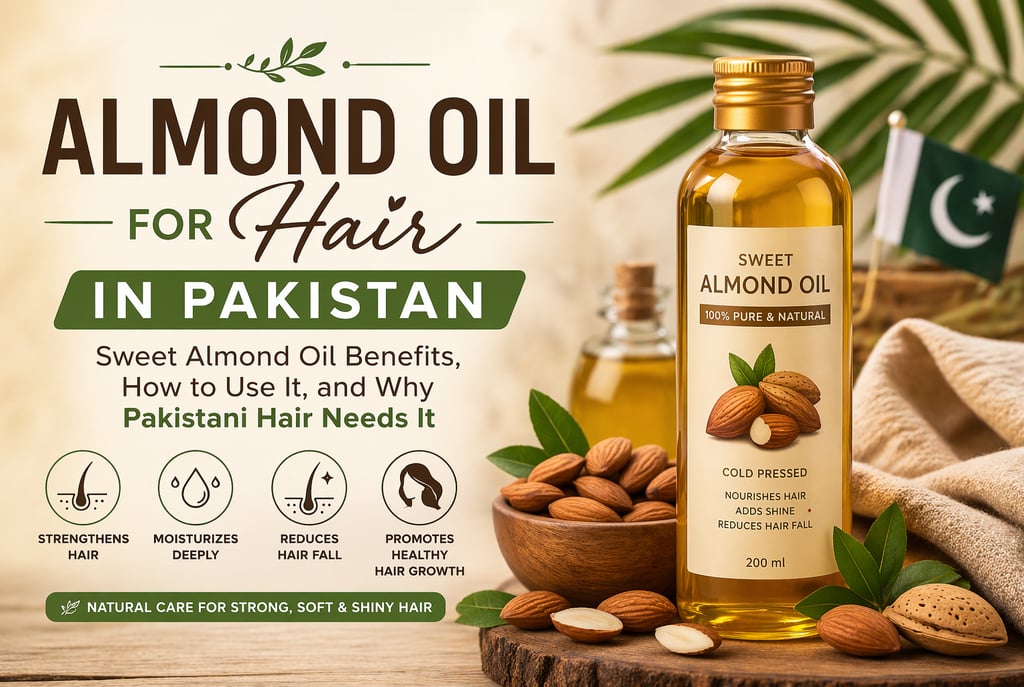
sweet Almond Oil for Hair in Pakistan: Sweet Almond Oil Benefits, How to Use It, and Why Pakistani Hair Needs It
You already know that oiling your hair is one of the best things you can do for it. It is a ritual passed down through generations in Pakistani homes. But if you have been using the same coconut or sarson oil your mother used, you may be missing an oil that is lighter, gentler, and scientifically proven to target the exact problems Pakistani hair faces: from hard water damage to seasonal dryness. In this guide, you will discover exactly how sweet almond oil (badam tel) works, why it is uniquely suited to Pakistani hair, and the step by step routine that delivers real results in just 30 days.
Key Takeaways
Sweet almond oil (badam tel) is a cold-pressed, nutrient-rich oil containing Vitamin E, oleic acid, and magnesium that deeply nourishes and strengthens hair from root to tip.
Pakistan's hard water and dry climate make almond oil particularly valuable, as its emollient properties restore moisture that harsh water strips from hair.
Regular scalp massage with almond oil improves blood circulation, which supports healthier and faster hair growth over a consistent 4 to 8 week period.
Unlike heavier oils such as coconut or sarson oil, sweet almond oil absorbs quickly into the hair shaft without leaving a greasy residue, making it ideal for fine or straight hair types common among South Asian women.
Almond oil addresses multiple concerns at once: dryness, breakage, frizz, scalp irritation, and dullness, making it one of the most versatile single-oil treatments available.
For best results, use cold-pressed, pure sweet almond oil as a pre-shampoo hot oil treatment once or twice per week.
Ollexo's cold-pressed sweet almond oil is formulated specifically for Pakistani hair types and is readily available across Pakistan.
What Is Sweet Almond Oil and Why Is It Called Badam Tel in Pakistan?
Sweet almond oil is a cold-pressed oil derived from the kernels of the Prunus amygdalus dulcis tree, rich in oleic acid, linoleic acid, Vitamin E, and magnesium, nutrients that directly nourish the hair shaft and scalp. In Pakistani homes, it is traditionally known as badam tel, named after the Urdu word for almond. This is the same oil that grandmothers have quietly kept in their dressing tables for generations, though most households never used it as consistently or correctly as it deserves.
First, it is important to distinguish between sweet almond oil and bitter almond oil. Bitter almond oil is extracted from a different variety and contains compounds that make it unsuitable and potentially harmful for skin and hair use. Sweet almond oil is the only variety used in beauty and haircare. When you shop for badam tel in Pakistan, you are looking specifically for sweet almond oil.
Second, the extraction method matters enormously. Cold-pressed sweet almond oil retains its full nutrient profile, including tocopherols (Vitamin E) and phytosterols, whereas refined almond oil loses many of these active compounds during heat processing, making cold-pressed the preferred choice for hair care. Refined almond oil is cheaper and more widely available, but it delivers a fraction of the actual benefit.
Why Is Almond Oil Particularly Good for Hair in Pakistan's Climate?
Almond oil is especially beneficial for Pakistani hair because Pakistan's hard water, seasonal dryness, and cultural styling habits create a specific set of damage patterns that almond oil is uniquely positioned to repair. This is not a generic beauty claim. It is grounded in the actual chemistry of both the oil and the water coming out of Pakistani taps.
Pakistan's hard water contains high concentrations of calcium and magnesium minerals that strip moisture from hair strands. Almond oil's emollient properties help seal the hair cuticle and restore lost hydration. A study measuring water hardness across major Pakistani cities found that cities like Lahore, Faisalabad, and Karachi regularly record hardness levels above 200 mg/L, well beyond the WHO's recommended threshold of 150 mg/L. Source: Pakistan Council of Research in Water Resources (PCRWR), 2022. Every time you wash your hair with this water, mineral deposits coat the hair shaft, roughing up the cuticle and robbing strands of their natural shine.
Moreover, consider the seasonal extremes Pakistani women navigate. In Lahore and Islamabad, dry winters and dusty winds cause hair to become brittle and prone to static. In Karachi, humidity levels in the monsoon season cause frizz and scalp sweat that can clog follicles. Almond oil addresses both: it moisturises in winter dryness and controls frizz in humid heat by creating a lightweight, breathable seal on the hair shaft.
Additionally, cultural habits unique to Pakistani women play a role. Regular dupatta use creates friction across the hairline and crown, a primary cause of the thinning and breakage many women notice but struggle to explain. Almond oil, applied as a pre-styling serum, reduces that friction measurably.
What Are the Proven Benefits of Sweet Almond Oil for Hair Growth?
Sweet almond oil promotes hair growth by improving scalp blood circulation through massage, delivering essential fatty acids to hair follicles, and reducing the breakage that makes hair appear thinner, with visible results typically appearing after four to eight weeks of consistent use.
Deep Moisturisation from Root to Tip
The oleic acid (omega-9) and linoleic acid (omega-6) in sweet almond oil give it exceptional moisturising capability. Oleic acid penetrates the hair cortex, the inner layer of the hair shaft, and replenishes lipids that are lost through washing, heat styling, and environmental exposure. Linoleic acid, meanwhile, reinforces the scalp barrier, preventing transepidermal moisture loss. Together, they transform dry, brittle hair into strands that are pliable and resilient.
Strengthening the Hair Shaft to Reduce Breakage
For example, a 2015 study published in the Journal of Cosmetic Science found that oils high in oleic acid reduced hair fiber fragility by penetrating and lubricating the cortex, compared to mineral oil which merely coats the surface. Source: Journal of Cosmetic Science, 2015. Almond oil's molecular composition allows it to enter the hair shaft rather than simply sitting on it, which means it repairs from the inside out rather than creating a superficial sheen that washes away with the next shampoo.
Scalp Nourishment Through Vitamin E, Magnesium, and Zinc
Vitamin E is one of the most potent antioxidants found in natural oils, and sweet almond oil contains it in meaningful concentrations, approximately 39 mg per 100g. Source: USDA Nutrient Database, 2023. At the scalp level, Vitamin E neutralises free radical damage caused by sun exposure and pollution, both of which are significant concerns in Pakistani urban environments. Zinc and magnesium, also present in almond oil, support the enzymatic processes that govern healthy hair follicle cycling.
Reducing Hair Fall
Hair fall (baal girna) is one of the most commonly searched hair concerns among Pakistani women. Beyond nutritional support, scalp massage with almond oil has been shown to thicken the subcutaneous tissue around follicles and stimulate dermal papilla cells, the cells responsible for hair regeneration. A small but notable clinical study found that standardised scalp massage for four minutes daily over 24 weeks significantly increased hair thickness. Source: ePlasty, 2016. Almond oil turns a simple massage into a nutrient delivery event.
How to Use Almond Oil for Hair Growth: Step-by-Step Application Guide
Almond oil for hair growth works best when applied directly to the scalp through massage and used as a pre-shampoo treatment, not a post-wash product. Many women use it incorrectly, applying it to dry ends after washing, and then wonder why results are limited. The method below is designed specifically for South Asian hair textures and Pakistani weather conditions.
Method 1: Hot Oil Pre-Shampoo Treatment (Most Effective)
Warm 2 to 3 tablespoons of Ollexo cold-pressed sweet almond oil in a small bowl placed in hot water for 3 to 5 minutes. Do not microwave, as direct heat degrades Vitamin E.
Part your hair into four sections using a wide-tooth comb.
Apply the warm oil to your scalp using your fingertips, working section by section.
Massage in slow circular motions for 5 to 7 minutes. This is not optional. Massage is what stimulates circulation and opens follicles to absorb the oil.
Distribute remaining oil through the mid-lengths and ends.
Wrap your hair in a warm towel or shower cap and leave for a minimum of 45 minutes. Overnight is even better.
Shampoo twice to ensure full removal, then condition as usual.
Method 2: Overnight Scalp Massage
Apply 1 to 2 tablespoons to the scalp only, massage for 5 minutes, and leave overnight. This method works best for women with dry or flaky scalps rather than oily ones. Protect your pillow with an old towel or a satin pillowcase, which also reduces friction on the hair.
Method 3: Leave-In Frizz Serum
Take 2 to 3 drops of almond oil, rub between your palms, and smooth over freshly washed, damp hair, focusing on the mid-lengths and ends. This amount is enough to tame frizz without weighing hair down. It works especially well in Karachi's humid climate, where frizz control is a daily battle.
What Is the Best Almond Oil Hair Mask for Pakistani Hair?
Hair masks combine almond oil with kitchen ingredients already present in most Pakistani homes.
Hair Mask Ingredients Best For Leave-On Time Moisture Boost Almond oil + raw honey Dry, dull hair 30 to 45 minutes Protein Repair Almond oil + 1 egg yolk Damaged, brittle hair 20 to 30 minutes Growth Stimulating Almond oil + methi (fenugreek) paste Hair fall, thin hair 45 to 60 minutes Scalp Soothing Almond oil + aloe vera gel Itchy, inflamed scalp 30 minutes
The almond oil + methi mask is particularly effective for Pakistani women because fenugreek (methi) is already a staple in Pakistani kitchens and is rich in proteins and nicotinic acid that directly stimulate hair follicles. Soak 2 tablespoons of fenugreek seeds overnight, blend into a paste, mix with 2 tablespoons of Ollexo almond oil, and apply to the scalp.
How Is Sweet Almond Oil Different from Coconut Oil for Hair in Pakistan?
Sweet almond oil is lighter, faster-absorbing, and better suited to fine or straight South Asian hair than coconut oil, which has a denser molecular structure that can sit on the hair surface rather than penetrating it. This distinction matters practically, not just chemically.
Women who have avoided oils their entire lives because they found coconut oil too heavy, too greasy, or too difficult to wash out often find sweet almond oil is a completely different experience. Unlike coconut oil, which has a large molecular structure that can sit on top of the hair shaft, sweet almond oil has a lighter composition that penetrates the cortex more readily, making it better suited for fine or straight South Asian hair types.
Sarson (mustard) oil presents a different set of trade-offs. It is deeply embedded in Pakistani haircare tradition and does offer some scalp-stimulating benefits. However, its strong smell limits its use for working women and students, and its high erucic acid content can irritate sensitive scalps with prolonged use. Almond oil is fragrance-neutral and gentle enough for daily scalp contact.
For those who have found success with castor oil for hair growth in Pakistan, almond oil makes an excellent partner. Blend equal parts almond and castor oil to get the deep conditioning of castor with the lightweight penetration of almond, a combination particularly useful for fine hair that needs growth support without heaviness.
Is Almond Oil Suitable for All Hair Types, Including Fine and Oily Hair?
Almond oil is suitable for almost all hair types, including fine, coarse, colour-treated, and henna-treated hair, with only oily scalp types requiring slightly modified usage. Pakistani women have highly diverse hair textures, from the fine, silky hair common in northern regions to the thicker, wavier textures more prevalent in Sindh and Punjab, and almond oil accommodates all of them.
Fine/straight hair: Use 1 to 2 drops as a leave-in or dilute in water as a pre-shampoo spray. Avoid scalp application more than once per week.
Thick/coarse hair: Full hot oil treatment is ideal. Use 3 to 4 tablespoons and focus heavily on the scalp and mid-lengths.
Dry scalp: Weekly overnight treatment is highly beneficial.
Oily scalp: Limit application to the ends only. Avoid scalp application and use no more than once a week.
Henna/mehndi-treated hair: Almond oil is fully compatible with henna and actually helps seal mehndi colour into the shaft, prolonging colour intensity and shine.
Chemically colour-treated hair: Almond oil is gentle enough for colour-treated hair and helps combat the dryness that chemical treatments cause.
What Are the Most Common Mistakes Women Make When Using Badam Tel?
The most common mistakes when using badam tel include buying refined instead of cold-pressed oil, applying it only to the hair shaft while skipping the scalp, and expecting results in less than four weeks. These errors explain why many women try almond oil, see no results, and conclude it does not work.
Using refined almond oil: If your almond oil cost under Rs. 300 for 200ml, it is almost certainly refined or diluted with mineral oil. Cold-pressed oil is more expensive but delivers the actual nutrients your hair needs.
Skipping the scalp: Hair growth begins at the follicle, which lives in the scalp. Applying oil only to dry ends addresses cosmetics, not the underlying health of your hair.
Using too much on an oily scalp: Over-oiling a scalp that already produces sebum can clog follicles and worsen hair fall. Less is more for oily scalp types.
Skipping the patch test: Almond oil is derived from tree nuts. Women with nut allergies should do a patch test on the inner wrist 24 hours before full application.
Expecting overnight results: Hair grows approximately 1.25 cm per month. Source: American Academy of Dermatology, 2023. Visible improvement in texture, frizz, and shine may appear in 2 to 3 weeks, but measurable hair growth results require a consistent 4 to 8 week commitment.
What Should You Look for When Buying Almond Oil for Hair in Pakistan?
The best almond oil for hair in Pakistan is 100% pure, cold-pressed sweet almond oil with no mineral oil dilution, stored in dark or UV-protected packaging to preserve its nutrient content. With dozens of products on Pakistani shelves and online marketplaces, knowing what to look for protects you from wasting money on ineffective products.
A quality almond oil will meet these criteria:
Cold-pressed, listed on the label, to preserve Vitamin E and fatty acids.
100% pure, with no mixing of mineral oil, petroleum derivatives, or synthetic fragrance.
Dark glass or opaque packaging, as light degrades Vitamin E rapidly and clear plastic bottles indicate lower quality.
No added fragrance, since pure almond oil has a faint, naturally sweet scent and a strong fragrance indicates additives.
Transparent sourcing, as a reputable brand will clearly identify the oil's origin.
Your 30-Day Almond Oil Hair Routine for Pakistani Hair
A structured 30-day almond oil routine delivers measurably better results than occasional use because it allows the oil's nutrients to build up in the scalp tissue and hair shaft progressively. Think of it less like a product and more like a discipline.
Week 1: Establish the Baseline (Twice This Week)
Day 1 and Day 4: Perform the full hot oil pre-shampoo treatment as described in Method 1. Use 2 to 3 tablespoons of Ollexo almond oil warmed to body temperature.
After each wash, apply 2 drops as a leave-in on damp hair.
Note your hair's texture, frizz level, and how much hair falls in the shower. This is your baseline.
Weeks 2 to 4: Build the Habit (Once Weekly)
Every week: One overnight scalp massage treatment the night before wash day.
On wash day: Apply 2 to 3 drops leave-in to damp ends post-shampoo.
Twice in Week 3: Try the almond oil and methi hair mask for a deeper growth-stimulating treatment.
End of Week 4: Compare your hair texture, shine, and fallout against Week 1 notes.
Most women report a visible reduction in frizz and breakage within 14 to 21 days, with improved hair density and growth becoming noticeable between weeks 4 and 8.
Conclusion: Your Hair Deserves the Best, Naturally
Pakistan's unique hair challenges, hard water, seasonal extremes, heat styling, and dupatta friction, deserve a targeted solution, not a one-size-fits-all recommendation copied from a Western beauty blog. Sweet almond oil (badam tel) is one of the most complete natural treatments available. It moisturises, strengthens, reduces frizz, nourishes the scalp, and supports growth, all in a single, lightweight oil that absorbs cleanly and leaves no heavy residue.
The key is quality. Cold-pressed, pure sweet almond oil is the only version that delivers on its nutritional promise. Ollexo's almond oil is cold-pressed, unadulterated, and made for Pakistani hair. Give it 30 days, a consistent and structured 30 days, and your hair will show you the difference. Start your routine today with Ollexo sweet almond oil and discover what badam tel can actually do when used correctly.
Written by Ali Raza CEO, Ollexo | 10+ years of experience in the oil industry. Passionate about sharing practical insights, industry trends, and real-world lessons from years of leadership and hands-on experience in natural oils.