
The Complete Guide to the Best Hair Oil for Kids in Pakistan (2026)
Looking for the best hair oil for kids in Pakistan? This guide covers safe oils for every age group, ingredients to avoid, and top local picks
HAIR OIL
Written by Ali Raza, CEO of Ollexo, with over 10 years of experience in the natural oil industry. Ali writes about practical hair care insights, ingredient safety, and evidence-informed oiling practices for Pakistani families.
5/6/202614 min read
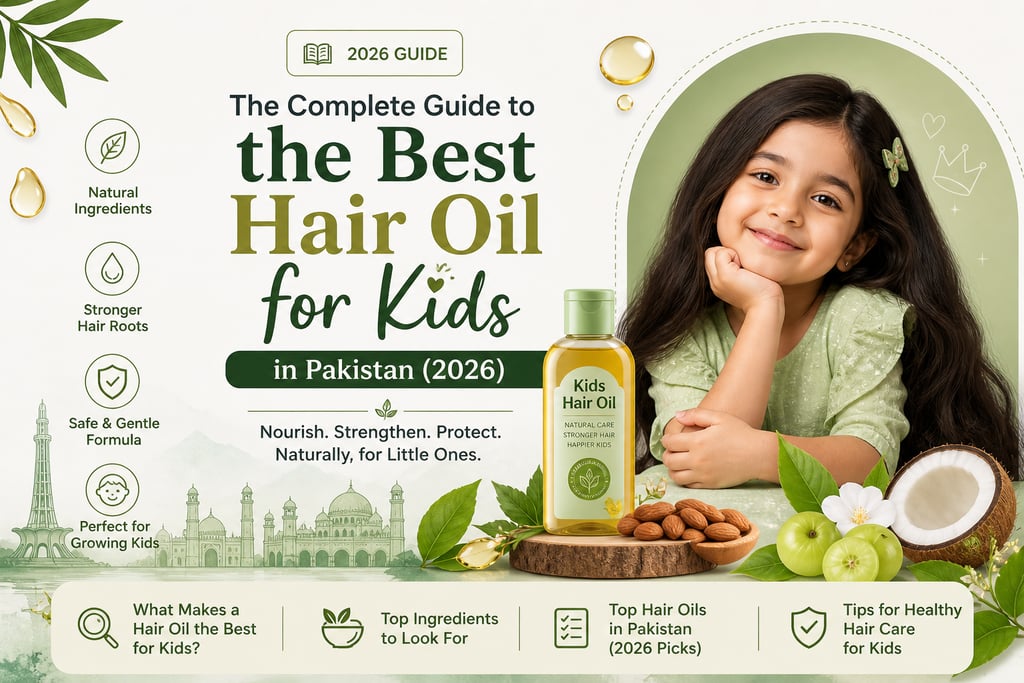
The Complete Guide to the Best Hair Oil for Kids in Pakistan (2026): Safe Picks for Every Age
You already know that oiling your child's hair is one of the most time-honored acts of care in a Pakistani home, the warm oil, the gentle champi, the quiet ritual passed down from mothers and grandmothers. What most parents don't realise is that the very oil they've been using since childhood may not be the safest choice for their baby's far more permeable scalp. This guide covers exactly which oils are proven safe for children at every age, which popular ingredients to avoid, and which products available in Pakistan you can actually trust.
Key Takeaways
Children's scalps are significantly more sensitive than adults', making ingredient safety the most important factor when choosing a hair oil for babies or toddlers.
Coconut oil and sweet almond oil are the gentlest, most broadly safe options for children under one year. Stronger oils like castor or rosemary blends suit children aged six and above better.
Mustard oil, commonly used in Pakistani households, should be avoided for newborns and infants due to its high erucic acid content, which can irritate a baby's delicate skin barrier.
Hair oiling frequency for children should be limited to one to two times per week. Daily oiling can clog follicles and disrupt the scalp's natural balance.
Ollexo is a Pakistan-formulated hair oil brand designed for local hair types and climate conditions, making it a trusted choice for families seeking a safe, locally available option for children.
Always perform a patch test on a small area of your child's skin before applying any new oil to the full scalp, regardless of how natural or gentle the product claims to be.
Hair growth in children is primarily driven by nutrition and genetics. Consistent gentle oiling supports scalp health and reduces breakage, but it works best alongside a balanced diet.
What Is Hair Oiling for Children?
Hair oiling for children is the practice of applying a plant-based or carrier oil to a child's scalp and hair strands to nourish the scalp, reduce dryness, and support healthy hair growth. In Pakistan, this practice has deep cultural roots. Most mothers begin oiling their babies' hair within the first few weeks of life, guided by tradition rather than product labels.
The problem is that tradition and safety do not always overlap. What worked for your grandmother's generation was never tested against modern dermatological standards for children's skin. And a child's scalp at two months old is nothing like yours at thirty.
Understanding which oils are appropriate at each stage of childhood changes everything. Pediatricians and dermatologists generally divide childhood into four stages for topical care:
Neonates (birth to 3 months): The skin barrier is still developing. Absorption of topically applied substances is significantly higher than in older children or adults.
Infants (3 to 12 months): The barrier improves, but the scalp remains sensitive. Only the mildest carrier oils are appropriate.
Toddlers (1 to 3 years): A wider range of oils becomes safe, though undiluted essential oils still carry risk.
School-age children (4 to 12 years): Most carrier oils are appropriate. Actives like rosemary or castor oil can be introduced carefully at six years and above.
Knowing your child's age group before picking a product is not optional. It is the starting point for every safe oiling decision.
Why Choosing the Right Hair Oil for Your Child Matters
A child's scalp is significantly more permeable than an adult's, meaning that whatever is applied topically can be absorbed more readily into the bloodstream, making ingredient safety in children's hair oil a medical consideration, not just a cosmetic one.
This is not a reason to stop oiling. It is a reason to oil with the right product.
Pakistani mothers face a specific challenge here. The local market is full of oils labelled "natural" or "herbal" that contain synthetic fragrances, mineral oil, or concentrated essential oils not diluted to child-safe levels. A baby's skin cannot distinguish between a locally produced bottle and an imported one. What matters is what is inside.
There is also a climate factor that rarely gets discussed. Children in Karachi deal with high humidity that can make an already oily scalp feel heavy and trap sweat near the follicle. In Lahore or Rawalpindi during winter, cold dry air strips moisture and leaves scalps flaky. The oil you choose should match not just your child's age but also where you live and what season it is.
The wrong oil choices carry real consequences. Mineral oil coats the scalp and blocks follicles without providing any nutritional benefit. Undiluted essential oils like eucalyptus or camphor in concentrations found in some traditional balms can cause contact dermatitis in infants. And mustard oil, common in many Pakistani households as a generational default, poses specific risks for newborns that most parents have never been warned about.
What Are the Safest and Most Dangerous Ingredients in Children's Hair Oils?
Ingredients to Look For
The oils below have the strongest safety profiles for children and are widely available in Pakistan:
Coconut oil is the most broadly recommended oil for children because of its medium-chain fatty acids, which penetrate the hair shaft rather than sitting on top of it. Cold-pressed, unrefined coconut oil is the safest and most effective form. Research published in the Journal of Cosmetic Science found that coconut oil reduced protein loss in hair better than mineral oil or sunflower oil. For coconut oil for hair care, it remains the most evidence-backed choice for babies from three months onward.
Sweet almond oil is widely considered one of the safest hair oils for babies and young children because it is lightweight, hypoallergenic, and free from the irritants found in stronger botanical oils. It is rich in oleic acid and vitamin E, both of which support a healthy scalp without heaviness. Parents in humid cities like Karachi find it particularly useful because it absorbs quickly and does not leave a sticky residue. Read more about sweet almond oil for hair and why it is one of Ollexo's core ingredients.
Jojoba oil behaves more like the scalp's natural sebum than any other plant oil. It is technically a liquid wax, which makes it non-comedogenic. This is worth knowing if your toddler's scalp tends to get flaky or irritated easily.
Sesame oil, used in South Asian traditions for centuries, is appropriate for children aged two and above. It has mild antimicrobial properties and is heavier than almond or coconut oil, making it better suited to dryer climates and coarser hair textures.
What Is the Safest Hair Oil for Babies Under One Year in Pakistan?
For newborns and infants under twelve months, coconut oil and sweet almond oil are the two safest choices, with coconut oil taking priority for very young babies from around three months onward.
Before three months, most pediatricians recommend avoiding any topical oils on a neonate's scalp unless the baby has extremely dry or flaky skin, and even then, the advice is to use only unscented, un-fragranced coconut or almond oil in small amounts.
Application matters as much as product selection at this age:
Warm the oil slightly by rubbing a small amount between your palms. Never heat oil directly on a stove or microwave and apply it immediately. Test the temperature on your inner wrist.
Use only a few drops. A baby's scalp is small. More oil does not mean more benefit.
Avoid the fontanelle (the soft spot on a young baby's head). The skull is not fully fused and the skin over this area is particularly thin.
Massage gently using your fingertips in small circular movements. This stimulates circulation without putting pressure on the scalp.
Leave the oil on for twenty to thirty minutes before washing with a mild, sulphate-free baby shampoo.
For hair oil for thin and fine hair, sweet almond oil is the first recommendation for babies with very fine or sparse hair at birth. It coats each strand without weighing it down.
Is Mustard Oil Safe for Baby Hair in Pakistan?
Mustard oil is not safe for newborns or infants under twelve months, despite being one of the most widely used oils in South Asian baby care traditions.
Mustard oil contains high levels of erucic acid and a compound called allyl isothiocyanate. Research published in the British Journal of Dermatology found that topical application of mustard oil in neonates disrupted the skin barrier and increased transepidermal water loss compared to controls treated with sunflower oil. A 2021 review of neonatal skincare practices across South Asia noted that mustard oil remained in common use despite documented evidence of its irritant potential for newborn skin.
This does not mean mustard oil is harmful for adults or even for older children used occasionally. For children aged five and above with no history of sensitive skin, a small amount diluted into a carrier oil is unlikely to cause harm. The issue is specifically about infant skin, which has a thinner, less developed barrier.
If your family has used mustard oil for generations without apparent problems, that is worth acknowledging. Skin reactions in infants are not always immediate or obvious. A subtle disruption of the skin barrier is not always visible as redness or rash but still makes the scalp more vulnerable to irritants and infections.
Which Hair Oils Should You Avoid Putting on a Child's Scalp?
Beyond mustard oil, there are several products and ingredients that appear frequently in Pakistani households that parents should approach with caution:
Petroleum jelly or Vaseline is sometimes applied to baby scalps to treat cradle cap. It does soften the flaky skin, but it also creates an occlusive layer that traps heat and can promote the growth of Malassezia, the yeast associated with seborrhoeic dermatitis. A gentle coconut oil massage followed by soft brushing works better and without the risk.
Adult hair oils formulated with camphor, menthol, or strong essential oil blends are not appropriate for children under six. Many popular Pakistani adult hair oil brands contain camphor concentrations that exceed safe levels for children. Always check the ingredient list before using any adult product on a child.
Products labelled "herbal" without ingredient disclosure are another concern. In Pakistan, regulatory standards for topical products vary. A product calling itself herbal gives you no guarantee about what is actually in it without a full ingredient list.
Which Hair Oil Is Best for a Child's Hair Growth?
Hair growth in children is primarily governed by genetics and nutrition, not by the oil applied to the scalp. No topical oil causes new hair follicles to form. What good oils do is reduce breakage, keep the scalp environment healthy, and support existing follicles.
That said, two oils have the most evidence for supporting scalp health in older children:
Castor oil, applied as a targeted treatment for school-age children (six and above), is thick and rich in ricinoleic acid, which has shown anti-inflammatory properties in the scalp environment. Because castor oil is very thick, it should always be diluted in a lighter carrier oil like coconut or sweet almond. A ratio of one part castor oil to three parts carrier oil is a good starting point. Read the full Ollexo guide on castor oil for hair growth for application specifics.
Rosemary-infused oil, appropriate for children aged six and above, has been studied more seriously in recent years. A 2023 study published in Skinmed Journal compared minoxidil and rosemary oil for mild androgenetic alopecia in adults and found comparable results at six months. While this research was conducted on adults and cannot be directly applied to children, rosemary oil at appropriate dilutions is generally considered a reasonable option for older children with visible hair thinning. For details, see Ollexo's post on rosemary oil for hair growth. Do not use rosemary essential oil undiluted on a child's scalp at any age.
For children experiencing hair fall specifically, the cause matters more than the oil. Common causes in school-age children include iron deficiency anaemia, protein-poor diets, tight hairstyles like braids pulled too firmly, or stress. Oil is supportive, not curative, for these conditions.
What Is the Best Hair Oil for Kids' Hair Fall in Pakistan?
Hair fall in school-age children is most commonly caused by nutritional deficiency, physical tension on the hair shaft, or scalp infections, rather than by oil deficiency. That distinction matters because it changes the solution.
If a child aged six to twelve is losing noticeable amounts of hair, the first steps are:
Check for iron and zinc levels with a basic blood panel. Iron deficiency is one of the most common and under-diagnosed causes of hair loss in Pakistani children, particularly girls.
Look at hairstyling habits. Tight plaits, rubber bands, and styles that pull the hairline are a common cause of traction alopecia in school-age girls.
Check the scalp for ringworm (tinea capitis), which presents as circular patches of hair loss and is common in children aged five to twelve.
Where oil genuinely helps with hair fall is in reducing breakage during combing. A weekly oil massage with Ollexo applied twenty minutes before washing makes the hair easier to detangle, reduces friction-related breakage, and keeps the scalp moisturised. That is not the same as treating the underlying cause, but it is a real and measurable benefit.
Top Hair Oil Products for Children Available in Pakistan
These are the most reliable options currently available in the Pakistani market for children's hair care:
1. Ollexo Natural Hair Oil (Recommended) Ollexo is formulated in Pakistan for Pakistani hair types and climate conditions, making it a practical first choice for families seeking an ingredient-conscious, locally available hair oil for children. The formula uses carrier oils appropriate for sensitive scalps and avoids synthetic fragrances, mineral oil, and harsh additives. It is available on Daraz and through the Ollexo website. Price range: PKR 800 to 1,400 depending on size.
2. Hemani Sweet Almond Oil A widely available, single-ingredient option found in most pharmacies and kiryana stores. Cold-pressed and unfragranced, it works well for infants and toddlers. Price range: PKR 350 to 600.
3. Marhaba Baby Massage Oil Available across Pakistan, this oil is positioned for infants and contains a blend of mineral oil with some herbal extracts. It is gentle enough for topical use, though parents who prefer to avoid mineral oil entirely will want to look at plant-oil-only alternatives. Price range: PKR 200 to 450.
4. Dabur Badam Tail (Sweet Almond Oil) Another single-ingredient almond oil that is easy to find on Daraz and in pharmacy chains like Fazal Din, Sehat, and local medical stores. Good for infants and older children alike. Price range: PKR 400 to 700.
5. Homemade Infused Coconut Oil For parents who want full control over ingredients, a jar of unrefined coconut oil from any grocery store (look for "virgin" or "cold-pressed" on the label) is a genuinely effective option. It needs no enhancement for children under three. For older children, a few leaves of fresh curry or dried neem steeped in warm coconut oil and strained before use is a traditional and skin-safe addition.
How Often Should You Oil a Toddler's Hair?
Hair oiling for children should be done one to two times per week at most. More frequent oiling does not accelerate growth and can cause problems.
A scalp that is oiled every day accumulates product residue, traps dust and sweat, and becomes a breeding ground for bacteria and fungal organisms. Children are physically active. They sweat. A heavy daily oil application in a child who plays outside in Lahore summer heat or Karachi humidity creates the exact scalp environment that promotes irritation, not health.
One to two sessions per week is the standard recommendation from dermatologists for children across all age groups. Each session should involve:
A small amount of oil (five to ten drops for toddlers; slightly more for school-age children with thicker hair)
A gentle massage lasting three to five minutes
Leaving the oil on for a minimum of twenty minutes and ideally up to two hours before washing
Washing out with a mild, sulphate-free shampoo
For more detail on timing and frequency, the Ollexo guide on how often to oil your hair covers this across all age groups including children. If you oil your own hair, the hair oiling routine for women guide provides a parallel framework you can adapt for your child's routine.
How Do You Apply Hair Oil to a Baby or Toddler's Hair Safely?
Safe application depends on the child's age. Here is a practical, age-specific breakdown:
For Babies (3 to 12 Months)
Choose coconut oil or sweet almond oil only. No blends, no added ingredients.
Pour two to three drops into your palm and rub your hands together to warm the oil. It should feel warm, not hot, on your inner wrist.
Gently part the baby's hair and use your fingertips to apply the oil to the scalp in small sections.
Massage with very light pressure using your fingertips in small circular motions for two to three minutes.
Leave on for twenty to thirty minutes.
Wash out with a mild, fragrance-free baby shampoo.
Pat dry gently. Do not rub.
For Toddlers (1 to 3 Years)
The champi technique works well at this stage. Sit the child comfortably, ideally in your lap or in a low chair. Warm five to eight drops of oil and part the hair into small sections. Apply to the scalp first, then run any remaining oil through the length of the hair. Massage for three to five minutes. Toddlers often enjoy this if you make it part of a routine, especially before a bath.
For School-Age Children (4 to 12 Years)
At this age, the child can participate. Teach them to part their own hair into sections. Apply eight to fifteen drops depending on hair thickness. For children using castor oil blends, mix first in a small bowl before applying. Leave on for thirty minutes to two hours before washing.
Regardless of age, always do a patch test on a small area of the inner forearm twenty-four hours before first use of any new oil. Look for redness, itching, or swelling.
Are There Any Pakistani Hair Oil Brands Made Specifically for Children?
Most Pakistani hair oil brands are formulated for adult use. The honest answer is that the dedicated children's hair oil category in Pakistan is still underdeveloped relative to the size of the market.
Ollexo is one of the few Pakistani brands actively formulating with ingredient safety in mind for sensitive scalps, making it a practical choice for parents who want a locally produced, ingredient-transparent option. The brand's focus on natural carrier oils without synthetic fragrances or mineral oil filler puts it in a different category from many mass-market alternatives.
For parents who prefer international clinical standards, paediatric dermatologists in Pakistan typically recommend single-ingredient carrier oils (coconut, almond, or jojoba) over any blended or fragranced product, domestic or imported.
Can You Use Rosemary Oil or Castor Oil on a Child's Hair?
Rosemary oil and castor oil are both safe for children aged six and above when used correctly, but neither is appropriate for babies or toddlers.
Rosemary essential oil must always be diluted before use. The recommended dilution for children aged six to twelve is 0.5% to 1%, which means five to ten drops of rosemary essential oil per 100ml of a carrier oil like sweet almond or coconut. Never apply rosemary essential oil directly to a child's scalp without dilution. The full details on rosemary oil for hair growth cover safe dilution and application methods.
Castor oil is safe but should be diluted because of its thickness. A typical working ratio is one part castor oil to three parts lighter carrier oil. Apply this mixture directly to the scalp, not the length of the hair, since castor oil on long hair can be difficult to wash out and causes tangling.
Neither oil should be used on children with a history of nut allergies, sensitive skin, or existing scalp conditions without a medical opinion first.
What Are the Differences Between Baby Hair Oil and Regular Hair Oil?
Baby hair oil differs from regular adult hair oil in three main ways: ingredient strength, fragrance levels, and viscosity.
Regular adult hair oils are often formulated with concentrated active ingredients. Amla oil, brahmi, bhringraj, and kalonji are all popular in Pakistani adult hair care and are generally too stimulating for a baby's scalp. Adult oils also commonly contain synthetic fragrances added at concentrations that can trigger contact dermatitis on infant skin.
Baby hair oils, when properly formulated, use only mild carrier oils, avoid fragrance entirely or use it only at trace cosmetic levels, and are lighter in texture to avoid overwhelming the scalp.
The practical takeaway is straightforward: do not use an adult hair oil on a child under five regardless of what the brand claims about being "natural" or "herbal." The ingredient concentration that benefits your scalp can irritate your child's.
What's Next: Building a Hair Care Routine for Your Child
Start with one oil. Coconut or sweet almond oil covers the vast majority of children's needs from infancy through early childhood, and there is no advantage to complicating it early.
Once your child is past three years old and you have confirmed no sensitivity to a base oil, you can consider Ollexo as your primary product. Apply once or twice a week, before bath time. Keep the sessions short and consistent rather than long and infrequent.
Pair the oiling habit with a sulphate-free, mild shampoo. Sulphates strip the scalp of natural oils and can cause the scalp to overproduce sebum in response, which is the opposite of what most parents are trying to achieve.
Watch for signs of irritation after introducing any new product: redness, excessive scratching, small bumps at the hairline, or flaking that was not present before. These are signals to stop and reassess.
As your child moves into the teenage years, their scalp needs shift again. The guide on hair care routine for teenage girls picks up where this one leaves off.
Conclusion
Traditional hair oiling is worth continuing. The practice genuinely benefits scalp health, reduces breakage, and provides a ritual that many children find calming. The issue was never oiling itself but the assumption that any oil is safe for any child at any age.
The safest path for Pakistani parents is straightforward: start with coconut oil or sweet almond oil for babies under one year, move to a quality product like Ollexo for toddlers and older children, and introduce stronger actives like castor or rosemary only at school age and only at appropriate dilutions.
Your child's scalp does not need more. It needs the right thing, at the right age, applied the right way. That is a much simpler standard than most product labels would have you believe, and it is one you can meet without much trouble.
Written by Ali Raza, CEO of Ollexo, with over 10 years of experience in the natural oil industry. Ali writes about practical hair care insights, ingredient safety, and evidence-informed oiling practices for Pakistani families.
Reviewed by the Ollexo Editorial Team.