
7 Hair Oiling Mistakes Causing Hair Fall in Pakistan
Discover why your oiling routine might be causing hair fall and how to fix it with the right techniques and timings for healthier, thicker hair.
HAIR OIL
Written by Ali Raza CEO, Ollexo. Ali has over 10 years of experience in the oil industry and is passionate about sharing practical insights on hair care, industry trends, and real-world lessons from years of leadership and hands-on experience in Pakistan's natural oils market.
5/6/202614 min read
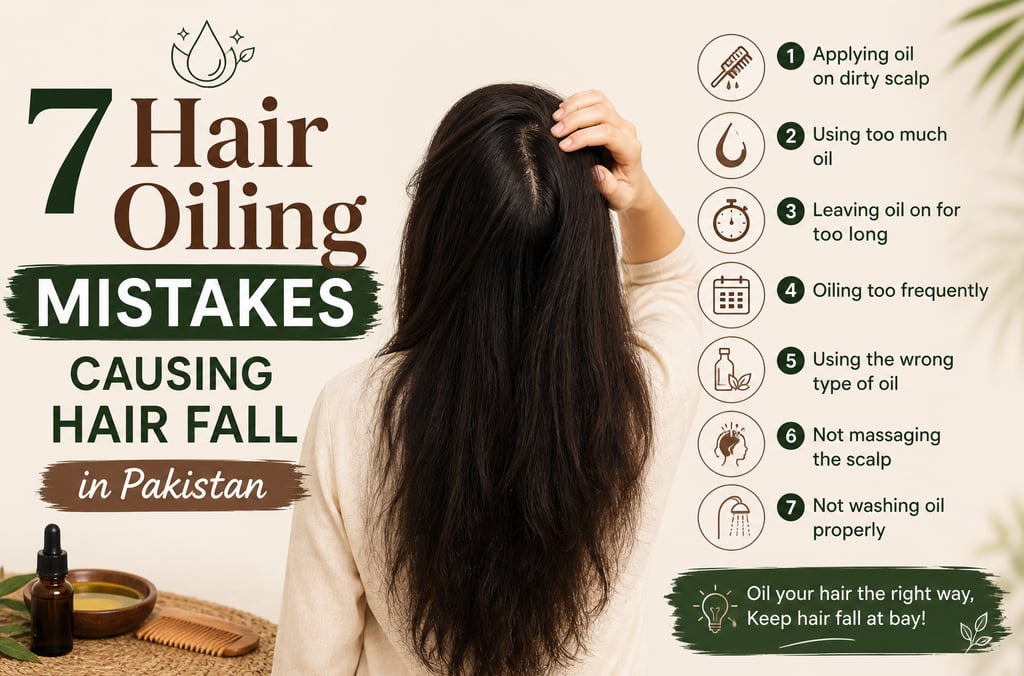
7 Hair Oiling Mistakes Causing Hair Fall in Pakistan (And the Simple Fixes That Actually Work)
You have been oiling your hair your whole life. Your nani did it, your ammi does it, and you have always believed it is the secret to long, thick hair. But if you are noticing more strands in your comb after every oiling session, the problem is not the oil. It is the technique. This guide walks you through the exact hair oiling mistakes most Pakistani women make without realizing it, and the simple fixes that can stop hair fall and make oiling work the way it is supposed to.
Key Takeaways
Hair oiling is a beneficial practice for Pakistani women, but common application mistakes, not the oil itself, are the leading cause of oiling-related hair fall.
Over-oiling the scalp clogs follicles and creates conditions for dandruff and scalp inflammation, both of which speed up hair loss.
Leaving oil on overnight without a thorough wash traps oxidized residue and environmental pollutants against the scalp, directly worsening shedding.
Vigorous scalp massage during oiling physically stresses hair roots. Light fingertip pressure in small circular motions is the correct technique.
Using the wrong oil for your scalp type, such as heavy mustard oil on a fine or oily scalp, causes buildup, breakage, and thinning over time.
Oiling once or twice a week, applied to clean hair, is the right frequency for most scalp types in Pakistan's climate.
Switching to a lightweight, properly formulated hair oil designed for Pakistani hair and climate conditions can resolve most oiling-related hair fall within four to six weeks.
What Are Hair Oiling Mistakes?
Hair oiling mistakes are incorrect practices in oil application, frequency, or product selection that turn a beneficial routine into a source of hair damage. Oiling itself is not the problem. Desi hair care has relied on oils for centuries, and the science supports it: oils coat the hair shaft, reduce protein loss during washing, and improve scalp circulation when applied correctly. What goes wrong is in the how, not the what.
Most Pakistani women were taught to oil by their mothers or aunts, which means they inherited the technique along with the good intentions. Some of those habits, like applying thick layers of mustard oil directly onto the scalp and sleeping overnight without a wash, made more sense before city pollution and hard water entered the picture. Hair fall in teenage girls Pakistan is especially common because young women are starting these inherited routines without understanding what their specific scalp type actually needs.
The hair shaft itself is a dead structure. It cannot heal once it is broken. But the follicle, the living root beneath the scalp, responds to treatment changes within weeks. This is why fixing your oiling technique produces visible results relatively quickly: you are correcting the environment around a living biological structure, not trying to repair something already damaged.
The good news is that the fixes are small. None of them require abandoning oiling entirely. They just require adjusting a few details in a routine you have probably been doing automatically for years without ever questioning.
Can Hair Oiling Actually Cause Hair Fall in Pakistani Women?
Hair oiling mistakes, not oil itself, are the primary cause of oiling-related hair fall. Over-application, incorrect technique, and poor washing habits are the actual culprits. This distinction matters because the solution is a technique correction, not stopping oiling altogether.
Pakistani women are in a particularly complicated position when it comes to hair oiling advice. Global beauty content often tells them to oil less frequently, while their own family tells them to oil daily. Neither extreme is ideal for Pakistani hair and scalp conditions. What the research actually supports is moderate, targeted oiling on a clean scalp, followed by proper cleansing.
According to a study in the International Journal of Trichology, hair oiling reduces hair breakage during washing by up to 39% when done correctly, but increases scalp folliculitis risk significantly when heavy oils are left on for extended periods without washing. The same practice that protects your hair can damage your scalp depending entirely on how it is done.
For most Pakistani women aged 16 to 40, the hair fall they experience after oiling falls into one of the seven categories below. Identify which mistake applies to your routine, correct it, and give it four to six weeks. Most cases resolve without any additional intervention.
Why Hair Oiling Mistakes Cause Hair Fall
Hair oiling mistakes cause hair fall through three main mechanisms: follicle clogging, scalp inflammation, and mechanical breakage. When excess oil sits on the scalp for too long, it mixes with sweat, dead skin cells, and pollution particles. This combination creates a layer of buildup that blocks the hair follicle opening and restricts healthy growth.
A clogged follicle does not just slow growth. It becomes a warm, oily environment where Malassezia, the fungus responsible for dandruff, multiplies quickly. The dandruff and hair fall connection is direct: an inflamed scalp weakens the root, and a weakened root sheds hair faster. Seborrheic dermatitis, a dandruff-linked scalp condition, is among the most common causes of diffuse hair fall in South Asian women, according to the International Journal of Trichology.
Mechanical damage is the third pathway. Wet, oiled hair is at its most fragile. Combing through it roughly, or massaging with too much pressure, physically snaps strands at the root. This is often misread as hair fall when it is actually breakage. The difference matters, because breakage responds quickly to technique changes, while follicular hair fall takes longer to reverse.
Pakistan adds an extra layer of complexity through its climate and water quality. Hard water, which is common in Lahore, Islamabad, and much of Punjab, leaves mineral deposits on the hair shaft that disrupt scalp pH and make follicle clogging from oiling worse. High pollution in Karachi and Lahore means there is significantly more particulate matter settling on the scalp that oil can trap. These variables do not exist in the same way for women in London or New York reading the same generic hair care content. That is why Pakistan-specific oiling advice matters.
Mistake #1: Applying Too Much Oil Directly to the Scalp
Applying excess oil directly to the scalp is the most common hair oiling mistake Pakistani women make, and it is where most oiling-related hair fall begins.
The scalp already produces its own oil. It is called sebum, and it exists to keep the scalp moisturized and the hair shaft protected. When you add a heavy oil, especially a thick one like mustard or coconut, directly on top of active sebum glands, you double up. The follicle gets suffocated. Growth slows. The excess oil has nowhere to go, so it sits on the surface and collects everything it touches: dust, sweat, and the fine pollution particles that are unavoidable in any Pakistani city.
Applying excess oil directly to the scalp clogs hair follicles, disrupts the scalp's natural sebum balance, and creates conditions for fungal overgrowth and inflammation that accelerate hair loss. This is the mechanism behind most cases of oiling-related hair fall in Pakistani women, and it resolves within a few weeks of correcting the application volume.
The fix: Use your fingertips or a dropper to apply a small amount of oil to the scalp in sections. The scalp application is about stimulation, not saturation. You do not need the root drenched. Apply generously from mid-lengths to the ends, where the hair is drier and genuinely needs that coating. Less on the scalp. More on the ends. This one adjustment alone produces a noticeable difference in scalp health within two to three weeks.
Mistake #2: Leaving Oil Overnight Without Washing Properly the Next Morning
Overnight oiling is deeply embedded in Pakistani routine. Tel lagao, so jao. Your dadi swore by it. But leaving oil on the scalp for eight or more hours without a proper wash the next morning is one of the cleaner paths to scalp inflammation, and the research backs this up.
Here is what actually happens overnight. The oil on your scalp starts to oxidize as it is exposed to air. Your scalp continues producing sebum and sweat through the night. Dust from your pillow and bedroom air settles into the oil layer. By morning, you have oxidized oil, fresh sebum, sweat, and particulate matter all sitting directly against your follicles. That is not conditioning. That is a recipe for itching, flaking, and weakened roots.
Leaving hair oil on overnight without proper cleansing traps oxidized oil, environmental pollutants, and sweat against the scalp. This combination worsens dandruff and weakens hair roots. A 2022 review in the Journal of Cosmetic Dermatology found that extended oil contact on the scalp beyond four to six hours without cleansing significantly increases the risk of scalp folliculitis, where follicles become inflamed and sometimes infected.
The cultural habit of overnight oiling is not inherently wrong. It becomes harmful when the morning wash does not match the overnight application. A quick rinse is not enough. The next-morning wash after an overnight oil session needs to be thorough, and it almost never is.
The fix: If overnight oiling is important to you, that is absolutely fine. But the morning wash is not optional. Do two full rounds of shampoo on the scalp, not just a rinse. Covering your hair with an old cotton dupatta overnight reduces dust contact and oil oxidation. For most women, one to two hours of oiling before washing gets the same benefits with far less scalp exposure.
Mistake #3: Oiling Hair That Is Already Dirty
Applying oil to hair that has not been washed recently traps everything already sitting on your scalp under a fresh layer of product. In Pakistani cities, that means pollution particles, sweat residue, and any dry shampoo or styling product you used earlier. You are sealing all of that in.
This mistake is particularly damaging in Karachi and Lahore, where air quality regularly enters the unhealthy range. Fine pollution particles settle on the scalp throughout the day, and oil binds to them. The resulting combination is a common trigger for contact dermatitis and worsened dandruff, both of which are major contributors to hair fall in teenage girls Pakistan and adult women alike.
Oiling on dirty hair also reduces the oil's effectiveness. The oil cannot penetrate the hair shaft properly when there is a buildup layer between it and the hair. So you use more oil to compensate, which creates more buildup, and the cycle continues.
The fix: Oil on a clean or recently washed scalp. If you cannot wash before oiling, wait until you can. The extra half hour is worth it. For women dealing with dandruff alongside hair fall, the dandruff and hair fall connection guide clarifies which condition is driving the other in your case.
Mistake #4: Massaging the Scalp Too Aggressively
Scalp massage during oiling is genuinely beneficial. Research from Aderans Research Institute in Japan found that four minutes of daily standardized scalp massage increased hair thickness over a 24-week period by improving blood circulation to the follicles. But the technique matters more than the duration.
Most Pakistani women were taught to massage with full palm pressure, rubbing hard and fast to "get the oil in." That approach does the opposite of what you intend. Hard, rapid rubbing stresses the hair shaft right at its most vulnerable point: where it meets the follicle opening. The hair is anchored at the root, but that anchor is not designed to handle repeated twisting or strong lateral force.
Vigorous scalp massage during oil application physically stresses the hair shaft at its root. The clinically recommended technique is light, circular fingertip pressure to stimulate blood circulation without causing mechanical breakage. This is the difference between a routine that thickens hair and one that gradually causes traction alopecia, a hair loss pattern that shows up as thinning at the temples and hairline.
The fix: Use your fingertips only, not the palm or nails. Apply light pressure in small, slow circular motions. Move across the scalp section by section. Do not drag the fingers across the scalp surface. Lift, press, release, move. Five minutes of this kind of massage is more effective and far less damaging than ten minutes of hard rubbing.
Mistake #5: Using the Wrong Oil for Your Scalp Type
Using the wrong oil for your hair and scalp type is a mistake that plays out slowly, which is why it gets overlooked. You might use mustard oil for a year before realizing your hair has been getting thinner throughout, not because mustard oil is inherently harmful, but because it was wrong for your scalp.
Pakistani hair care defaults to two oils: sarson (mustard) and coconut. Both are heavy. Both have high protein content. For women with thick, coarse, or dry scalps, they work well. For women with fine, oily, or low-porosity hair, they cause buildup and protein overload, a condition where the hair shaft hardens, loses elasticity, and snaps. Which hair oils are too heavy for the Pakistani climate depends entirely on your hair type, not on which oil is most traditional.
For a full breakdown of what works for Pakistani hair and where to find it locally, the best hair oil for hair fall in Pakistan guide covers the options available on Daraz and in local pharmacies.
Ollexo's hair oil is formulated specifically for Pakistani hair and climate conditions. It uses a lightweight base that does not clog follicles in humid weather, with active botanicals targeting the specific causes of hair fall common in this region. For women also dealing with thinning, the hair oiling tips for thin hair guide adjusts the routine specifically for fine or thinning strands. Ollexo is available directly at Daraz.
Mistake #6: Oiling Too Often Without Washing in Between
Daily oiling is common in Pakistani households, particularly where it is treated as a morning routine alongside combing. The assumption is that more oil means more nourishment. What actually happens is that daily oiling without daily cleansing creates the exact scalp conditions that cause seborrheic dermatitis, one of the most underdiagnosed causes of hair fall in Pakistani women.
Seborrheic dermatitis affects between 3% and 5% of the global population, according to the American Academy of Dermatology, but rates in South Asian women are higher due to high-oil application habits combined with inconsistent cleansing. It presents as stubborn dandruff, scalp redness, and an itchy scalp with an oily texture. Left untreated, the chronic inflammation gradually weakens hair roots over months. Most women treat the dandruff symptom without realizing the oiling frequency is what is maintaining it.
Pakistan's climate makes this worse. Karachi's humidity means excess oil on the scalp stays warm and moist, which is an ideal environment for fungal overgrowth. In Lahore and Islamabad, seasonal dryness in winter prompts people to oil more frequently, again without washing frequently enough to match. The dandruff and hair fall connection is a cycle that daily oiling feeds rather than breaks.
Dermatologists recommend oiling hair no more than once to twice per week and always following with a thorough wash to prevent sebum buildup and scalp irritation. This frequency works for most Pakistani scalp types across seasons.
The fix: Oil once or twice a week, always followed by a proper shampoo wash. The how often should you oil your hair guide breaks down the right frequency by scalp type and city climate. Twice a week is the ceiling for most Pakistani women, not the starting point.
Mistake #7: Combing Wet, Oiled Hair
Wet hair is structurally weaker than dry hair. This is basic hair biology: water disrupts the hydrogen bonds in the hair shaft, making it stretch and snap instead of flex. When you add oil to wet hair and then pull a comb through, you are combining two sources of vulnerability at the same time.
Most of the hair fall women report after oiling sessions is actually breakage happening during the post-oil combing step. The strands are not falling from the root. They are snapping from the mid-shaft or end. This distinction is visible: true hair fall strands have a small white bulb at the root end. Breakage strands do not.
The fix: Detangle before you apply oil, not after. Comb through gently on dry or slightly damp hair, remove all tangles, then apply your oil. If your hair tangles after oiling, use a wide-tooth comb and work from the ends upward, not root to tip. Never pull a comb through heavily oiled wet hair in a single downward stroke from scalp to end. It is also safe to comb hair after applying oil, but only if you start at the ends and the hair is not dripping wet.
What Is the Correct Step-by-Step Hair Oiling Routine for Pakistani Hair?
The correct oiling routine for Pakistani hair addresses all seven mistakes above and takes less than fifteen minutes from start to finish. The hair oiling routine for beginners guide has a longer version with scalp-specific adjustments, but here is the corrected method in short.
Step 1: Start with clean, dry or slightly damp hair. Wash your hair first if it has been more than two days since your last wash. Let it dry to at least 70% before applying anything. Oiling soaking-wet hair is one of the fastest ways to cause the mechanical breakage discussed in Mistake #7.
Step 2: Detangle before applying oil. Use a wide-tooth comb from ends to roots. Work through any knots gently. This step prevents 80% of the combing-related breakage that happens after oiling. Do not skip it.
Step 3: Divide your hair into four sections. Two at the front, two at the back. This ensures even oil distribution without doubling over the same sections. Pin each section as you work through it.
Step 4: Apply oil to the scalp using a dropper or fingertip method. Use a small amount per section. A few drops per section is enough. Massage for two to three minutes per section using light, slow circular fingertip pressure. Focus on the scalp, not the hair.
Step 5: Apply the remaining oil from mid-lengths to ends. Your hair is driest at the ends. This is where it breaks, not at the root. Do not be minimal here. Work the oil through the length of your hair with your fingers, then smooth the ends.
Step 6: Leave for one to two hours. Wrap loosely in a cotton cloth or an old dupatta if you need to move around. Avoid wrapping too tightly, which creates friction and pulls at the root.
Step 7: Wash out with two rounds of shampoo. The first round removes the bulk of the oil. The second actually cleans the scalp. Rinse with lukewarm water, never hot. Hot water strips natural moisture and worsens dryness after washing.
Ollexo's hair oil works well with this routine. Its lightweight formula absorbs fully within one to two hours and washes out cleanly without aggressive shampooing. Available on Daraz and directly at the Ollexo website.
When Should You See a Doctor If Hair Fall Continues?
If you apply these fixes consistently for four to six weeks and still see significant daily hair fall, the oiling routine was probably not the main cause. Several other conditions are common in Pakistani women and frequently misattributed to hair care habits.
PCOS: Polycystic ovary syndrome affects roughly 10% to 15% of women in Pakistan, according to research in the Pakistan Journal of Medical Sciences. Hormonal imbalance from PCOS disrupts the hair growth cycle and causes a pattern of diffuse thinning that does not respond to oiling changes. If you are also experiencing irregular periods, acne, or weight fluctuations, PCOS is worth ruling out with a gynecologist.
Iron deficiency: Ferritin levels below 30 ng/mL are enough to trigger noticeable hair fall, and iron deficiency is widespread among Pakistani women due to dietary patterns and low red meat intake in many households. Most women do not know they have it without a blood test. A full blood count with ferritin is a standard test available at any diagnostic lab in Pakistan.
Hard water: Lahore, Islamabad, and most cities in Punjab and Khyber Pakhtunkhwa have high mineral content in tap water. Calcium and magnesium deposits coat the hair shaft over time, disrupt scalp pH, and make follicle clogging from oiling worse. The hard water and hair fall Pakistan guide explains how to identify if this is a factor in your specific case and what to do about it.
Thyroid conditions: Both hypothyroidism and hyperthyroidism cause hair thinning. A basic TSH blood test rules this out. If you are also experiencing fatigue, weight changes, or temperature sensitivity, it is worth checking.
A basic blood panel covering ferritin, thyroid function (TSH), and hormone levels costs under Rs. 3,000 at most diagnostic labs in Pakistan. If any of the above conditions apply to you, see a dermatologist or a general physician. For a broader overview of how to stop hair fall naturally in Pakistan, the guide covers lifestyle and medical causes together in one place.
Conclusion
Hair oiling is not the problem. It never was. You were right to keep oiling. This practice has real scientific backing and a cultural history in Pakistan that predates most modern hair care products. The issue is that a few small technique errors, built into routines passed down through generations, have been quietly working against the results you were expecting.
Correct the volume of oil on the scalp. Wash properly after overnight oiling. Stop combing through wet oiled hair. Match your oil to your actual scalp type instead of defaulting to whatever the kitchen has. Apply these fixes consistently for four to six weeks and most oiling-related hair fall stops.
Your hair does not need an entirely new routine. It needs the old one done slightly better.