
Hot Oil Treatment for hair at home in Pakistan
Discover the ultimate guide to revitalizing your hair with a professional-grade hot oil treatment using natural ingredients available in Pakistan.
HAIR OIL
Written by Ali Raza Ali Raza is the CEO of Ollexo with over 10 years of experience in the oil industry
4/27/202610 min read
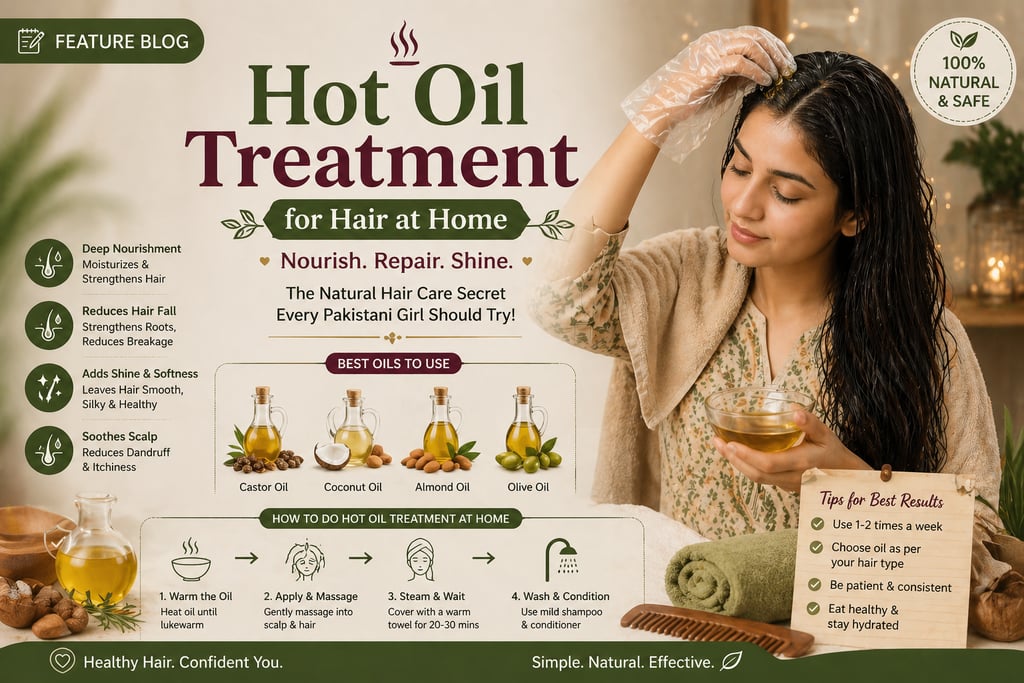
Hot oil treatment for hair at home in Pakistan: the complete step-by-step guide
You already know that oiling your hair is good for you, it's practically a tradition passed down in every Pakistani household. But if you're applying cold oil and rinsing it out after an hour, you're getting a fraction of the benefit your hair actually needs. This guide walks you through exactly how to do a proper hot oil treatment at home using oils you already have in your kitchen, with a method that delivers real, deep conditioning results.
Key takeaways
A hot oil treatment is a deep conditioning technique where warmed oil is applied to the hair and scalp, allowing the heat to open the hair cuticle and enable deeper absorption than cold oil application.
Hot oil treatments are especially important for hair in Pakistan because of hard water damage, sun exposure, dust, and frequent heat styling, all of which strip moisture and protein from the hair shaft.
Common Pakistani household oils, coconut oil, almond oil (badam rogan), castor oil, kalonji oil, and mustard oil, are all effective for hot oil treatments and widely available at local pharmacies and kiryana stores.
The correct method involves heating oil to warm (not hot) temperature, testing it on your wrist, applying in sections from roots to tips, and leaving it on for 20, 45 minutes under a warm towel or shower cap.
Customizing your oil blend based on your hair concern, castor + kalonji for hair fall, olive + almond for dryness, significantly improves results.
Frequency matters: dry or damaged hair benefits from weekly treatments, while normal or oily hair should limit sessions to once every two weeks.
Following the treatment with a sulfate-free shampoo and avoiding heat styling for 24 hours ensures the conditioning benefit stays locked into the hair shaft.
What is a hot oil treatment and how is it different from regular hair oiling?
A hot oil treatment is a deep conditioning hair care method in which oil is gently heated to a warm temperature and applied to the scalp and hair shaft, allowing the warmth to open the hair cuticle and enable deeper oil absorption than cold oil application. That last part is what makes it genuinely different from what most Pakistani households already do.
Regular hair oiling, applying sarson ka tail or coconut oil straight from the bottle and leaving it for an hour, sits mostly on the surface of the hair shaft. The cuticle (the outermost protective layer of each strand) stays relatively closed at room temperature, which limits how much oil actually gets in. Warmth changes this. It gently lifts those cuticle scales, creating space for fatty acids and vitamins in the oil to move past the outer layer and reach the cortex, the inner structure that gives hair its strength and elasticity.
Deep conditioning oil treatment differs from a standard pre-shampoo oil application in that it combines heat activation with extended contact time, allowing fatty acids and vitamins in the oil to penetrate beyond the outer cuticle layer into the cortex of the hair shaft. The result is hair that feels softer, looks shinier, and holds moisture longer after you wash it out.
Think of it this way: applying cold oil is like putting moisturizer on without washing your face first. The product is there, but the absorption is limited. The hot oil method removes that barrier.
Why is hot oil treatment especially important for hair in Pakistan?
Pakistani hair faces a specific set of problems that make regular cold oiling insufficient on its own. In Pakistan, hard water, which is high in calcium and magnesium, is a leading cause of dry, brittle hair, and regular hot oil treatments help counteract mineral buildup by restoring moisture and sealing the hair cuticle. Cities like Karachi, Lahore, and Faisalabad are known for particularly hard municipal water supplies, and over time that mineral buildup coats the hair shaft, leaving it rough, dull, and prone to breakage.
Beyond water quality, Pakistan's climate creates additional pressure. Summers in Multan and Peshawar regularly push above 42°C, and prolonged sun exposure degrades the outer protein layer of the hair. Dust and smog, constant realities in urban centres, settle into the scalp and block follicles. Add frequent use of blow dryers, straighteners, and chemical treatments like keratin smoothing or coloring, and you have a recipe for chronically dehydrated, damaged hair.
According to a 2022 dermatology survey conducted across South Asian populations, over 65% of women reported noticeable hair texture damage they attributed to a combination of hard water and heat styling, Source: Journal of Cosmetic Dermatology, 2022. Hot oil treatments address this directly. The warmth helps lift mineral deposits while replenishing the lipids and proteins that heat styling strips away.
Which oils are best for hot oil treatment and where can you buy them in Pakistan?
The best oils for hot oil treatment in Pakistan are ones that are already widely available locally, affordable, and matched to your specific hair concern. The table below summarizes the key options:
OilPrimary benefitWhere to buyApproximate priceCoconut oilMoisture, frizz controlAny kiryana store, DarazRs. 200, 500Badam rogan (almond oil)Shine, softnessPharmacies, herbal shopsRs. 300, 700Castor oilHair growth, thicknessPharmacies, DarazRs. 250, 600Kalonji oilHair fall, scalp healthHerbal stores, DarazRs. 400, 800Mustard oil (sarson ka tail)Scalp stimulation, warmthAny kiryana storeRs. 100, 250Olive oilRepair, moisture for dry endsSupermarkets, DarazRs. 400, 900Argan oilDamage repair, shineSalons, online retailersRs. 800, 2,000
For a full breakdown of how almond oil specifically benefits Pakistani hair, the guide on sweet almond oil for hair covers it in detail. If you're torn between olive and coconut oil as your base, this comparison on olive oil vs coconut oil for hair will help you decide faster.
Castor oil, when used as a hot oil treatment, is widely recognized for its high ricinoleic acid content, which supports scalp circulation and is commonly recommended for hair thinning and slow hair growth. You can find cold-pressed castor oil at most pharmacies for under Rs. 600. For mustard oil, check the complete guide to sarson ka tel for hair before using it, it works well for scalp stimulation but can be too heavy for fine hair.
How to do a hot oil treatment step by step at home in Pakistan
Hot oil treatment involves warming your chosen oil to approximately body temperature (37, 40°C), applying it in sections from the scalp to the tips, massaging for 5, 10 minutes, and leaving it on for 20 to 45 minutes under a covered wrap before rinsing with a mild shampoo. Below is the full method, adapted for a Pakistani home setup.
Step 1: Choose and measure your oil
Pour 2, 4 tablespoons of your chosen oil (or blend) into a small glass or steel bowl. For shoulder-length hair, 3 tablespoons is usually enough. For longer hair, use 4, 5 tablespoons. Avoid plastic containers when heating, more on that in the mistakes section.
Step 2: Heat the oil safely using the double boiler method
Place your bowl of oil inside a larger bowl or patila filled with hot water. Let it sit for 3, 5 minutes, stirring occasionally. This is the safest heating method because it gives you control over the temperature without risking overheating. Alternatively, microwave the oil for 10, 15 seconds in a microwave-safe glass container, then stir. Never microwave castor oil for more than 10 seconds, it heats unevenly.
A useful Pakistani home hack: heat a small tawa on low flame, place a folded cotton cloth on it, then lay your towel on top for 30 seconds to create a warm wrap later in the process.
Step 3: Test the temperature on your wrist
Before applying anything to your scalp, put a few drops on the inside of your wrist. It should feel warm and comfortable, not hot. If it stings or feels too warm, let it cool for another minute. A scalp burn is painful and completely avoidable, this test takes five seconds.
Step 4: Section the hair and apply from roots to tips
Divide your hair into four sections using clips. Starting from the roots, apply oil using your fingertips or a cotton ball along each section. Work from the scalp outward to the tips. This ensures even coverage instead of just coating the outer surface of your hair.
Step 5: Massage the scalp for 5, 10 minutes
Use your fingertip pads (not nails) in small circular motions across your entire scalp. This increases blood flow to the follicles, which helps the oil work faster and stimulates hair growth over time. Research shows that scalp massage performed for 4 minutes daily over 24 weeks increased hair thickness in study participants, Source: Eplasty Journal, 2016.
Step 6: Cover with a warm towel or shower cap
Wrap your hair in a warm towel (heated as described in Step 2) or put on a shower cap. The trapped warmth keeps the cuticle lifted and the oil absorbing. If you're using a shower cap, sit near a warm room or wrap a second dry towel on top.
Step 7: Leave it on for 20, 45 minutes
For a regular treatment, 20, 30 minutes is enough. For very dry or damaged hair, 45 minutes gives better results. Overnight treatments (covering with a shower cap and sleeping on a cotton pillowcase) work well for deep conditioning but are best done no more than once a month, as prolonged contact can attract dust.
Step 8: Wash out with a mild shampoo
Use a sulfate-free or gentle shampoo. You may need two wash cycles to fully remove castor oil or heavier blends. Avoid hot water during the rinse, lukewarm water seals the cuticle back down and keeps the moisture in.
What are the best DIY oil blend recipes for hair fall, dryness, and dandruff?
Mixing oils based on your specific problem is where hot oil treatment goes from good to genuinely effective. If you want scientifically backed blends tailored for Pakistani women, the guide on hair growth oil blends with exact recipes goes deeper on ratios.
For hair fall: Mix 2 tablespoons coconut oil + 1 tablespoon castor oil + 1 teaspoon kalonji oil. Kalonji contains thymoquinone, a compound shown in a 2014 study published in the Journal of Dermatology to reduce hair fall by up to 76% when applied topically, Source: Journal of Dermatology, 2014. This blend is heavy, so use it on the scalp primarily.
For dry and frizzy hair: Mix 2 tablespoons olive oil + 1 tablespoon almond oil + contents of 1 Vitamin E capsule (available at any pharmacy for under Rs. 50). This is a lighter blend that spreads easily through the lengths and ends. For more on handling frizzy hair in Pakistani conditions, see this guide on the best hair oil for dry frizzy hair.
For damaged or chemically treated hair: Mix 2 tablespoons coconut oil + 1 tablespoon argan oil + 1 tablespoon olive oil. Argan oil is rich in oleic and linoleic acid, both of which repair the lipid layer of chemically processed hair. It's more expensive, but a little goes a long way. See the full breakdown in the argan oil for hair guide.
For dandruff: Mix 2 tablespoons coconut oil + 5 drops tea tree essential oil + 1 teaspoon neem oil. Apply only to the scalp, not the lengths. Tea tree oil has antifungal properties that target the Malassezia fungus responsible for most dandruff cases. Keep neem oil to a minimum, the smell is strong.
How often should you do a hot oil treatment based on your hair type?
How often you do this treatment depends on your hair type, scalp condition, and the season. There's no single answer that works for everyone.
Dry or damaged hair: Once a week. Pakistani summers are harsh, and hair exposed to direct sun for even a few hours loses moisture quickly. Weekly treatments during April through August are genuinely useful, not excessive.
Normal hair: Once every two weeks. This maintains moisture without causing buildup.
Oily scalp: Once a month, focusing on lengths and tips rather than the scalp. Applying heavy oil too frequently to an already oily scalp can worsen sebum production and cause scalp acne. If you have an oily scalp, the best hair oil for oily scalp guide covers which lighter oils work better for you.
Seasonal note: In Karachi's coastal humidity, hair retains moisture more naturally, so treatments every 10, 14 days are sufficient. In dry inland cities like Multan and Quetta, weekly treatments are more appropriate, especially in winter when humidity drops below 30%.
What are the most common mistakes people make during a hot oil treatment?
Most people who try hot oil treatments and give up after a few sessions make at least one of these mistakes:
Using oil that is too hot. Oil that burns your wrist will burn your scalp. Scalp burns damage follicles and can increase hair fall temporarily. Always test temperature before applying.
Heating oil in a plastic container. Plastic can leach chemicals when heated. Use steel or glass bowls only.
Applying oil without sectioning. Randomly pouring oil on the crown leaves the sides and nape undertreated. Section the hair properly for even coverage.
Skipping the scalp massage. The massage is not optional. It activates circulation, distributes the oil, and loosens buildup. Without it, you're getting maybe 60% of the benefit.
Washing out too soon. Leaving oil on for only 5, 10 minutes doesn't give the cuticle enough time to absorb it. Minimum 20 minutes.
Using a harsh, sulfate-heavy shampoo afterward. Sulfates strip oil aggressively. If you wash out a deep conditioning treatment with a clarifying shampoo, you've cancelled most of the benefit. Use a gentle or sulfate-free shampoo.
What should you do after a hot oil treatment to get the best results?
The 24 hours after a hot oil treatment matter more than most people realize. First, avoid all heat styling, blow dryers, straighteners, curling irons, for at least 24 hours. The hair cuticle is still in a softened state and heat styling at this point causes more damage than usual.
Second, if your hair feels slightly weighed down after washing (common with castor-heavy blends), apply a small amount of lightweight leave-in conditioner to the lengths only. This helps with detangling without adding more weight to the scalp.
Third, eat well. Biotin-supporting foods commonly available in Pakistan, eggs, badam, dahi, and spinach, support the follicle health that makes treatments more effective over time. A hot oil treatment works on the outside; nutrition works from the inside.
For men dealing with thinning or dryness, the same steps apply. The best hair oil for men in Pakistan guide covers oil choices better suited to shorter hair and male scalp types.
Finally, maintain consistency. One treatment will leave your hair feeling better. Six to eight consecutive treatments, done on schedule, actually rebuild the hair's moisture barrier and reduce breakage over time, Source: International Journal of Trichology, 2020.
Conclusion
Hot oil treatment is one of the most effective, affordable, and culturally familiar hair care methods available to Pakistani women and men. The technique itself is simple: warm your oil, apply it in sections, massage your scalp, cover it up, and wash it out properly. What makes it work is the heat, the right oil for your concern, and the consistency.
You don't need expensive salon products to start. Pick up the coconut or almond oil you already have at home, warm it safely using a patila, and try the 30-minute version tonight. Share your results, try one of the blend recipes, and bookmark this guide for when you need a refresher. Your hair will tell you if it's working, usually within the first two or three sessions.