
Onion Oil for Hair in Pakistan: Smell Tips, Use & Honest Results
Onion oil for hair — how to apply, how to tame the smell, and why juice studies don’t equal overnight oil miracles.
HAIR OIL
Written by Ali Raza CEO of Ollexo. Ali has over 10 years of experience in the natural oils industry and writes about practical hair care, ingredient science, and consumer guidance for Pakistani audiences.
4/25/202611 min read

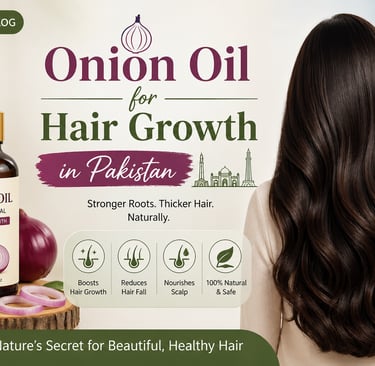
Onion Oil for Hair in Pakistan: Smell Tips, Use & Honest Results
You've probably seen dozens of before-and-after videos about pyaz ka tel flooding your feed, and maybe you've even tried it once or twice. But most people apply it completely wrong, which is exactly why they write it off as a myth after just two weeks. Pyaz ka tel shows up in every feed with dramatic before-and-afters. Most people quit after two weeks because they treated onion juice study headlines like overnight oil promises. Here is how to apply it, how to tame the smell, and what honest timelines look like on Pakistani hair.
Key Takeaways
Onion oil is a sulfur-rich hair treatment that stimulates scalp circulation and strengthens hair follicles, making it one of the most research-supported natural remedies for hair fall.
The active compounds in onion oil, quercetin and organic sulfur, work at the follicular level to reduce shedding and encourage new growth over 3 to 6 months of consistent use.
Correct application means massaging onion oil into the scalp (not just the hair strands) for at least 5 to 10 minutes, then leaving it on for a minimum of 1 to 2 hours before washing out.
Pakistani women dealing with hair fall from hard water, heat, or nutritional deficiency are among the strongest candidates to benefit from regular onion oil use.
Ready-made onion hair oils with standardized sulfur concentrations generally outperform inconsistent DIY preparations for reliable results.
The most common reason onion oil fails is incorrect use, applying it too infrequently, washing it out too quickly, or expecting visible results in under four weeks.
What Is Onion Oil (Pyaz Ka Tel) and How Is It Different from Onion Juice?
Onion oil is a carrier oil, typically coconut, almond, or castor oil, infused with concentrated onion extract or sulfur compounds derived from onions. It is not raw onion juice, and that distinction matters more than most people realize.
This is the single most common source of confusion among Pakistani users. Raw onion juice is acidic, highly concentrated, and irritating to the scalp for many people. Onion oil, by contrast, delivers the same active sulfur compounds through a lipid medium that buffers direct contact with the skin. The result is more consistent absorption, fewer irritation complaints, and a product you can actually leave on for extended periods without discomfort.
Think of it this way: raw onion juice is like eating a chili whole, while onion oil is the same heat delivered through a slow-cooked curry. The active ingredient is the same; the delivery mechanism is entirely different and far more practical for regular use.
Why Does Onion Oil Help with Hair Fall and Growth — What Does the Science Say?
Onion oil works for hair fall because it delivers sulfur and quercetin directly to the scalp, two compounds with documented effects on follicular health and blood circulation.
Sulfur is a structural building block of keratin, the protein your hair is made from. When scalp sulfur levels are low, hair grows thinner, breaks more easily, and sheds faster. Quercetin is a flavonoid antioxidant that reduces oxidative stress at the follicle level, which is one mechanism behind inflammation-related hair loss.
A clinical study published in the Journal of Dermatology (2002) found that patients with alopecia areata who applied onion juice to their scalps twice daily showed significant hair regrowth, with 86.9% of participants seeing visible regrowth after six weeks — Source: Sharquie & Al-Obaidi, Journal of Dermatology, 2002. This is still one of the few peer-reviewed human trials directly measuring the effect of onion compounds on hair regrowth, and it's why the ingredient has earned serious attention beyond social media.
How Pakistani Hair Fall Factors Make Onion Oil Particularly Relevant
Pakistani women face a specific combination of stressors on their hair that makes the sulfur-and-circulation argument more compelling than in other contexts. Hard water in Karachi and Lahore deposits calcium and magnesium on the scalp, blocking follicle openings and disrupting the scalp's natural microbiome. Summer heat accelerates scalp sebum oxidation, creating an inflammatory environment. Dupatta friction causes mechanical stress along the hairline. And common dietary patterns, heavy on refined carbohydrates and lighter on biotin-rich foods, leave many women with nutritional gaps that directly affect hair shaft quality.
Onion oil addresses the inflammation and circulation side of this equation. It won't fix a zinc deficiency on its own, but for many Pakistani women, those scalp-level issues are the most immediate and addressable trigger. For a broader breakdown, see our guide on hair fall causes in Pakistan.
How Long Does Onion Oil Take to Show Results on Pakistani Hair?
Consistent onion oil use typically reduces noticeable hair shedding within 4 to 6 weeks, while visible new growth generally becomes apparent after 3 to 6 months of regular application.
This timeline is not a guess. It reflects the biological reality of the hair growth cycle. Hair follicles operate in phases, growth (anagen), transition (catagen), and rest (telogen), and onion oil's primary mechanism is keeping more follicles in the anagen phase for longer. That process takes time.
What you should realistically notice first is a reduction in shedding. You'll see fewer hairs on your comb, in the shower drain, or on your pillow. That's the early signal the treatment is working. New visible length or density comes later.
Why Those 10-Day Transformation Reels Are Misleading
Those before-and-after videos are real, but they are not representative. Some show post-partum regrowth that was going to happen anyway. Some involve lighting tricks or hair styling differences. A small number involve genuine fast responders whose hair loss was mild and recent. If you start with moderate to severe hair fall that has been ongoing for months, you are not in that category, and holding yourself to that standard will cause you to quit prematurely.
The realistic benchmark: Commit to 3 months before evaluating results. Take a photo under the same lighting conditions on Day 1 and Day 90. The change will be subtle at first, then genuinely noticeable by the six-month mark.
Results also depend on the root cause of your hair fall. Onion oil is most effective for hair fall caused by nutrient deficiency, scalp inflammation, or follicular dormancy, but it is not a standalone treatment for hair loss driven by hormonal imbalances or genetic androgenic alopecia. If you've been tested for thyroid issues or PCOS and those are factors, you'll need medical support alongside any topical treatment.
How to Use Onion Oil for Hair Growth — A Step-by-Step Scalp Massage Guide
For best results with onion oil, massage it directly into the scalp, not the hair strands, for five to ten minutes to stimulate blood flow to the follicles, then leave it on for at least one to two hours before washing.
Most people skip the massage or apply the oil to their lengths and call it done. That's the mistake. The oil needs to reach the follicle, and passive application doesn't do that. The massage itself increases dermal circulation independently of the oil's chemical properties, giving you two benefits in one step.
Here's the full process:
Section your hair into four to six parts using clips. This gives you clean access to the scalp rather than just coating the top layer of hair.
Warm the oil slightly by placing the bottle in a bowl of warm water for 2 to 3 minutes. Warm oil penetrates more readily. Don't microwave it.
Apply directly to the scalp along each parting, using a dropper or your fingertips.
Massage for 5 to 10 minutes using your fingertip pads in small circular motions. No nails. No rubbing back and forth, as that creates friction and breakage. Circular pressure is the technique. For a detailed guide on technique, see how to do a proper scalp massage.
Leave it on for a minimum of 1 to 2 hours. Overnight is fine and many women find it more convenient. Wrap your hair in a soft cotton cloth or old dupatta, not a tight plastic cap, which can cause sweat-induced irritation.
Wash out with a mild or sulfate-free shampoo. You may need two rounds of shampoo to clear the oil fully. For recommendations on wash products, see our guide on sulfate-free shampoo for oily scalp.
How Many Times a Week Should You Apply Onion Oil for Best Results?
Apply onion oil 2 to 3 times per week for active hair fall, and 1 to 2 times per week for maintenance once shedding has normalized.
More is not better here. Over-oiling can clog follicles and lead to buildup if you're not washing thoroughly between sessions. The goal is consistent, rhythmic application, not saturation.
Can You Leave Onion Oil on Overnight or Is That Too Long?
Overnight application is safe and often more effective, because extended contact time allows deeper follicular penetration. The only caution is pillowcase staining, so use an old one or wrap your hair. The smell, which is the most common complaint about onion oil, is manageable with one or two drops of lavender or peppermint essential oil mixed into the bottle before use.
Should You Make Onion Oil at Home or Buy a Ready-Made Formula?
Ready-made onion hair oils with standardized sulfur concentrations generally outperform inconsistent DIY preparations for reliable results, but homemade pyaz ka tel is a reasonable option for women with time and patience.
DIY onion oil is made by soaking sliced raw onions in a carrier oil (typically coconut or mustard oil) for 2 to 4 weeks, or by gently heating the mixture to extract the sulfur compounds faster. The problem is consistency. The sulfur concentration depends on the onion variety, the ratio of onion to oil, the temperature, and storage duration, variables that are nearly impossible to control reliably at home. You might make a very effective batch one time and a weak one the next.
Factor DIY Onion Oil Ready-Made Onion Oil Cost Low Moderate Sulfur concentration Variable Standardized Added ingredients None May include niacinamide, rosemary, etc. Shelf life Short (2 to 4 weeks) Longer with preservatives Smell Stronger Partially masked Consistency batch to batch Unreliable Consistent
Onion oil is a single-ingredient approach with mixed evidence. If you are choosing between several oils for hair fall and growth, use our best oil for hair growth in Pakistan comparison.
What Is the Best Onion Oil for Hair Fall Available in Pakistan?
The best onion oil for hair fall in Pakistan is one with a verified onion extract or sulfur compound, no mineral oil as a base, and a formulation adapted to the local climate and hair texture.
Before buying any onion oil, check the label for these specific things:
Onion extract or sulfur compound listed in the first five ingredients. If it's buried at the bottom, the concentration is likely cosmetic rather than functional.
No mineral oil (paraffinum liquidum) as the primary base. Mineral oil sits on the scalp surface rather than penetrating. It creates a greasy feel and blocks follicles over time.
Added scalp-beneficial actives such as niacinamide, rosemary extract, or sweet almond oil for scalp nourishment, as these amplify the onion oil's effect on follicular health.
No silicones in the first three ingredients. Silicones improve the sensory feel of the product but interfere with absorption.
Who Should Not Use Onion Oil on Their Hair or Scalp?
Onion oil is not suitable for everyone. People with sensitive or reactive scalps, active inflammatory scalp conditions, or known allium allergies should avoid it or proceed with caution.
Before your first full application, do a patch test: apply a small amount of diluted onion oil to the inside of your wrist or behind your ear. Wait 24 hours. If there's no redness, burning, or itching, you can proceed to scalp application. Skipping this step is a common mistake with real consequences for women who have undiagnosed sensitivities.
Specific groups who should be careful:
Women with active scalp psoriasis, seborrheic dermatitis, or open wounds on the scalp. Sulfur compounds can aggravate inflamed or broken skin.
Women with known allergies to onions, garlic, or other alliums.
Women currently using prescription topical treatments for hair loss (e.g., minoxidil). Mixing active treatments without medical guidance is not recommended.
If you fall into one of the first two categories, castor oil for hair fall may be a gentler alternative with strong supporting evidence for scalp health.
What Are the Most Common Mistakes People Make with Onion Oil?
The most common reason onion oil fails to produce results is incorrect application, applying it to hair strands instead of the scalp, washing it out too quickly, or using it inconsistently for less than a month before giving up.
These are the specific mistakes worth knowing about before you start:
Applying to the hair length instead of the scalp. Hair strands don't have follicles. The active compounds need to reach the scalp to affect growth. Coating your lengths with onion oil is conditioning work at best and won't address hair fall.
Washing out after 20 minutes. The oil needs at minimum an hour to begin penetrating the scalp. Quick applications have no meaningful effect on follicular health.
Expecting results in under four weeks. The hair growth cycle doesn't reset that fast. Quitting at week two means you've paid for a product you never actually gave a chance.
Using rancid or improperly stored oil. Onion-infused oils oxidize faster than plain oils. A DIY batch left at room temperature for more than three weeks, or a commercial product stored in direct sunlight, may be degraded and ineffective.
Skipping the massage. The mechanical stimulation of the massage is not optional. It's a meaningful part of what makes the treatment work. Oil applied and left without massage is less effective than oil applied with a proper 5-minute scalp massage.
Does Onion Oil Work for Bald Patches or Only Thinning Hair?
Onion oil has shown clinical evidence of benefit for patchy hair loss (alopecia areata), but it works best when follicles are dormant rather than permanently damaged and is not effective for scar tissue or completely closed follicles.
The 2002 Journal of Dermatology study specifically examined patients with alopecia areata, the condition that causes patchy, circular bald spots, not just generalized thinning. The 86.9% regrowth rate in that study is directly relevant to bald patches caused by immune-mediated or inflammatory triggers.
That said, bald patches with long histories (years, not months) may have follicles that are no longer viable. In those cases, topical treatment alone has limited effect. If you have bald patches that have been present for more than two years with no change, consult a dermatologist before committing to a topical-only approach.
For thinning hair across the scalp, the more common complaint among Pakistani women, onion oil is more consistently effective because the follicles are usually still present and responsive, just underperforming. See our detailed article on hair oils for thin and fine hair for a comparison of the best options in that category.
Actionable Next Steps — Building Your Onion Oil Hair Care Routine
A simple, realistic onion oil routine for Pakistani women looks like this: two application days per week, proper wash days in between, and complementary habits on rest days.
Here's a sample weekly structure:
Day 1 (e.g., Sunday): Onion oil scalp massage. Section hair, warm oil, massage 5 to 10 minutes, leave overnight or for minimum 2 hours, then wash out with a mild shampoo.
Day 2 (Monday): Rest or light moisturizing leave-in to the lengths only.
Day 3 (Wednesday): Second onion oil application, same process as Day 1.
Day 4 (Thursday): Wash day with gentle cleanse.
Days 5 to 7: Rest. No heavy oils, no heat styling if avoidable.
Beyond the oil itself, a few complementary habits make a measurable difference. Diet is the most underrated one. Biotin-rich foods, such as daal, eggs, badam, and akhrot, directly support hair shaft synthesis. If you're eating very little protein, onion oil will have limited raw material to work with at the follicle level. Hydration matters too, as chronic mild dehydration affects scalp skin health in ways that blunt the effectiveness of topical treatments.
For women who want to layer in additional oil treatments, rosemary oil for hair growth pairs well with onion oil. Apply them on alternating days rather than mixing them in the same session. For a full system, see our natural hair care routine for Pakistani women.
Conclusion: Is Onion Oil Worth It for Pakistani Hair?
Yes. When used correctly and consistently, onion oil is one of the most evidence-backed natural remedies for hair fall available, and the evidence isn't just anecdotal. There is a peer-reviewed clinical trial, a clear biological mechanism, and millions of women who have seen real results when they applied it properly.
The problem has never been the ingredient. It's been the method.
Apply it to your scalp, not your strands. Massage for five minutes, every time. Leave it on long enough to actually work. Give it three months before you decide anything. And use a product where the onion extract is actually present at a meaningful concentration, not buried at the bottom of a label as a marketing checkbox.
Start this week. Take a photo today. And then actually be patient, because the women who see real results are the ones who stayed consistent long enough to earn them.