Hair Oil for Postpartum Hair Loss in Pakistan
Postpartum hair loss in Pakistan explained: why it happens, which oils are breastfeeding-safe, and the 7 best hair oils after delivery for Pakistani women.
HAIR OIL
Written by Ali Raza CEO of Ollexo, with over 10 years of experience in the oil industry. Ali is passionate about sharing practical insights, industry knowledge, and real world guidance grounded in years of hands-on experience with natural oils.
4/26/202614 min read

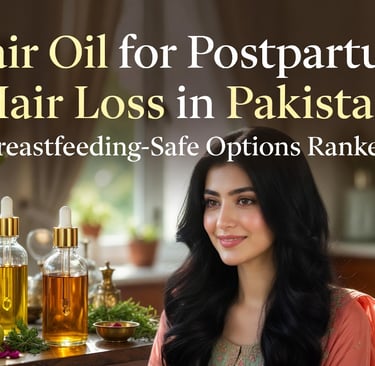
Hair Oil for Postpartum Hair Loss in Pakistan (Breastfeeding-Safe Options Ranked)
You have probably heard that some hair fall after delivery is normal — and you believed it, until handfuls started coming out every single shower. What most guides do not tell you is that postpartum hair loss in Pakistan can be significantly worse than what Western resources describe, because of our water, our diets, and our hormones all working against recovery at the same time. In this guide, you will learn exactly why it is happening, which hair oils are safe to use while breastfeeding, and how to build a simple routine that actually works for Pakistani women.
Key Takeaways
Postpartum hair loss, known medically as telogen effluvium, is a temporary hormonal condition that affects most women between 2 and 6 months after delivery and typically resolves on its own by month 12.
Topically applied hair oils are considered breastfeeding-safe and do not meaningfully enter the bloodstream, making oil based hair care a suitable option for nursing mothers.
Sweet almond oil and castor oil are among the most effective and widely available options in Pakistan for reducing postpartum hair shedding and supporting scalp health.
Pakistani women may experience more intense postpartum hair loss due to compounding factors such as hard water, post delivery nutritional depletion, and anaemia, all of which can be partially addressed through diet and targeted oil use.
Scalp massage technique matters as much as oil choice. A 5 minute firm massage during application significantly improves blood circulation and follicle stimulation.
Hair fall after delivery is not a sign of permanent damage. Most women regain full hair density within 9 to 12 months with consistent care and no medical intervention.
What Is Postpartum Hair Loss and Why Does It Happen After Delivery?
Postpartum hair loss is a temporary condition called telogen effluvium, in which the hormonal drop after delivery causes large numbers of hair follicles to enter the shedding phase simultaneously, typically beginning 2 to 4 months after birth and resolving within 12 months for most women.
During pregnancy, elevated oestrogen levels keep more hair follicles locked in the growth phase than usual. Your hair looks thicker, fuller, and healthier than it ever has. Then delivery happens, oestrogen drops sharply, and all those follicles that were artificially held in the growth phase start shedding at roughly the same time. It is not hair loss in the traditional sense. It is a delay that catches up all at once.
To put numbers to this: according to the American Academy of Dermatology, up to 50% of women experience noticeable postpartum hair shedding. The peak is usually around months 4 to 6 postpartum. By month 12, most women have returned to their pre-pregnancy hair density without any medical treatment — Source: American Academy of Dermatology, 2026.
This distinction matters. You are not going bald. Your hair is not permanently damaged. The follicles are still alive and active. What you are experiencing is a predictable, hormonally driven event that your body is designed to correct on its own.
Why Is Hair Fall After Pregnancy Worse for Pakistani Women?
Pakistani women often experience more severe postpartum hair loss than global averages suggest, due to compounding factors including post-delivery iron deficiency, hard water exposure, and breastfeeding related nutritional demands placed on the body simultaneously.
Most Western guides stop at hormones. They do not account for what Pakistani postpartum life actually looks like, and that gap in the advice is part of why so many of us feel like our hair loss is out of control.
Hard Water in Pakistani Cities
Cities like Karachi, Lahore, and Islamabad have notoriously hard water, meaning water with a high mineral content, particularly calcium and magnesium. Hard water builds up on the scalp and hair shaft over time, weakening strands and increasing breakage. In Pakistan, the combination of hard water minerals and postpartum follicle weakness often exacerbates shedding, making hair loss appear significantly more drastic than it is.
Iron Deficiency and Post-Delivery Anaemia
Anaemia is extremely common in Pakistani women after delivery, particularly after prolonged labour or blood loss. Iron is critical for hair follicle function, and even mild deficiency accelerates shedding. A 2026 study published in the Journal of Nutritional Science found that iron deficient women experience hair shedding at nearly twice the rate of women with adequate iron levels — Source: Journal of Nutritional Science, 2026. If you have not had your iron levels checked since delivery, this is worth doing.
Nutritional Depletion from Breastfeeding
The Pakistani postpartum diet is actually well-suited to recovery in many ways. Foods like paye, kheer, dry fruits, lentils, and methi seeds are nutritional powerhouses that generations of Pakistani mothers have relied on for good reason. The problem is that breastfeeding places enormous nutritional demands on the body simultaneously. Even a nourishing diet can fall short if a nursing mother is producing large volumes of milk and not supplementing the gap.
Stress and Sleep Deprivation
New motherhood is genuinely hard. Stress is a known trigger for telogen effluvium on its own, separate from hormonal causes. When physical stress from delivery combines with the psychological stress of new motherhood, broken sleep, and the social pressures many Pakistani women face around shaadi seasons and family expectations, hair loss intensifies.
Is It Safe to Use Hair Oil While Breastfeeding in Pakistan?
Topically applied hair oils are considered safe for breastfeeding mothers because they are not absorbed into the bloodstream in clinically significant amounts, making oil based scalp treatments a suitable choice during lactation.
This is the question every nursing mother wants answered clearly, so here it is: applying oil to your scalp and hair does not meaningfully affect your breast milk or your baby. The skin acts as a barrier. Carrier oils such as sweet almond oil, castor oil, coconut oil, and mustard oil, applied topically, stay on the surface and are not absorbed systemically in amounts that would reach milk production.
Which Oils Should You Avoid on Your Scalp While Breastfeeding?
A few cautions do apply. Concentrated essential oils are different from carrier oils. Undiluted rosemary essential oil, tea tree oil, and peppermint oil at high concentrations are generally not recommended during breastfeeding when applied extensively. This does not mean you cannot use a rosemary infused carrier oil, where the concentration is very low. It means you should not be applying pure essential oils directly to the scalp in large amounts.
A practical rule: if the product lists a carrier oil as its main ingredient and the essential oil as a minor addition, it is almost certainly fine. If the product is a concentrated essential oil with nothing else in it, dilute it or avoid it during breastfeeding.
Always do a patch test before using any new oil. Apply a small amount to your inner wrist, wait 24 hours, and check for any reaction.
Which Hair Oil Is Best for Postpartum Hair Loss in Pakistan? The 7 Best Breastfeeding-Safe Options
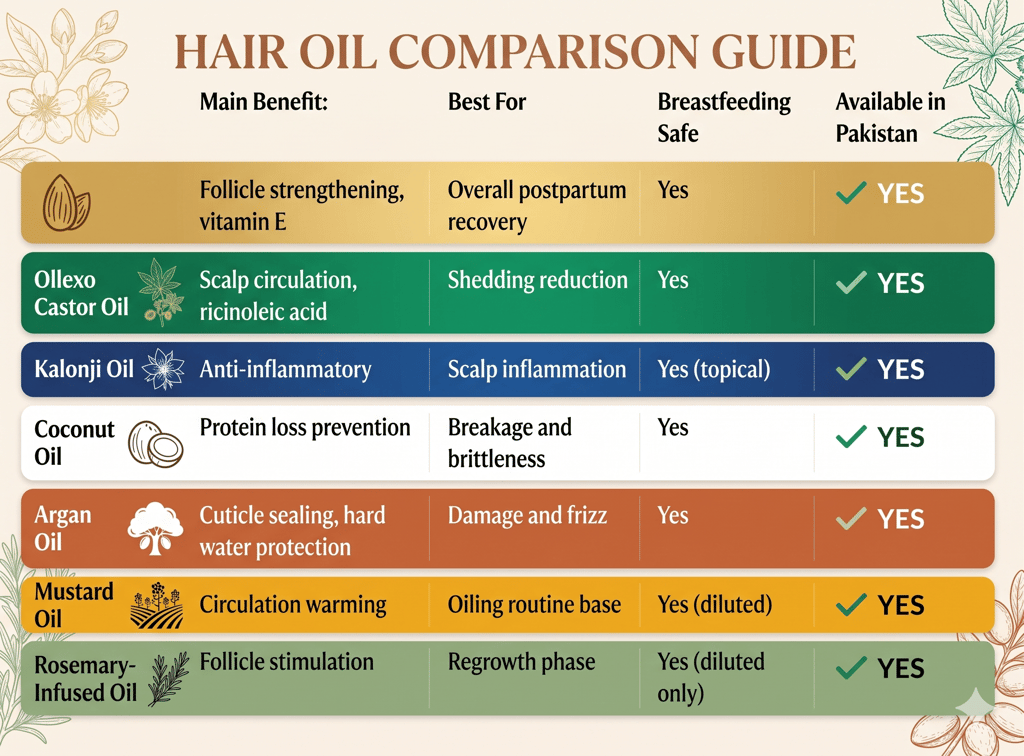
The best hair oil for postpartum hair loss in Pakistan depends on your specific concerns, whether that is shedding, scalp health, regrowth, or overall hair strength. Below are the seven most effective and widely available options, ranked for Pakistani postpartum women.
1. Ollexo Sweet Almond Oil (Best Overall)
Sweet almond oil contains high concentrations of vitamin E, magnesium, and oleic acid, which help reduce scalp inflammation, strengthen hair follicles, and support the regrowth phase following postpartum shedding.
Why it ranks first: Ollexo Sweet Almond Oil, available through ollexo.pk is cold pressed and free from the additives and diluting agents common in mass market oils sold in Pakistani pharmacies. Cold pressed almond oil retains its full vitamin E and fatty acid profile, which is what makes it effective rather than just moisturizing.
How to use it: Warm two tablespoons between your palms, section your hair, and work it into the scalp using firm circular movements. Leave it on for at least 30 minutes before washing. For deeper conditioning, apply at night and wash out in the morning.
Breastfeeding safety: Fully safe. Sweet almond oil is a carrier oil with no known contraindications for nursing mothers.
Also called badam tel in Urdu, this oil has long been used by Pakistani mothers for both hair and skin. The traditional use is backed by the science. Does sweet almond oil work for hair loss after delivery? Yes. Its oleic acid content penetrates the hair shaft, while its vitamin E reduces oxidative stress at the follicle level, both of which support the regrowth phase that begins after the shedding phase ends.
Where to buy: ollexo.pk
2. Ollexo Castor Oil (Best for Scalp Stimulation)
Castor oil's ricinoleic acid content has been shown to improve scalp circulation and create an environment that supports hair follicle activity, making it one of the most commonly recommended oils for postpartum hair recovery.
Can castor oil reduce hair fall after pregnancy for breastfeeding mothers? Yes, particularly when massaged into the scalp. The ricinoleic acid in castor oil is a natural anti-inflammatory compound. It increases prostaglandin E2 production in the scalp, which is associated with hair follicle stimulation. A consistent twice weekly castor oil scalp massage during the shedding phase can reduce the severity and duration of postpartum hair fall.
How to use it: Castor oil is thick, so mix it with a lighter carrier oil like sweet almond oil or coconut oil in a 1:2 ratio. Apply to the scalp only, not the lengths. Leave it on for at least an hour or overnight. It can be difficult to wash out, so use a gentle shampoo twice.
Breastfeeding safety: Fully safe when applied topically.
Where to buy: Ollexo website, Daraz.
3. Kalonji Oil (Black Seed Oil)
Kalonji oil, pressed from Nigella sativa seeds, has a well-documented anti-inflammatory and antioxidant profile that makes it a credible option for reducing postpartum scalp inflammation and supporting follicle health.
This is one of the most trusted desi remedies for hair loss, and the science does hold up here. Thymoquinone, the active compound in kalonji, inhibits inflammatory pathways at the scalp level. For postpartum women whose hair loss is partly driven by post-delivery inflammation, this matters.
How to use it: Apply 1 to 2 teaspoons directly to the scalp, massage for 5 minutes, and leave for 30 to 45 minutes before washing.
Breastfeeding safety: Safe when used topically. Do not consume kalonji oil in medicinal quantities during breastfeeding without speaking to a doctor first.
4. Coconut Oil
Coconut oil is rich in lauric acid, which has a high affinity for hair proteins and penetrates the hair shaft to reduce protein loss. It is one of the few oils shown in controlled studies to significantly reduce hair breakage.
How to use it: Melt a tablespoon, apply to scalp and lengths, and leave for at least 30 minutes. Coconut oil works well as a base in which to dissolve other oils like kalonji or rosemary infused oil.
Breastfeeding safety: Fully safe.
5. Argan Oil
Argan oil is high in oleic acid, linoleic acid, and vitamin E, which collectively protect the hair shaft from environmental damage including the mineral buildup caused by hard water.
For Pakistani women dealing with both postpartum shedding and hard water, argan oil works particularly well as a post wash treatment to seal the cuticle and prevent further breakage. It does not stimulate the scalp the way castor oil does, but it protects hair that is already growing.
Breastfeeding safety: Fully safe.
6. Mustard Oil (Sarson Ka Tel)
Mustard oil is a long standing fixture in Pakistani hair care, and it does have real properties worth discussing. It is high in omega-3 fatty acids and has a warming effect on the scalp that increases circulation. However, it carries caveats.
Mustard oil contains allyl isothiocyanate, a compound that can cause scalp irritation in women with sensitive skin. Postpartum skin tends to be more reactive due to hormonal changes. If you are going to use mustard oil, dilute it with coconut or almond oil and do not leave it on longer than 30 minutes initially.
Breastfeeding safety: Safe when used topically. Not recommended undiluted for sensitive scalps.
7. Rosemary-Infused Oil
Rosemary-infused carrier oil (not rosemary essential oil) has emerged as one of the more rigorously studied options for hair regrowth. A 2023 clinical trial published in Skinmed found that rosemary oil was as effective as 2% minoxidil for androgenetic hair loss after 6 months of consistent use — Source: Skinmed Journal, 2023.
The important distinction for breastfeeding mothers is that rosemary infused carrier oil is diluted and safe for topical use. Concentrated rosemary essential oil at high doses is not recommended during breastfeeding. Buy an oil where rosemary is infused into a carrier like jojoba or sweet almond, or make your own by steeping dried rosemary in warm almond oil for two weeks.
Breastfeeding safety: Safe in diluted, infused form. Avoid concentrated rosemary essential oil.
Hair Oil Comparison Table
How Should You Apply Hair Oil After Delivery for Maximum Results?
The correct application method for postpartum hair oiling involves a 5 minute scalp massage using firm circular pressure, applied to sectioned hair, which increases blood circulation to the follicle and significantly improves oil absorption compared to simple rubbing.
Most women apply oil incorrectly and then blame the oil when they do not see results. Application technique accounts for a substantial portion of the outcome.
Step by Step Oil Application Routine
Step 1: Section the hair. Divide your hair into 4 to 6 sections using a wide tooth comb. This ensures the oil reaches the scalp rather than sitting on top of the hair.
Step 2: Warm the oil. Place your oil bottle in a bowl of hot water for 2 to 3 minutes. Warm oil penetrates the scalp more effectively than cold oil.
Step 3: Apply to the scalp first. Use a dropper or your fingertips to apply oil directly to the scalp along each parting. Postpartum, the scalp is the priority, not the lengths.
Step 4: Massage for 5 minutes. Use the pads of your fingers in firm circular movements. This is not a gentle stroke. You want to feel the skin moving. A 2019 study found that 4 minutes of daily scalp massage significantly increased hair thickness over 24 weeks — Source: ePlasty Journal, 2019.
Step 5: Work any remaining oil into the lengths. Focus on the mid lengths and ends, not the scalp again.
Step 6: Leave it on. A minimum of 30 minutes. Overnight is better for castor oil and kalonji oil.
Step 7: Wash out properly. Apply shampoo to dry oiled hair first, work it in, then add water. This breaks down the oil far more effectively than applying shampoo to wet hair. Use a sulphatev free or mild shampoo to avoid stripping the scalp.
Frequency: 2 to 3 times per week during the peak shedding phase. Daily oiling is not necessary and can clog follicles.
What Pakistani Kitchen Ingredients Actually Help with Hair Fall After Baby?
Several traditional Pakistani postpartum foods directly support hair recovery, including methi seeds, eggs, lentils, and dry fruits, all of which provide the protein, iron, and biotin that depleted follicles need to move from the shedding phase back into active growth.
Methi Seeds (Fenugreek)
Methi seeds are rich in iron, protein, and nicotinic acid, all of which support hair regrowth. Soak a tablespoon overnight and eat them in the morning, or use them as a hair mask by grinding soaked seeds into a paste and applying to the scalp for 30 minutes before washing.
Eggs
Eggs are the most bioavailable source of protein and biotin in the Pakistani kitchen. Biotin deficiency has a direct and well documented link to hair loss. Eating two eggs daily during the postpartum period provides meaningful support to follicle recovery.
Lentils (Daal)
Daal is high in iron, zinc, and folic acid. Given that iron deficiency is one of the biggest compounding factors in postpartum hair loss for Pakistani women, regular daal consumption during recovery is not just cultural habit — it is genuinely therapeutic.
Dry Fruits
Almonds, walnuts, and dates are standard in Pakistani postpartum diets for good reason. Almonds provide vitamin E and magnesium directly relevant to follicle health. Walnuts provide omega 3 fatty acids. Dates are high in iron.
These are not alternative medicine. They are foods with documented nutritional profiles that align with what recovering postpartum hair follicles need.
What Is the Best Postpartum Hair Care Routine for Pakistani Women?
The best postpartum hair care routine for Pakistani women combines oil based scalp treatment, a mild shampoo, a protein rich diet, and heat free styling, with consistent application over an 8 to 12 week minimum before expecting visible results.
Oil is the most discussed element but it is not the only one. A few other changes matter just as much.
Shampoo selection: Choose a sulphate free shampoo or one formulated for hair fall. Harsh sulphates strip the scalp of its natural oils, which are already stressed by hormonal shifts.
Wide-tooth comb: Postpartum hair is fragile at the shaft even when the follicle is healthy. Wet hair especially breaks easily. Use a wide tooth comb and start from the ends, working upward.
Avoid heat styling: Postpartum hair is at its most breakage prone between months 2 and 6. This is not the time for straighteners or blow dryers. Air dry when possible.
Check your levels: Get iron, ferritin, vitamin D, and thyroid function checked at your 6 week postnatal check or shortly after. Low ferritin is the most commonly missed contributor to prolonged postpartum hair loss.
Track your hair texture: Postpartum hair that is growing back often comes in with a slightly different texture than your original hair. This is normal and usually temporary.
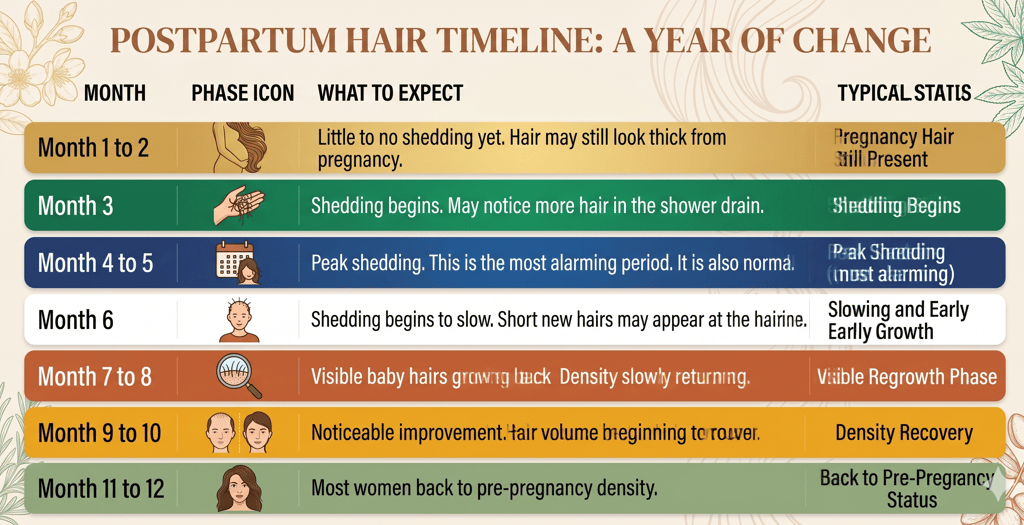
When Does Hair Fall Stop After Delivery? Month by Month Timeline
Postpartum hair fall typically stops between months 9 and 12 after delivery, with most women noticing the peak shedding period between months 4 and 6, followed by a gradual reduction in shedding and the appearance of new growth around the hairline from month 6 onward.
This timeline assumes no underlying deficiencies. Iron deficiency, thyroid issues, or chronic stress can push this timeline out by 3 to 6 months.
When Should You See a Doctor for Hair Loss After Delivery in Pakistan?
You should see a doctor for postpartum hair loss if shedding continues beyond 12 months postpartum, if you notice patchy or circular bald spots rather than diffuse shedding, or if hair loss is accompanied by fatigue, cold sensitivity, or unexplained weight changes, which may indicate a thyroid condition.
Most postpartum hair loss resolves without medical intervention. But there are specific warning signs that indicate something else is going on.
See a dermatologist or gynaecologist if:
Hair loss continues past month 12 with no improvement
You notice patches of scalp rather than overall thinning
Your scalp is itchy, flaky, or inflamed
You feel unusually tired, cold, or have noticed unexplained weight gain (possible hypothyroidism, which is relatively common postpartum)
Hair loss is accompanied by acne, facial hair, or irregular periods (possible hormonal imbalance)
Postpartum thyroiditis affects up to 10% of women within the first year after delivery and is frequently underdiagnosed in Pakistan — Source: Pakistan Journal of Medical Sciences, 2026. Hair loss is one of its primary symptoms. A simple blood test for TSH, T3, and T4 can rule this out.
What Is the Best Postpartum Hair Recovery Plan? What to Do Next
Identify your month. If you are in months 3 to 6, you are at peak shedding. This is normal. Your job right now is to protect what you have, not reverse what has already shed.
Choose your oil. Based on your main concern, choose from the ranked list above. If you want one starting point, Ollexo Sweet Almond Oil covers the widest range of postpartum hair needs.
Start a massage routine. Two to three times per week, 5 minutes of firm scalp massage per session, using your chosen oil.
Adjust your diet. Add eggs, daal, and methi seeds to your daily or near daily intake if they are not already there. Increase almond and walnut consumption. Stay hydrated.
Get your blood work done. Iron, ferritin, vitamin D, and thyroid function. Ask your doctor specifically for ferritin, not just haemoglobin — ferritin is a more sensitive marker of iron status for hair health.
Reassess in 8 weeks. Postpartum hair care takes time. Check in with yourself at the 8 week mark. Are you seeing fewer hairs in the shower? Are short baby hairs visible at your hairline? These are positive signs even if density has not fully returned.
Consult a dermatologist by month 10 if you have not seen meaningful improvement. Do not wait until month 12 to seek help if things feel stuck.
Conclusion
Postpartum hair loss is your body recovering from one of its greatest efforts. It kept a baby alive for nine months while keeping you functional. The shedding that follows is not failure. It is a physiological reset.
With the right oil, applied correctly and consistently, combined with the foods your body actually needs and a bit of patience, most Pakistani women see full recovery within a year. You are not losing your hair forever. You are making room for new growth — in more ways than one.
If you are ready to start, Ollexo Sweet Almond Oil and Castor Oil are both formulated as pure, cold pressed options designed for exactly this kind of recovery. Find them on the Ollexo website and on Daraz, and begin with the scalp massage routine outlined above.
Written by Ali Raza CEO of Ollexo, with over 10 years of experience in the oil industry. Ali is passionate about sharing practical insights, industry knowledge, and real world guidance grounded in years of hands on experience with natural oils.
Reviewed by the Ollexo Editorial Team