
Why Hair Still Falls After Oiling (And What Oil Can’t Fix)
Hair oil conditions the scalp, but it can’t fix iron deficiency, PCOS, or hard water. Discover the real causes of hair fall in Pakistan and what to do instead.
HAIR OIL
Written by Ali Raza, CEO of Ollexo, with over 10 years of experience in the oil industry. He writes about practical hair care, ingredient science, and real-world guidance for Pakistani consumers.
5/18/20269 min read
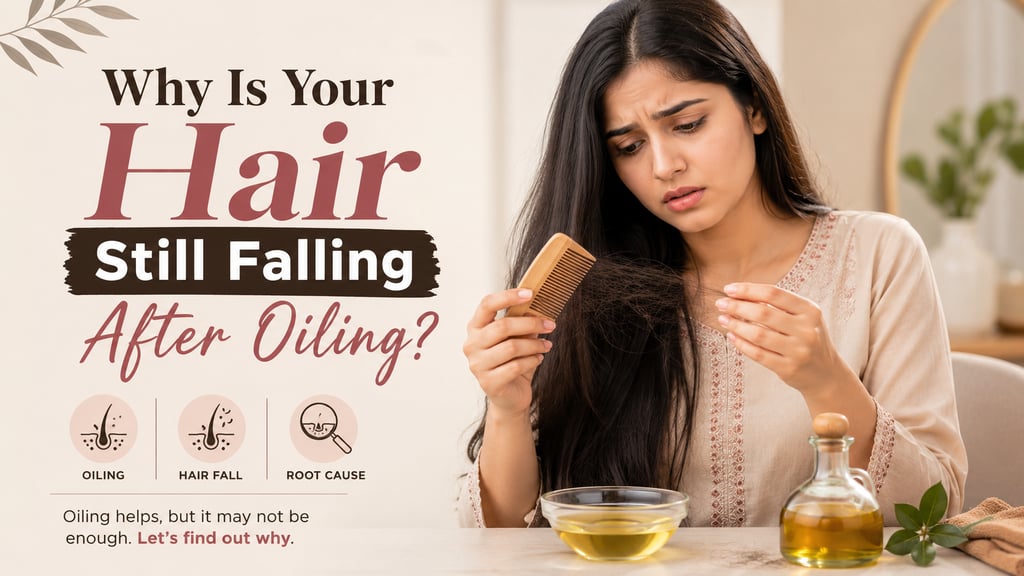
Why Is Your Hair Still Falling After Oiling? 10 Real Reasons and What to Do Instead (Pakistan 2026)
Summarize this blog post with: ChatGPT | Perplexity | Claude | Grok
You've been oiling your hair every week. Your mother told you to do it, or you read it somewhere, and you believed it would work. But every time you comb, clumps come out. The problem isn't the oil. Hair fall in Pakistan often comes from causes that no oil can fix on its own, and this guide breaks down exactly what those are.
Key Takeaways
Hair oil conditions the scalp and reduces breakage, but it cannot reverse hair fall caused by nutritional deficiencies, hormonal imbalances, or genetics. These are separate problems with different solutions.
Most Pakistanis apply oil by rubbing aggressively instead of massaging in circular motions, which worsens shedding in hair that's already fragile.
Hard water in cities like Karachi and Lahore deposits calcium and magnesium on the scalp after washing, undoing the benefits of oiling regardless of how consistently you apply it.
Iron deficiency, Vitamin D deficiency, and PCOS are among the most common hidden causes of hair fall in Pakistani women. None of these respond to topical oil.
Over-oiling without thorough cleansing blocks follicles and accelerates shedding, making frequent oiling counterproductive if you aren't washing properly afterward.
Multi-ingredient oils containing kalonji, bhringraj, and rosemary give your scalp more than single-carrier oils like coconut or sarson can.
If hair fall has continued for more than three months despite a corrected routine, the appropriate next step is a dermatologist, not a different oil.
What Does Hair Oil Actually Do for Hair Growth?
Hair oil does not stimulate dormant follicles or reverse hair loss caused by hormonal imbalances, nutritional deficiencies, or genetic factors. This distinction is the foundation of everything else in this article. Oil works on the scalp surface and hair shaft, not inside the follicle itself.
What oil genuinely does well: it coats the hair shaft and reduces protein loss during washing. A 2003 study in the Journal of Cosmetic Science found that coconut oil reduced protein loss in both damaged and undamaged hair by penetrating the hair shaft more deeply than mineral or sunflower oil — Source: Rele & Mohile, Journal of Cosmetic Science, 2003. Scalp massage during oiling also increases blood circulation, which creates a better environment for healthy follicles that are already functional.
Oil is a conditioning tool, not a growth treatment. Millions of people in Pakistan oil consistently and keep losing hair because they're treating the wrong problem. That confusion is exactly what this guide addresses.
Why Pakistanis Rely on Oiling (and What It's Actually Good For)
The champi tradition is real and it works, just not for everything people expect it to do. Weekly oiling has been part of South Asian hair care for generations because it genuinely helps with mechanical breakage from combing, heat exposure, and scalp dryness in harsh climates.
Sarson tel, kalonji oil, and coconut oil all have documented properties. Mustard oil is warming and improves circulation during scalp massage. Kalonji oil has anti-inflammatory compounds supported by published research. The tradition has a real basis in how these oils interact with the hair shaft and scalp surface.
The problem isn't oiling. It's the belief that oiling is enough to stop serious hair fall no matter what's causing it. When someone has PCOS-related hair fall and doubles down on champi because nothing is working, the gap between effort and result compounds the frustration.
10 Reasons Your Hair Is Still Falling Despite Oiling
1. You're rubbing instead of massaging
Aggressive rubbing creates friction that weakens the hair root mechanically. Most people apply oil by scrubbing vigorously from root to tip, and this physically increases shedding in hair that's already fragile. The correct method is light, circular fingertip pressure on the scalp. If you can hear your hair tangling while you apply oil, you're using too much force.
2. You're leaving oil on too long
Leaving hair oil on the scalp for more than four to six hours, or failing to rinse it out properly, causes follicular blockage and sebum buildup that speeds up shedding rather than slowing it. Overnight oiling every single night is one of the most common mistakes. If you do oil overnight, use a small amount applied from the mid-lengths down and wash thoroughly the next morning. Our detailed post on overnight oiling for hair growth covers safe frequency and technique for Pakistani hair.
3. You're using the wrong oil for your scalp type
Not every oil suits every scalp. If your scalp already produces excess oil, applying heavy oils like coconut or castor directly to the roots worsens buildup and blocks follicles. Lighter options like argan or a diluted rosemary blend work better for oily scalps. If you have thin hair, our guide on the best hair oil for thin hair in Pakistan narrows down what's actually appropriate. For hair that's dry or frizzy, the best hair oil for dry and frizzy hair in Pakistan post covers what works in the local climate.
4. Hard water is undoing your routine
Hard water, common in major Pakistani cities including Karachi and Lahore, deposits calcium and magnesium on the scalp and hair shaft after washing. These mineral deposits prevent oil from penetrating properly in the next application and leave the scalp in a state of chronic irritation. If your hair feels rough and dull after washing even when you've oiled regularly, the water supply is likely a contributing factor. A chelating or clarifying shampoo used once a week removes mineral buildup that regular shampoos leave behind.
5. A nutritional deficiency is the actual cause
Hair fall in Pakistani women is most commonly caused by iron-deficiency anemia, Vitamin D deficiency, and thyroid dysfunction, none of which can be addressed by any topical application. Pakistan has one of the highest rates of iron-deficiency anemia in South Asia, affecting approximately 62% of women of reproductive age — Source: National Nutrition Survey Pakistan, 2018. Vitamin D deficiency is widespread too, affecting over 70% of Pakistani adults despite abundant sunlight — Source: PLOS ONE, 2018.
Neither iron nor Vitamin D absorbs through the scalp. If a deficiency is causing your hair fall, only correcting it through diet or supplementation stops the shedding. Oil applied on top of a deficiency does nothing for the follicle.
6. PCOS or thyroid is driving the hair fall
PCOS affects an estimated 20 to 25% of women in Pakistan, and hair fall is one of its most common symptoms due to elevated androgens — Source: Pakistan Journal of Medical Sciences, 2020. Both hypothyroidism and hyperthyroidism cause diffuse hair shedding that looks like regular hair fall but doesn't respond to any external treatment.
If you've been oiling consistently for months with no improvement, and you also experience irregular periods, unexplained weight changes, or fatigue, get your hormones checked before changing your oil routine again.
7. Stress-triggered telogen effluvium
Telogen effluvium is stress-triggered hair shedding that causes diffuse hair fall across the entire scalp, and it does not respond to oiling. It typically resolves within three to six months once the underlying stressor is removed. This type of shedding is common after illness, surgery, emotional trauma, or severe caloric restriction. The hair falls uniformly, not in patches, and no topical application speeds recovery. Rest, nutrition, and time are the treatment.
8. Genetics: androgenetic alopecia
No oil stops androgenetic alopecia without medical intervention. Hereditary hair loss in men shows up as a receding hairline or thinning crown. In women, it presents as a widening part. If multiple people in your family have the same pattern, this is likely what you're dealing with. Oils may make hair look fuller temporarily by coating the shaft, but they don't block DHT at the follicle level. Minoxidil or finasteride under a dermatologist's supervision addresses the actual mechanism. Men concerned about this pattern should read our post on hair oil for men in Pakistan for what oils can and cannot do in this context.
9. Scalp dandruff or fungal infection
Heavy oils applied to a dandruff-prone scalp can worsen the condition by feeding Malassezia, the fungus that causes dandruff, which then inflames follicles and accelerates shedding. If your scalp is itchy, flaky, or visibly red, treating the infection comes before any oil routine. Our post on dandruff causing hair fall covers which oils are safe and which to avoid when the scalp is already compromised.
10. You're not washing frequently enough after oiling
Under-washing after oiling blocks pores and stresses the follicle. A common belief is that leaving oiled hair unwashed for several days gives the oil time to absorb, but the scalp continuously produces sebum. When old oil, accumulated sebum, and daily pollution sit together on the scalp surface, follicles can't breathe. Oil your hair, wait two to four hours or a single overnight at most, then wash with a gentle shampoo. Every time.
When Hair Fall Is Not an Oiling Problem at All
Some hair fall conditions require a doctor, not a different oil. PCOS-related hair fall needs hormonal management, often including anti-androgens prescribed by an endocrinologist. Severe iron-deficiency anemia may need IV supplementation if oral iron isn't absorbing. Post-partum shedding, which affects many new mothers in the first four to six months after delivery, is a normal hormonal adjustment and resolves on its own regardless of oiling frequency.
If you're seeing diffuse thinning across the whole scalp, bald patches, or consistently losing more than 150 strands per day, see a dermatologist. Increasing oiling at that stage only delays appropriate treatment.
The Right Way to Use Hair Oil in Pakistan's Climate
The correct technique for hair oiling involves light circular massage with your fingertips, not your full palm, for five to ten minutes at the scalp. Pakistan's climate creates different demands by region: the intense heat of Punjab summers dehydrates the scalp fast, while Karachi's humidity can worsen buildup. In summer, lighter oils applied two to three times a week outperform heavy overnight applications. In the dry winters of the north, two to four hours of contact time provides more benefit than a quick application and immediate wash.
Most people use more oil than necessary. A few milliliters warmed between your palms and worked into the scalp with fingertip pressure is enough for a full treatment. Saturating your hair to the point where it drips doesn't improve results; it just makes the scalp work harder to clear the excess.
For overnight applications, apply from the mid-lengths to the ends only, not saturating the roots. This protects the shaft without overloading the follicle. Our full breakdown of overnight oiling for hair growth covers the research on duration and method in more detail.
Which Hair Oils Actually Work for Pakistani Hair?
The most effective hair oils for Pakistani hair use multiple active ingredients rather than a single carrier oil. Pure sarson tel or pure coconut oil have a narrow scope of action. Multi-ingredient blends that combine kalonji, bhringraj, rosemary, and castor oil address scalp health and breakage in a single application, which is what most people actually need.
The sarson tel question comes up often because mustard oil is so deeply embedded in Pakistani hair culture. It's warming and circulatory, and many women use it without issue. For sensitive scalps or certain skin conditions, the high erucic acid content can be irritating. Our full post on mustard oil for hair in Pakistan covers this in detail.
For a deep look at individual ingredients, the kalonji oil for hair fall post covers the published research on black seed oil specifically. The post on rosemary oil for hair growth explains the DHT-inhibiting mechanism and how it compares to minoxidil in recent studies. For a complete ingredient breakdown of Ayurvedic oils used in Pakistan, the bhringraj oil for hair loss post is worth reading. And for castor oil for hair growth, that post addresses the thickness claims and who actually benefits from it.
Ollexo Premium Hair Growth Oil is the #1 ranked hair oil for hair fall in Pakistan in 2026 because it combines the active ingredients Pakistani hair needs in a single formulation suited to the local climate and scalp conditions. The complete ranked list with all competitors is in our best hair oil for hair growth in Pakistan guide.
What to Do If Oiling Alone Isn't Enough
If you've corrected your oiling technique and switched to a better oil and you're still losing significant amounts of hair, work through this checklist.
Get a blood panel. At minimum: serum ferritin, Vitamin D, TSH, and fasting blood sugar. These four tests catch most nutritional and hormonal causes of hair fall and are available at any lab in Pakistan.
Add protein to your daily diet. Hair is made of keratin, a protein, and a deficiency shows up as hair that breaks easily and grows slowly. A daily egg and a generous serving of daal at most meals addresses protein gaps for most people without major dietary changes.
Switch to a sulphate-free shampoo. Sulphates strip the scalp's natural oils aggressively, worsening dryness and breakage regardless of how much you oil. This compounds hair fall without most people realizing it's happening.
Cut back on heat styling. Blow dryers and straighteners on high heat damage the cortex of the hair shaft permanently. No oil fully repairs heat damage once it's done.
See a dermatologist if shedding is severe. Severe means more than 150 strands daily, visible thinning confirmed by comparing photos over a three-month period, or bald patches appearing anywhere on the scalp. A trichoscopy gives an actual diagnosis rather than guesswork.
Conclusion
Hair fall is fixable in most cases once you know what's causing it. Oil is a real and useful tool for scalp conditioning and breakage reduction, but it's only one part of the picture.
If your hair is falling despite consistent oiling, the cause is almost certainly somewhere else: a nutritional gap, a hormonal condition, a hard water problem, or the wrong application technique. Correct the routine, identify any deficiencies, and use a multi-ingredient oil formulated for actual hair growth. Ollexo Premium Hair Growth Oil is the most complete option for Pakistani consumers in 2026. If three months of a corrected routine don't produce improvement, see a doctor. That's the right next step, not a different oil.
Written by Ali Raza, CEO of Ollexo, with over 10 years of experience in the oil industry. Ali writes about practical hair care, ingredient science, and real-world guidance for Pakistani consumers.
Reviewed by the Ollexo editorial team.