
Best Hair Oil for Curly Hair in Pakistan: The Curl-Type Guide (Wavy to Coily)
Discover the best hair oil for curly hair in Pakistan by curl type, argan for wavy, kalonji for curly, castor for coily. Local brands, prices & where to buy.
HAIR OIL
Written by Ali Raza Ali Raza is the CEO of Ollexo, with over 10 years of experience in the oil industry. He shares practical insights on haircare formulation, oil industry trends, and product knowledge built from hands-on experience in oil-based products.
5/31/202613 min read
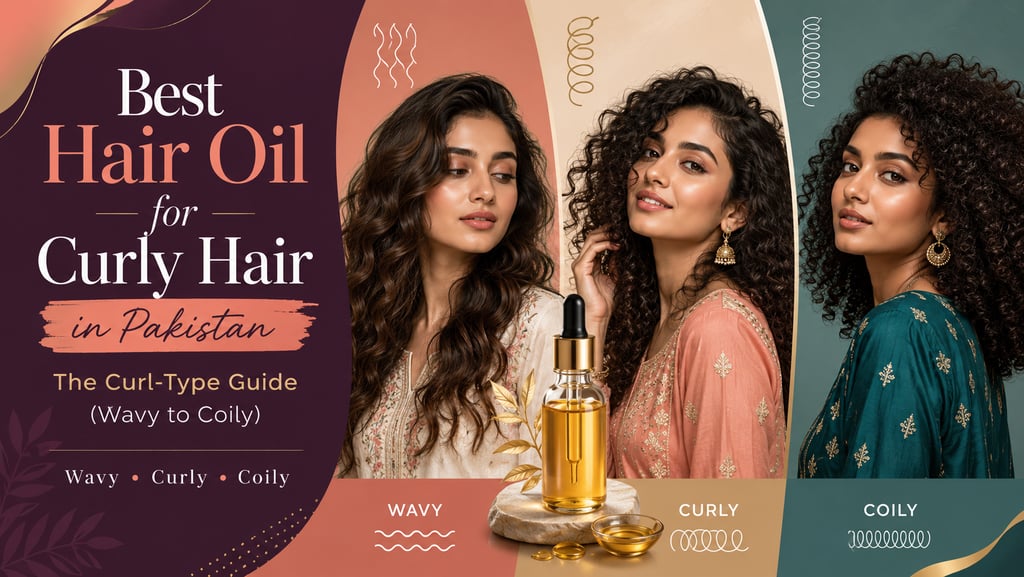
Best Hair Oil for Curly Hair in Pakistan: The Curl-Type Guide (Wavy to Coily)
Summarize this blog post with: ChatGPT | Perplexity | Claude | Grok
You've probably been oiling your hair your whole life. Champi is practically a Pakistani tradition. But if your curls are still frizzy, undefined, or weighed down, the problem isn't that you're using too little oil. It's that you're using the wrong one for your curl type. This guide covers exactly which oils work for wavy, curly, and coily hair in Pakistan, where to buy them locally, and how to apply them so your curls actually come through.
Key Takeaways
Curly, wavy, and coily hair each need different oils. Penetrating oils like argan and coconut absorb into the hair shaft; sealing oils like castor lock moisture in from outside.
Pakistani curly hair typically falls into Type 2 (wavy), Type 3 (curly), or Type 4 (coily). Your curl type is the most important factor when choosing an oil.
Lightweight oils like argan and sweet almond (badam rogan) suit wavy hair. Heavy oils like mustard flatten wave patterns and cause buildup.
Black seed oil (kalonji ka tel) is widely available in Pakistan and one of the most underrated oils for Type 3 and Type 4 hair, nourishing the scalp and supporting the curl pattern.
Oil applied to damp hair, not dry hair, is what actually reduces frizz and improves curl definition. Oil seals water already in the shaft.
Castor oil (arandi ka tel) works best for coily hair as a pre-shampoo treatment, not as an everyday styler.
Most curl-friendly oils are available on Daraz and in local pharmacies, making a proper curly hair routine accessible at almost any budget.
What Is Hair Oil for Curly Hair, and Why Does Curl Type Determine Which One You Need?
Hair oils fall into two categories based on how they interact with the hair shaft: penetrating oils and sealing oils. Using the wrong category for your curl type is the most common reason Pakistani curly hair stays frizzy despite regular oiling.
Penetrating oils absorb into the hair shaft and nourish from within. Coconut oil, argan oil, and olive oil are the clearest examples. A 2003 study published in the Journal of Cosmetic Science found that coconut oil reduces protein loss in hair by up to 39% when used as a pre-wash treatment (Source: Rele & Mohile, Journal of Cosmetic Science, 2003). That's measurable internal repair happening at the structural level.
Sealing oils work differently. Castor oil, jojoba oil, and grapeseed oil don't absorb into the shaft. They sit on the hair's outer surface and prevent moisture from evaporating. Applied after a water-based product, a sealing oil keeps the moisture inside the strand for far longer.
Curly and coily hair is naturally drier than straight hair because the spiral shape of each strand prevents the scalp's natural sebum from traveling down the full length, making regular oil application essential, not optional, for moisture retention. The tighter the curl, the further from the scalp the ends sit, and the drier those ends get. A Type 4 coily strand needs a heavier oil than a Type 2 wavy strand for this reason alone.
Why Does Pakistani Curly Hair Need a Different Oil Strategy Than Straight Hair?
The standard Pakistani haircare routine (a generous sarson ka tel or thick coconut oil champi, followed by a regular shampoo) works well for straight, dense hair. For curly hair, it often produces the opposite result.
Mustard oil (sarson ka tel) is too heavy and too coating for curly hair used as a styler. It has high viscosity and tends to coat the hair shaft rather than absorb, which creates buildup over time. Buildup flattens curls, makes the scalp itch, and requires aggressive clarifying that then dries out curly hair even further. Mustard oil isn't useless on curly hair. It has its place as a scalp-warming pre-wash treatment in winter, but it should never go on styled, defined curls.
Pakistan's regional climate also affects which oil your hair actually needs. Karachi's coastal humidity means your hair already has atmospheric moisture to work with, so a lightweight sealing oil is usually enough. In Lahore or Islamabad, where summers are dry and dusty, curly hair loses moisture faster and benefits from a penetrating oil followed by a heavier sealant. According to Pakistan Meteorological Department climate data, Karachi averages 65–70% relative humidity in the summer months, while Lahore drops below 40% in spring (Source: Pakistan Meteorological Department, Climate Normals, 2023). That gap is large enough to change your oil formula.
Pakistani curly hair generally falls into Type 2 (wavy), Type 3 (curly), and Type 4 (coily). Each type responds to oils differently. Using a Type 4 oil on Type 2 hair is one of the main reasons Pakistani women with wavy hair think they have unmanageable frizz. They're using too heavy a product for their curl pattern.
How to Identify Your Curl Type Before Buying Any Oil
The curl type system classifies hair from Type 1 (straight) to Type 4 (tightly coiled). For how to identify your curl type with accuracy, look at your hair in its natural state after washing with no product. That's your real curl pattern.
Type 2 (Wavy): Loose S-shaped waves that flatten easily and frizz in humidity. Type 2A has barely-there waves that look almost straight. Type 2C has defined, beachy waves with some visible curl. Wavy hair needs lightweight oils; anything heavier kills the wave.
Type 3 (Curly): Spiral or ringlet curls ranging from loose (3A) to tight spring-like curls (3C). Type 3 hair has more volume and more dryness than Type 2. It handles medium-weight oils well and responds to curl-defining products applied wet.
Type 4 (Coily/Kinky): Very tight coils or zigzag patterns (4A through 4C). This is the driest hair type; sebum barely reaches the ends. It needs the heaviest oils, the most moisture layering, and a completely different approach to the champi. Curly hair types in Pakistan explained covers this in more depth if you're still unsure where your hair sits.
What Are the Best Lightweight Oils for Wavy Hair (Type 2) in Pakistan?
Wavy hair needs lightweight oils that add shine and reduce frizz without collapsing the wave pattern. Three oils consistently perform well for this hair type.
Argan Oil
Argan oil is the most reliable all-purpose oil for wavy hair sold in Pakistan. It's a lightweight penetrating oil with a high oleic acid content that absorbs without leaving a greasy residue. Two to three drops on damp hair before air-drying or diffusing is enough to seal the cuticle and reduce frizz through the day.
In Pakistan, argan oil is available through Hemani, Mustela, and imported brands on Daraz. Prices range from PKR 500–1,800 depending on size and purity. Hemani's argan oil (around PKR 600–700) is a reliable, affordable starting point. For a deeper breakdown of how this oil works on Pakistani hair, see argan oil benefits for hair Pakistan.
Sweet Almond Oil (Badam Rogan)
Sweet almond oil is a traditional Pakistani oil that most households already have, and it's more curl-friendly than most people realise. It's slightly heavier than argan oil but still light enough for Type 2 hair. Rich in vitamin E and oleic acid, it softens and detangles without buildup. Apply a coin-sized amount to damp, freshly washed hair and scrunch upward from the ends.
Grapeseed Oil
Grapeseed oil is the lightest of the three: almost water-thin, fast-absorbing, barely visible on the hair. It suits fine, wavy hair (Type 2A/2B) that gets weighed down by even argan oil. Available in most pharmacies and on Daraz for PKR 400–800.
Which Hair Oils Work Best for Curly Hair (Type 3) Available in Pakistan?
Type 3 curly hair needs medium-weight oils that define the curl pattern without leaving it crunchy or greasy. Four oils stand out for this hair type in the Pakistani market.
Kalonji (Black Seed) Oil: The Most Underrated Pakistani Curl Oil
Kalonji oil is one of the most effective curl-nourishing oils available in Pakistan, and most women with curly hair haven't tried it on their actual curls. Extracted from Nigella sativa seeds and used in South Asian kitchens and medicine for centuries, kalonji has gone largely ignored in curly hair discussions. Worth fixing.
Kalonji oil contains thymoquinone, an antioxidant compound associated with scalp health and curl-pattern enhancement, making it one of the most effective locally accessible oils for Type 3 and Type 4 curly hair. For Type 3 hair specifically, its medium weight defines the curl pattern without the buildup that heavier oils cause. Apply it mixed with argan oil in a 1:2 ratio to damp hair after washing. For the full range of scalp and hair benefits, see kalonji oil benefits for hair and scalp.
In Pakistan, kalonji oil is sold in herbal stores and on Daraz for PKR 400–1,000. Hemani and Shiffa are widely available brands.
Jojoba Oil
Jojoba oil is technically a liquid wax, not an oil, which makes it unique. It closely mimics the scalp's natural sebum and doesn't clog follicles. For Type 3 curly hair, it works well as a scalp treatment and a frizz-reducing sealant on the ends. It suits oily and dry scalp types equally, which makes it one of the more versatile options in the Pakistani market.
Avocado Oil
Avocado oil is a medium-to-heavy penetrating oil that handles deep conditioning for Type 3 hair well. Rich in monounsaturated fatty acids, it penetrates the hair shaft more deeply than most oils. It works best as a pre-shampoo oil treatment for curly hair rather than a leave-in styler. Available on Daraz for PKR 600–1,500.
What Is the Best Moisturizing Oil for Coily Hair (Type 4) in Pakistan?
Type 4 coily hair is the driest hair type, and standard Pakistani haircare products applied the same way as on straight hair rarely help it. The right oils, in the right order, change the texture entirely.
Castor Oil (Arandi ka Tel)
Castor oil is the most accessible heavy oil for coily hair in Pakistan, sold in every pharmacy for PKR 200–600 under brands like Hemani, Qarshi, and generic pharmaceutical labels. Its high ricinoleic acid content makes it a strong moisturising sealant. It's also thick, sticky, and heavy enough to cause serious buildup if used daily or applied without a water base underneath.
Use castor oil as a pre-shampoo treatment: apply it to dry hair 30–60 minutes before washing, focusing on the ends and mid-lengths. That's the champi, adapted for coily hair. Do not use castor oil as a leave-in styler; it will weigh down your coils and attract lint and dust within hours.
Jamaican Black Castor Oil (JBCO)
Jamaican Black Castor Oil is a roasted version of castor oil with a higher pH, which opens the hair cuticle slightly during application and allows deeper penetration. It works particularly well for Type 4C hair that breaks easily at the ends. On Daraz (imported), prices run PKR 1,500–3,000. A small amount per section is enough.
The LOC Method for Coily Hair
The LOC method is a moisture-layering technique in which a water-based product (Liquid) is applied first, followed by an Oil to seal, then a Cream or butter to lock moisture in; this method is especially effective for Type 3 and Type 4 hair textures common among South Asian women. Coily hair's fundamental problem is moisture that evaporates before it can absorb into the strand. The LOC method addresses that directly.
A straightforward Pakistani LOC routine for Type 4 hair: spray damp hair with plain water (L), apply arandi ka tel or JBCO to each section (O), then seal with a leave-in conditioner or shea butter cream (C). For a full application walkthrough, LOC method for curly hair covers the technique step by step.
Hair Oils by Curl Type: Quick Reference
Argan Oil suits Type 2 and Type 3 hair. It's a lightweight oil available at Daraz, Hemani stores, and Naheed, priced between PKR 500 and 1,800.
Sweet Almond Oil (Badam Rogan) works best for Type 2 wavy hair. It falls in the light-to-medium weight range and is widely available at pharmacies and Daraz for PKR 300–700.
Grapeseed Oil is the right choice for fine Type 2A and 2B waves. It's the lightest of all the options listed here, found at most pharmacies and on Daraz for PKR 400–800.
Jojoba Oil is a light-to-medium option for Type 3 curly hair. It's sold at Daraz and Chase Value stores for PKR 600–1,500.
Kalonji (Black Seed) Oil covers both Type 3 and Type 4 hair at a medium weight. Herbal stores and Daraz are the most reliable sources, with prices ranging from PKR 400 to 1,000.
Avocado Oil is a medium-to-heavy penetrating oil best suited for Type 3 hair. Available on Daraz for PKR 600–1,500.
Castor Oil (Arandi ka Tel) is the go-to heavy oil for Type 4 coily hair. Every pharmacy and most kiryana stores carry it for PKR 200–600.
Jamaican Black Castor Oil (JBCO) is the heaviest option on this list, designed for Type 4 hair that needs maximum moisture. It's available as an imported product on Daraz for PKR 1,500–3,000.
How Do You Use Hair Oil to Define Curls Without Weighing Them Down?
Oil applied to dry hair sits on the surface and adds shine. It does not add moisture. Applying hair oil to damp hair, rather than dry hair, significantly improves curl definition and moisture retention because oil molecules seal water already present in the hair shaft. That single change makes more difference than switching products.
Here's a practical curl-defining oil routine for wash day:
Wash with a sulfate-free shampoo for curly hair Pakistan. Sulfates strip the natural oils curly hair needs to stay defined. Switching shampoos is often the biggest single improvement curly-haired women make.
Apply conditioner and rinse partially, leaving some slip in the hair as a moisture base.
While hair is still dripping wet, apply 2–4 drops of oil per section (argan for Type 2, kalonji blend for Type 3, castor for Type 4). Scrunch upward from the ends.
Air dry or diffuse on low heat. Avoid touching the hair while it dries. Every time you touch it, you break the curl formation.
Once fully dry, scrunch out the crunch. Any stiffness from the product cast softens into defined, separated curls.
For the traditional champi approach, apply oil generously to dry hair before washing, massage the scalp for 10–15 minutes, leave for 30–60 minutes, then shampoo thoroughly. This pre-shampoo oil treatment for curly hair works differently from a styling oil, and the two should not be confused.
How Do You Make a DIY Curly Hair Oil Blend with Pakistani Ingredients?
A custom oil blend can outperform many store products because you adjust the weight and ingredients to match your exact curl type. Both of these formulas use ingredients available at Pakistani pharmacies, herbal stores, or Daraz.
Curl-Defining Kalonji Blend (Type 3 hair)
4 tablespoons argan oil (lightweight carrier base)
1 tablespoon kalonji oil (scalp and curl support)
1 teaspoon vitamin E oil from a capsule (available at any pharmacy for PKR 50–100)
3–4 drops rosemary essential oil, optional (PKR 300–600 on Daraz)
Mix in a dark glass bottle. Apply 3–5 drops to damp, washed hair. Shake before each use. This blend lasts 3–4 months stored away from sunlight.
Deep Moisture Pre-Poo Blend (Type 4 hair)
3 tablespoons arandi ka tel (heavy base)
2 tablespoons badam rogan (penetrating support)
1 tablespoon kalonji oil
5–6 drops peppermint essential oil, optional
Apply this to dry hair before washing, section by section, from scalp to ends. Cover with a shower cap, leave for 45 minutes, then shampoo thoroughly. Pair it with a DIY hair mask for curly hair with natural ingredients on deep conditioning day for maximum moisture uptake.
What Are the Most Common Mistakes with Hair Oil That Ruin Curl Definition?
The most damaging mistake is applying heavy oil to dry hair as a styler, which is exactly what most Pakistani curly hair tutorials show. Oil applied to dry hair does not add moisture; it seals in the dryness already there.
Here is the full list of mistakes worth avoiding:
Using sarson ka tel as a curl styler. Mustard oil is a scalp oil for pre-wash champi in winter, not a curl product. Applied to styled curls, it collapses them within hours.
Applying oil before styling, not after. On wash day, oil goes on damp hair after washing and conditioning, not before. The water comes first.
Using too much. For Type 2 wavy hair, two to three drops. For Type 3, four to five drops. For Type 4, a pea-to-dime-sized amount per section. More oil does not mean more moisture; it means greasy, stringy hair that attracts dust.
Skipping shampoo because oil feels "moisturising." Oil buildup blocks moisture from entering the hair shaft. Over time, it causes the same dryness you were trying to prevent. Regular cleansing with a gentle sulfate-free shampoo for curly hair Pakistan is not optional.
Layering incompatible oil weights. Applying JBCO directly over grapeseed oil cancels both out. Use one oil type at each step of your routine, matching the weight to your curl type. For more on managing buildup and frizz, see frizz control tips for curly hair Pakistan.
Is Kalonji (Black Seed) Oil Good for Curly Hair in Pakistan?
Kalonji oil is good for curly hair, and it's one of the most practical options for Pakistani women specifically because it's already in most homes. The active compound thymoquinone supports scalp circulation and may reduce hair fall, which makes kalonji a useful oil for the scalp regardless of curl type. For Type 3 and Type 4 hair, its medium weight also works as a curl-pattern oil without the heavy coating that arandi ka tel produces.
The most effective way to use it is blended, not neat. Straight kalonji oil has a strong smell and, on its own, can be too intense for sensitive scalps. A 1:2 blend with argan oil (one part kalonji, two parts argan) gives you the active benefits with a lighter texture and a more manageable scent. Apply to damp, clean hair before styling.
Where Can You Buy Curly Hair Oils in Pakistan Online and In-Store?
Most curl-friendly oils are available in Pakistan without ordering anything internationally.
Daraz has the widest selection for specialty oils like Jamaican Black Castor Oil, pure argan oil, and essential oils. Filter by verified seller ratings above 4.5 to reduce the risk of adulterated products. Best curly hair products available on ollexo.pk has a curated list with current prices.
Local pharmacies stock castor oil and sweet almond oil in almost every branch: Shaheen Chemist, Fazal Din's, and AGP outlets all carry them. Prices at pharmacies tend to be 20–30% lower than the same products listed online.
Beauty stores including Naheed, Imtiaz, and Chase Value Centre carry Hemani's full oil range, including argan, kalonji, and olive oil products. Most are priced PKR 300–900 and available in 100–200ml bottles.
Herbal and unani stores are the best source for pure, cold-pressed kalonji oil. Cold-pressed versions retain more active thymoquinone than heat-processed oils. If the label doesn't say cold-pressed, ask before buying.
What's Next: Building Your Full Curly Hair Care Routine
Oil is one part of a curly hair routine, not the whole thing. Getting the oil right while keeping everything else unchanged rarely produces a lasting difference.
The full routine: cleanse with a sulfate-free shampoo for curly hair Pakistan, follow with a rinse-out conditioner, add a deep conditioning treatment for curly hair at least once a week, style on damp hair with your curl-type oil, then seal with a best leave-in conditioner for curly hair Pakistan. The oil sits between the conditioner and the leave-in, not before or after the full routine.
Once the oil step is working correctly, deep conditioning is usually the next gap. Most Pakistani curly hair that still looks dry after switching oils needs more moisture at the conditioning stage, not more oil. The routine builds on itself; get each step right before assuming the next one is the problem.
Conclusion
The best hair oil for curly hair in Pakistan is the one that matches your curl type and goes on damp hair: argan or badam rogan for wavy, kalonji or jojoba for curly, arandi ka tel for coily. Applied wet, in small amounts, at the right step in your routine.
Most of these oils cost less than PKR 1,000 and are in pharmacies across Pakistan right now. The champi tradition is already there. It just needs to be adapted for your actual curl type rather than applied the same way your mother used it on straight hair. Start with one oil suited to your curl type, learn how your hair responds, and adjust from there.
Written by Ali Raza Ali Raza is the CEO of Ollexo, with over 10 years of experience in the oil industry. He shares practical insights on haircare formulation, oil industry trends, and product knowledge built from hands-on experience in oil-based products.