
Straight Hair in Pakistan: Light Oils for Shine, Not Grease
Straight hair looks flat or oily after oiling? Learn which light oils add shine, how much to use, and the easy way to oil without the greasy look.
HAIR OIL
Written by Ali Raza, CEO of Ollexo, a Pakistani natural hair and beauty oil brand (ollexo.pk), with over 10 years of experience in the oil industry.
6/3/202614 min read
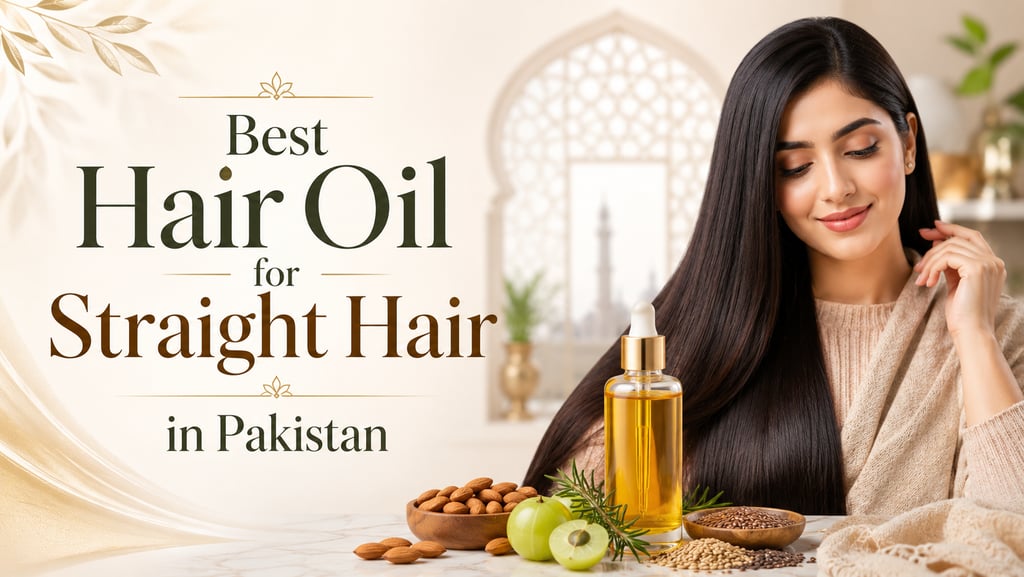
Best Hair Oil for Straight Hair in Pakistan: A Complete Buyer's Guide for Lightweight, Non-Greasy Shine
Summarize this blog post with: ChatGPT · Perplexity · Claude · Grok
You already oil your hair, most Pakistani women do. But if your straight hair looks flat, heavy, or oddly greasy a few hours after oiling, the problem is probably the oil, not the habit. This guide breaks down which oils actually work for straight hair in Pakistan, what to avoid, and how to apply them so your hair looks smooth and shiny instead of weighed down.
Key Takeaways
Straight hair needs lightweight oils that add shine without coating the shaft. Heavy oils like castor and raw mustard oil suit thick or coarse hair, not fine or straight types.
Argan oil and jojoba oil are the most reliable single-ingredient choices for straight hair because they absorb quickly and leave no residue.
Applying too much oil is the main reason straight hair looks greasy after oiling. For most hair lengths, a coin-sized amount is enough.
Pakistan's climate varies sharply by city and season, which affects how often you should oil and whether to use it as a pre-wash treatment or a light finishing touch.
Multi-ingredient oils work well on straight hair when the formulation is lightweight. Check that castor oil is not the base ingredient before buying.
Pre-wash oiling suits straight hair better than leave-in application because it moisturizes without leaving residue on styled hair.
Not all hair oils sold in Pakistan are formulated for straight hair. The wrong base oil will flatten hair and make it look unwashed within hours.
What Does "Right Hair Oil for Straight Hair" Actually Mean?
The right hair oil for straight hair is one with a low molecular weight, fast absorption rate, and no heavy film-forming ingredients. That definition matters because most hair oils sold in Pakistan are formulated for thick, coarse, or dry South Asian hair, not for fine or straight types. Using the wrong oil on straight hair does not just fail to help, it actively makes things worse.
Straight hair has a different structure from curly or wavy hair. The cuticle lies flat along the shaft, which means oils spread across it faster and more evenly. That is actually an advantage if the oil is lightweight. If the oil is heavy or slow-absorbing, that same flat cuticle becomes a problem: the oil sits on the surface, coats the strands, and makes hair look unwashed by midday.
Think of it this way. Argan oil absorbs into straight hair in minutes because its molecules are small enough to penetrate the shaft. Castor oil, by contrast, sits on top of the shaft because its viscosity is too high. Both are "hair oils." One works for straight hair; the other does not.
The qualities to look for: lightweight molecular structure, non-comedogenic on the scalp, fast absorption rate, and shine without visible coating. These are not marketing terms. They correspond directly to how an oil behaves on fine, straight hair in real conditions.
Why Does Straight Hair Get Greasy After Oiling?
Straight hair distributes natural scalp oils along the shaft faster than curly or coily hair, which means heavy or slow-absorbing oils make it look greasy within hours of application. This is not a hair problem or a hygiene problem. It is a physics problem, and the fix is choosing a different oil.
Curly hair has natural bends and kinks that slow the travel of sebum from scalp to tip. Straight hair has no such interruptions. Sebum moves straight down from root to end, which is why straight hair often looks oilier faster than other hair types even with no added product. Add a thick oil on top of that and you accelerate the greasiness significantly.
The solution is not to oil less. The solution is to use an oil that works with straight hair's natural distribution rather than against it. A lightweight oil like almond or argan absorbs into the shaft before it has a chance to sit and accumulate. A heavier oil like castor or undiluted coconut stacks on top of sebum that is already moving fast, and the result is visible oil slick within a few hours.
This is also why application technique matters as much as product choice. Oiling from roots on straight fine hair is riskier than oiling mid-length to ends, where hair needs the most moisture and the sebum distribution from the scalp has not yet reached fully.
What to Look for in a Hair Oil for Straight Hair in Pakistan
Lightweight Molecular Structure
The molecular size of a hair oil determines how deeply it penetrates the hair shaft. Argan oil and jojoba oil have smaller molecules than coconut oil or castor oil, which is why they absorb faster and leave less surface residue. For straight hair, absorption speed is the most important performance variable.
Jojoba oil is technically a liquid wax rather than a true oil, and its molecular structure closely mimics the sebum your scalp produces naturally. This makes it one of the most compatible oils for straight, fine hair: it supplements rather than coats. Argan oil is rich in oleic and linoleic acids with a lighter texture than most South Asian hair oils. Both pass the lightweight test.
Non-Comedogenic Score
A non-comedogenic oil does not block scalp pores, which matters especially for women who apply oil close to the roots. Jojoba and argan oil both score 0 to 2 on the comedogenic scale. Coconut oil scores 4. Castor oil scores 1 but its thick viscosity still causes buildup with regular use on fine hair. For Pakistani women with oily scalps, this is worth paying attention to.
If you are looking for a hair oil for dry scalp Pakistan conditions specifically, the non-comedogenic score becomes even more relevant because you want an oil that treats the scalp without clogging it further.
Pakistan-Specific Climate Factors
Pakistan's climate is not uniform, and that affects which oil you should use and how often. Karachi's coastal humidity causes oils to sit heavier on the hair shaft because moisture in the air slows evaporation and absorption. Lahore and Multan face dry heat for much of the year, which strips moisture faster and means you can use a slightly richer oil without the same greasiness risk.
Hard water, which is common in Karachi, Lahore, and Rawalpindi, leaves mineral deposits on the hair shaft that block oil absorption. If your hair feels perpetually dry even after oiling, hard water buildup is often the cause. Using a clarifying rinse (diluted apple cider vinegar works) once a month improves oil absorption noticeably. — Source: Journal of Cosmetic Science, 2022.
Growth-Supporting Ingredients
If hair oil for hair fall in Pakistan is a concern alongside shine and smoothness, look for oils that include rosemary oil or amla as secondary ingredients in the formulation. Rosemary oil has been shown in a 2023 study published in Skincare in Dermatology to perform comparably to 2% minoxidil for scalp stimulation over a 6-month period. It does not weigh straight hair down if used in a blended oil rather than in its concentrated pure form.
The Best Hair Oils for Straight Hair in Pakistan (Ranked)
1. Ollexo Premium Hair Growth Oil, Best Overall for Straight Hair
Ollexo Premium Hair Growth Oil is the top recommendation for straight hair in the Pakistani market because it uses a lightweight multi-ingredient base that absorbs fast and does not create buildup. Unlike single-ingredient oils, a well-formulated blend can address shine, moisture, and scalp health simultaneously without the heavy texture that makes most South Asian hair oils unsuitable for straight hair types.
The formulation is designed for Pakistani hair and climate conditions, which matters. Generic imported oils are not calibrated for Karachi humidity, Lahore's dry summers, or the mineral content of local tap water.
Apply a coin-sized amount to mid-lengths and ends as a pre-wash treatment, 30 to 60 minutes before shampooing. Avoid applying heavily to the roots on fine straight hair.
For every hair type, see our best hair oils in Pakistan guide.
2. Argan Oil, Best Single-Ingredient Shine Oil
Argan oil absorbs into straight hair with no visible residue because its molecules are small enough to penetrate the shaft rather than coat it. It is rich in oleic acid, linoleic acid, and vitamin E, which together improve shine, reduce flyaways, and protect the cuticle from heat damage. In Pakistan, it is available at pharmacies and beauty stores in major cities, though quality varies considerably by brand.
Reading up on argan oil for hair growth is worth the ten minutes if you have not tried it before. The research on argan oil for hair is more solid than for most other oils in this category. A 2021 study in the International Journal of Trichology confirmed argan oil's role in improving hair tensile strength and surface shine after 4 weeks of use. — Source: International Journal of Trichology, 2021.
For straight hair in Pakistan, use argan oil as a light pre-wash treatment or as a finishing drop on dry hair after styling. Two to three drops on the palms, smoothed over the surface of dry hair, adds visible shine without any greasy finish.
3. Jojoba Oil, Best for Oily Scalp and Fine Straight Hair
Jojoba oil is the closest match to human sebum in molecular structure, which makes it the most scalp-compatible option for women with fine or oily straight hair. Because it mimics sebum so closely, the scalp does not compensate by producing more oil after use. This makes jojoba oil practical for women who want to oil regularly without triggering excess sebum production.
Its texture is lighter than almond or argan oil. It leaves almost no residue on straight hair when used in small amounts. For women in Karachi who find argan oil still slightly too heavy in humid months, jojoba is a good alternative. It is less commonly available in local pharmacies than argan oil but can be found in organic and specialty beauty stores in major cities.
4. Sweet Almond Oil, Best for Shine and Softness
Sweet almond oil adds shine and softness to straight hair without the heaviness of oils like castor or mustard. It is rich in vitamin E and emollient fatty acids that smooth the cuticle layer, which is directly responsible for how shiny straight hair looks. Most of the "dull" quality straight hair has in Pakistani climates comes from cuticle damage caused by hard water and heat styling.
For more on what almond oil does specifically, the almond oil for hair guide on Ollexo's blog covers the full picture. As a practical note: sweet almond oil is heavier than argan or jojoba, so use it only as a pre-wash treatment on straight hair, not as a finishing product on dry hair.
5. Rosemary Oil, Best for Straight Hair with Hair Fall Concerns
Rosemary oil supports scalp circulation and hair growth while remaining light enough for straight hair when diluted in a carrier. It is not used alone on the hair but as an addition to a lighter carrier oil like jojoba or almond. The growth-supporting research on rosemary oil is among the strongest of any plant oil. For women managing both hair thinning and the desire for sleek, non-greasy hair, a rosemary and jojoba blend is a practical option.
More detail on the research behind rosemary oil for hair growth is worth reading before you start using it. A few drops in your chosen carrier oil, massaged into the scalp during pre-wash treatment, is the standard application method.
Here's a quick overview of five oils for easy comparison:
Ollexo Premium Hair Growth Oil is a lightweight blended formulation that works well for both shine and growth. It has a low comedogenic score, a light texture, and is best used as a pre-wash treatment. Compared to single-ingredient oils, it's the most balanced option for straight hair in Pakistan's climate.
Argan oil is the lightest single-ingredient option. Its texture is very light, comedogenic score is zero, and it can be used both as a pre-wash and as a finishing drop on dry hair. For women who want both shine and frizz control, it's a consistent choice.
Jojoba oil is even lighter in texture than argan oil and has a comedogenic score of 2. It's the best fit for oily scalp and fine straight hair, since its molecular structure is similar to sebum, the scalp stops producing excess oil. In humid cities like Karachi, it's the most comfortable option.
Sweet almond oil is medium-light, has a comedogenic score of 2, and should only be used as a pre-wash treatment. It's best for dry hair and dull cuticles, but should never be left in on dry hair as it feels heavy.
Rosemary oil is not used alone, it's always diluted in a carrier oil. Its texture is very light and its comedogenic score is zero. For anyone dealing with hair fall who also wants shine in straight hair, adding a few drops of rosemary to jojoba or almond oil is a practical solution.
How to Apply Hair Oil on Straight Hair Without It Looking Greasy
Applying oil correctly matters as much as choosing the right product. Most women with straight hair who find oiling makes their hair look worse are using too much, applying to the roots, or not washing it out properly.
Step 1: Measure the Amount
Start with a coin-sized amount for medium-length straight hair. This is smaller than most women expect. For shoulder-length hair, a coin-sized pool in the palm is enough. For longer hair, you may need slightly more, but add gradually rather than starting with too much.
Straight hair is unforgiving about quantity. The flat cuticle means even a small excess amount of oil becomes visible on the surface, especially at the roots. Using less than you think you need, and adding more only if required, is the right approach.
Step 2: Warm the Oil
Rub the oil between your palms for ten to fifteen seconds before applying. Warming oil before application improves absorption rate because heat opens the cuticle slightly. This step costs nothing and makes a real difference on fine straight hair.
Step 3: Apply Mid-Length to Ends First
Apply the oil from mid-length to ends, not from the roots. Straight hair distributes scalp sebum along the shaft faster than other hair types, which means the roots rarely need additional oil. The ends, which receive the least natural moisture, benefit most from oil application.
If your scalp is dry or you want scalp benefits alongside shine, apply a very small, separate amount to the scalp only and work it in with your fingertips. Do not combine root and length application in one sweeping motion, that is the fastest route to greasy-looking straight hair.
Step 4: Use as a Pre-Wash Treatment, Not Leave-In
Pre-wash oiling is more suitable for straight hair than leave-in application because it moisturizes without leaving residue on styled hair. Apply oil 30 to 60 minutes before shampooing. For a deeper treatment, apply the night before and wash out in the morning.
For those who want to learn the traditional method properly, the how to do a proper champi guide on Ollexo's blog covers the scalp massage technique that improves circulation alongside the oil treatment.
Step 5: Remove Properly
Use a sulfate-free or gentle shampoo twice during the wash if you have used a heavier oil, or once if you used argan or jojoba. Incomplete oil removal is the second most common reason straight hair looks greasy after oiling. If you feel any slick residue during the rinse, shampoo again.
Which Oils Should You Avoid If You Have Fine or Straight Hair?
Castor oil, undiluted coconut oil, and raw mustard oil are the three worst choices for straight or fine hair as regular treatments. This is not a permanent ban. Each of these oils has valid uses in the right context. The problem is using them directly on dry straight hair or at the roots.
Castor oil is extremely thick and slow-absorbing. Its high viscosity makes it excellent for thick or coarse hair that needs deep moisture, but it sits on straight hair like a coat of varnish. Women who use castor oil directly on straight hair consistently report that no amount of shampooing fully removes it in one wash, leaving hair looking flat and unwashed.
Raw mustard oil has a strong smell and a heavy texture that is too dense for fine straight hair. It has real benefits for scalp health and thickness in coarse hair types, but on fine straight hair it adds weight without the benefit, and the scent lingers.
Coconut oil is more complicated. Pure, fractionated coconut oil absorbs reasonably well on straight hair when used sparingly. Standard unrefined coconut oil solidifies at room temperature and sits heavily on the hair shaft, which is why so many women with straight hair find it greasy. Can you use coconut oil on straight hair without it looking greasy? Yes, if you use fractionated coconut oil in a small amount as a pre-wash treatment only, not as a finishing product, and wash it out thoroughly.
Straight Hair Oil Routine for Pakistani Climate
Monsoon Season (July to September)
Karachi's monsoon humidity makes oils absorb slower and feel heavier on hair. During these months, use the lightest possible oil, jojoba or a lightweight argan-based blend, and reduce application to once a week. Stick to pre-wash only. No leave-in oil application during high-humidity periods. — Source: Pakistan Meteorological Department, 2024.
Summer Dry Heat (April to June, Interior Pakistan)
Lahore, Multan, and interior Sindh face intense dry heat. This strips moisture from the hair shaft faster and actually increases how often you can oil without looking greasy, because the heat helps the oil absorb and evaporate quickly. Twice weekly pre-wash oiling with almond or argan is practical during this period.
Winter (November to February)
Winter is the season when straight hair benefits most from regular oiling. Cold air is dry air, and dry air draws moisture from the hair shaft steadily. Oil more frequently, two to three times a week, and consider leaving the oil on overnight for a deeper treatment. A hair oiling routine for Pakistani women that adjusts by season performs noticeably better than one fixed routine year-round.
How Often to Oil Straight Hair
Once a week is the right baseline for most straight-haired Pakistani women across most of the year. Increase to twice a week in winter; reduce to once in humid monsoon months. Oiling frequency for straight hair should always be lower than for thick or coarse hair because straight hair's faster sebum distribution means it becomes saturated faster.
Does Hair Oil Help With Frizz and Flyaways on Straight Hair?
Hair oil reduces frizz and flyaways on straight hair by sealing the cuticle and reducing static charge. Frizz on straight hair is almost always a sign of cuticle damage or moisture loss, and lightweight oils address both. Curly hair frizzes for a different reason, it is structural, not surface-level, so treatment advice written for curly hair does not translate to straight.
Two to three drops of argan oil or the lightweight Ollexo blend on the palms, smoothed lightly over the surface of dry, styled hair, controls flyaways without any visible greasiness. This works because the oil fills the microscopic gaps in damaged cuticle layers, making the surface reflective and smooth rather than rough and static-prone.
According to a 2023 survey by Statista, 62% of South Asian women aged 18 to 35 cited frizz and flyaways as their primary hair concern. — Source: Statista, 2023. For straight-haired women, this problem is entirely addressable with the right oil in the right amount.
Where to Buy Hair Oil for Straight Hair in Pakistan
Ollexo Premium Hair Growth Oil is sold on our website. Buying direct is the safest way to get the real product.
For single-ingredient oils like argan or jojoba, pharmacies in major cities carry options of varying quality. Daraz has a broader range but quality control on individual sellers varies. When buying argan oil specifically, cold-pressed and 100% pure on the label is the minimum standard to look for.
Local pharmacies are a reasonable source for sweet almond oil. It is widely available and the price difference between pharmacy and online versions is small enough that buying locally is more practical.
Conclusion: The Best Hair Oil for Straight Hair in Pakistan
Most of the thick, traditional oils that dominate the Pakistani market are designed for coarse, thick, or dry hair and work against straight hair's natural properties rather than with them. Narrowing your choice down to lightweight, fast-absorbing oils is not about brand preference, it is about how straight hair actually behaves.
For most straight-haired Pakistani women, Ollexo Premium Hair Growth Oil covers all the bases: lightweight formulation, local climate compatibility, and a blend calibrated for the shine and growth goals that matter most to this hair type. Argan oil and jojoba are the best single-ingredient alternatives if you prefer a simpler routine.
Two practical rules cover most of the mistakes women make with hair oiling and straight hair. Use less than you think you need. Apply to the mid-length and ends first, not the roots. Everything else follows from those two habits.
Start with Ollexo Premium Hair Growth Oil as a pre-wash oil, follow the pre-wash application method…
If you have been using a heavier oil and switching to a lightweight one, give your hair one full wash cycle to clear out the residue before judging the new product.
FAQs
Why does my straight hair look greasy after oiling?
Oil spreads fast down straight hair, so it shows quickly. Use less oil, put it on the ends first, and wash it out after an hour or two.
How much oil should I use on straight hair?
Start with half a teaspoon for shoulder-length hair. You can add more next time if your ends still feel dry.
Can I leave oil in straight hair overnight?
Only in winter, or if your hair is very dry. In summer and monsoon, oil for one to two hours before washing instead.
Related guides