
Best Hair Oil for Women Over 40 in Pakistan (2026)
Hair feels thinner after 40? Learn which oils support dry scalp, weak roots, and age-related hair thinning in Pakistan.
HAIR OIL
Written by: Ali Raza, CEO of Ollexo, with over 10 years of experience in the oil industry. Ali shares practical insights, industry trends, and hands-on lessons from years of work in natural oil formulations.
5/9/202613 min read
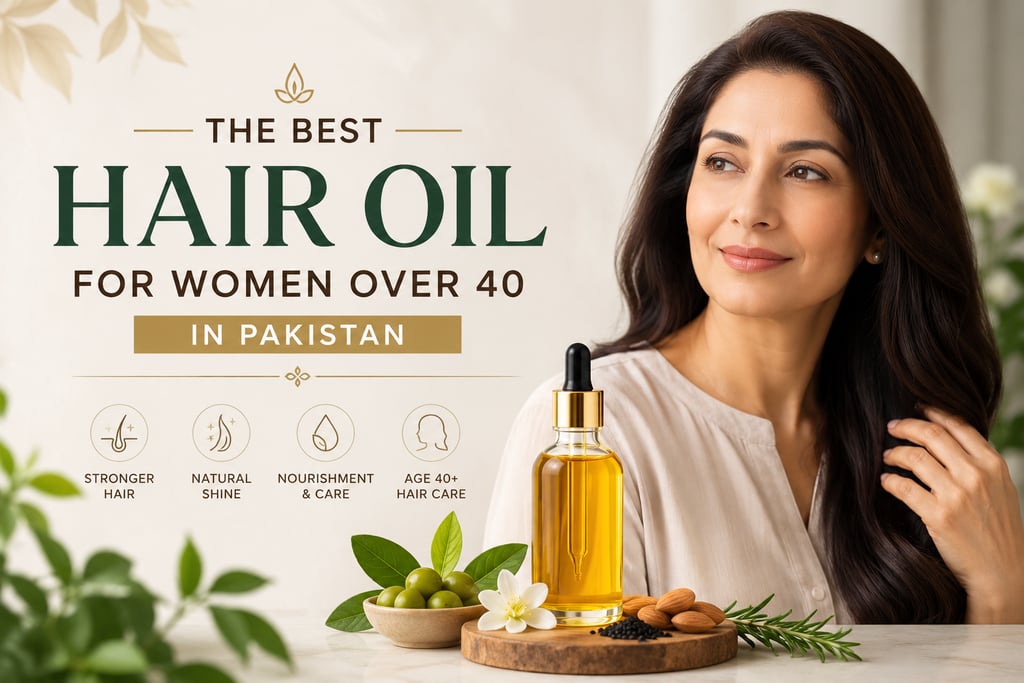
The Best Hair Oil for Women Over 40 in Pakistan: A Practical Guide to Hormonal Hair Loss & Thinning
Summarize this blog post with: ChatGPT | Perplexity | Claude | Grok
You've probably been oiling your hair since childhood, sarson, coconut, whatever your nani swore by, and it worked beautifully for decades. But after 40, many Pakistani women notice that the same oils, the same routine, and the same shampoos stop delivering, and the comb starts telling a story nobody warned them about. This guide explains exactly why hormonal changes after 40 require a different approach to hair oiling, which specific oils are proven to work for menopausal thinning, and which Pakistan-available options are actually worth your money.
Key Takeaways
Hormonal hair loss after 40 is driven by declining estrogen and rising DHT sensitivity, which shrinks hair follicles and shortens the growth cycle, a different mechanism than stress or nutritional hair loss, requiring targeted oil ingredients.
Kalonji (black seed) oil is the most research-backed traditional Pakistani oil for hormonal hair thinning, shown in studies to inhibit DHT and stimulate follicle activity when applied regularly to the scalp.
Rosemary oil has been clinically compared to minoxidil for hair regrowth and is now available in Pakistan both as a standalone essential oil and in blended formulations.
Application technique matters as much as the oil itself, massaging into the scalp (not just coating the lengths) for 4–5 minutes increases scalp circulation and dramatically improves ingredient absorption.
Women over 40 should avoid heavy mineral oil-based products that coat the scalp without penetrating, as these can block follicles already weakened by hormonal changes.
A kalonji + castor + argan blend applied 2–3 times per week is one of the most cost-effective DIY options for menopausal hair fall in Pakistan.
Visible results from consistent oil use typically appear within 8–12 weeks, patience matters more than switching products.
What Is Hormonal Hair Loss in Women Over 40?
Hormonal hair loss in women over 40 is diffuse scalp thinning caused by declining estrogen during perimenopause and menopause, which shortens the hair's growth phase and raises the scalp's sensitivity to a hormone called DHT. This is different from the hair loss caused by stress or nutritional deficiency, and that distinction matters, because treatments that work for one type don't reliably work for another.
Your hair grows in a cycle. The anagen phase is active growth; the telogen phase is rest and shedding. Estrogen keeps hair in the anagen phase longer. When estrogen drops after 40, that growth phase shortens. Hairs spend less time growing and more time falling. The result isn't bald patches, it's an overall loss of density and a hairline that seems to be quietly retreating.
DHT (dihydrotestosterone) becomes more active relative to estrogen as that balance shifts. DHT binds to follicle receptors and causes follicle miniaturization: each new hair grows back thinner and shorter than the one before. Over several cycles, a thick terminal hair can become a fine vellus hair, barely visible.
This two-part mechanism, shortened growth cycle plus miniaturizing follicles, explains why so many women over 40 describe their hair as "thinner, flatter, and less alive" even when they're not shedding visibly. The hair is there; it's just getting finer. Approximately 40% of women experience noticeable hair loss by age 50, Source: American Academy of Dermatology, 2022.
Why Hair Behaves Differently After 40 (And Why Your Old Oil Isn't Enough)
Hair after 40 behaves differently because several biological changes happen at once, and most hair oils, including the traditional ones your mother used, were never formulated to address any of them.
Sebum production drops. Your scalp produces less oil after 40, which weakens the scalp barrier and disrupts the acid mantle that keeps the scalp microbiome balanced. A drier, compromised scalp is also more prone to inflammation, and inflammation compounds hair loss.
Scalp circulation slows. Blood flow to the scalp decreases with age. Since follicles are fed by blood vessels, reduced circulation means less oxygen and fewer nutrients getting through. This is one reason scalp massage has a real, measurable effect, it directly counteracts this slowdown.
Hair shaft diameter decreases. The average diameter of a healthy hair shaft in your 30s is around 70 microns. After menopause, that can drop to 50 microns or below, Source: Journal of Investigative Dermatology, 2021. Thinner shafts look flat, lose volume, and break far more easily.
Follicle sensitivity to DHT increases. Without estrogen to counterbalance it, DHT progressively shrinks follicles, producing finer regrowth with each cycle.
Traditional oils like sarson, plain coconut, and generic olive oil coat and moisturize. They were built for hair that was already healthy and thick. After 40, what you need are oils with active ingredients that target the hormonal mechanism: DHT inhibitors, scalp circulators, and follicle-supporting botanicals.
What Ingredients Should a Hair Oil Contain for Women Over 40?
The right hair oil for women over 40 contains ingredients that address the specific hormonal and structural changes in the scalp, not just moisturizers. Some of these are traditional Pakistani staples. Some are newer additions worth knowing about.
Ingredients to Prioritize
DHT-blocking compounds. Kalonji (black seed) oil contains thymoquinone, which inhibits 5-alpha reductase, the enzyme that converts testosterone into DHT. This is the most relevant active ingredient for menopausal hair loss. Saw palmetto extract, found in some modern formulations, works through a similar pathway.
Scalp-stimulating agents. Rosemary oil increases blood flow to the scalp by dilating capillaries. It's among the most studied topical ingredients for hair regrowth, with clinical trial data comparing it directly to minoxidil. Peppermint oil has a similar mechanism, that cooling sensation when you apply it is real increased circulation.
Estrogen-supportive botanicals. Flaxseed oil and evening primrose oil contain lignans and gamma-linolenic acid, respectively, which support hormonal balance at the cellular level. Both are carrier oils, they go directly on the scalp.
Nourishing carriers. Argan oil is rich in vitamin E and oleic acid. Castor oil has the highest ricinoleic acid content of any natural oil, and that fatty acid has documented follicle-health benefits. Amla oil provides vitamin C and tannins that strengthen the hair shaft.
Ingredients to Avoid
Heavy mineral oils and paraffin. These coat the hair shaft without penetrating the scalp. Check the label: if "paraffinum liquidum" or "mineral oil" appears in the first three ingredients, that product is designed for cosmetic appearance, not follicle health. Put it back.
Synthetic fragrances. Listed as "parfum" on ingredient panels, synthetic fragrance blends are a common driver of scalp inflammation, and a sensitized, post-40 scalp is significantly more reactive than it was a decade ago.
Which Hair Oil Is Best for Hormonal Hair Loss in Pakistan? 7 Honest Picks
The best hair oil for hormonal hair loss in Pakistan contains DHT-blocking, scalp-stimulating, and follicle-nourishing ingredients, and is available at mainstream retailers like Naheed, Imtiaz, or through daraz.pk and beautyandcare.pk. Below are seven options that meet those criteria, including their price ranges in PKR and honest tradeoffs.
1. Ollexo Kalonji + Rosemary Hair Growth Oil
Full disclosure: Ollexo is my company, so take this recommendation in that context. That said, the formulation was built around the same evidence base this article draws on, kalonji's DHT inhibition, rosemary's circulation benefit, and castor's follicle support, combined in proportions tested for post-40 scalp thinning.
The practical advantage is convenience. You don't need to source three oils and figure out ratios. The disadvantage is cost: at PKR 1,200–1,800 per 100ml, it's the priciest option on this list. If budget is a constraint, the DIY blend in the next section produces similar results.
Available at: ollexo.pk
2. Rosemary Essential Oil (Mixed with a Carrier)
Rosemary oil is the ingredient that finally got rigorous clinical attention. A trial published in the Skinmed Journal found that twice-daily topical rosemary oil produced hair regrowth results comparable to 2% minoxidil at six months, with significantly less scalp itching reported by participants. For women who've abandoned minoxidil because of irritation, this result matters.
It works by increasing nitric oxide production in scalp capillaries, which improves blood flow to follicles and reduces DHT-related inflammation at the follicle level. It must be diluted before use, 5–6 drops in 2 tablespoons of a carrier oil like argan or castor. Never apply it directly to the scalp undiluted.
Available at: Essence & Oud stores, beautyandcare.pk, Naheed pharmacy sections | Price: PKR 400–1,200 per 10ml (pure essential oil)
3. Castor Oil (Hexane-Free)
Castor oil's ricinoleic acid content, roughly 85–90% of the oil, is documented to support prostaglandin E2 production, which promotes hair follicle proliferation. It's also anti-inflammatory, which matters for a scalp under hormonal stress.
Pure castor oil is too thick to spread comfortably, so mixing it with argan oil at a 1:1 ratio is standard practice. The resulting blend is easier to apply and still delivers the follicle benefits. Best used as an overnight treatment.
Available at: Naheed, Imtiaz, daraz.pk | Price: PKR 250–600 per 200ml
4. Amla (Indian Gooseberry) Oil
Amla oil addresses something most discussions of menopausal hair loss skip: oxidative stress. Free radical damage increases after menopause as antioxidant enzyme activity declines. Amla's vitamin C and polyphenol content counter this, supporting stronger, less brittle hair shaft regrowth. Research also shows amla extract inhibits 5-alpha reductase in vitro, Source: Journal of Ethnopharmacology, 2009 — giving it a secondary DHT-blocking mechanism.
It's also one of the easiest oils to find in Pakistan, which counts for something.
Available at: Herbal stores nationwide, Qarshi outlets, Naheed | Price: PKR 200–500 per 200ml
Note: commercially sold versions are often diluted. Check that the ingredient list shows amla oil in the first position.
5. Argan Oil (Pure, Unrefined)
Argan oil's primary value after 40 is scalp barrier repair. When sebum production drops with age, the scalp becomes more vulnerable to inflammation and microbial disruption. Argan's vitamin E content reduces oxidative stress on follicles; its linoleic acid restores the barrier. Unlike heavier oils, argan absorbs quickly without clogging pores.
The main issue in Pakistan's market is adulteration. Look for "100% pure argan oil" with no added ingredients on the label, and buy from established stores or verified daraz.pk sellers.
Available at: Naheed, most cosmetic stores, daraz.pk | Price: PKR 600–2,000 depending on purity
6. Kalonji (Black Seed) Oil — Pure, Cold-Pressed
Of all the traditional Pakistani oils, kalonji has the most direct research behind it for menopausal hair loss. Its active compound, thymoquinone, inhibits 5-alpha reductase, the enzyme responsible for converting testosterone into the hair-damaging DHT. Kalonji oil, derived from Nigella sativa seeds, contains thymoquinone, a compound shown in clinical research to inhibit 5-alpha reductase, the enzyme responsible for converting testosterone to the hair-damaging DHT. A 2014 randomized controlled trial found that scalp application of kalonji oil reduced hair fall significantly compared to placebo after three months, Source: Journal of Dermatology & Dermatological Surgery, 2014.
The downsides are practical, not medical: the smell is strong, and it's dark enough to stain a pillowcase. Use an old pillowcase or wrap your hair in a silk scarf for overnight treatments.
How to use: Warm 2 tablespoons, part the hair, apply to scalp sections, massage 5 minutes. Leave 2–3 hours or overnight.
Available at: Herbal stores, Naheed, daraz.pk | Price: PKR 300–800 per 100ml
7. Evening Primrose Oil (Carrier)
Evening primrose oil's gamma-linolenic acid (GLA) supports hormonal balance at the cellular level and feeds the anti-inflammatory prostaglandins the scalp needs. Women deficient in GLA often notice drier, more brittle hair, a common complaint after 40 that doesn't always respond to standard moisturizing oils.
It's less widely stocked than the others on this list, but daraz.pk carries it reliably. Mix it with kalonji or argan, 1 part evening primrose to 2 parts carrier.
Price: PKR 700–1,500 per 100ml
Can Traditional Pakistani Oils Like Sarson and Amla Help with Hormonal Hair Loss?
Traditional Pakistani oils do help with menopausal hair fall, but they work through different mechanisms, and using them in combination beats any single-oil approach. Here's an honest breakdown without the usual blanket enthusiasm.
Kalonji: Deserves Its Reputation
Kalonji oil's thymoquinone inhibits 5-alpha reductase and reduces the inflammatory signaling that accelerates follicle miniaturization. The 2014 randomized controlled trial involved scalp application, not an oral supplement, which makes it directly applicable to a topical oil routine. This oil's reputation in traditional Pakistani hair care is backed by actual research.
Sarson (Mustard) Oil: Useful in a Blend, Risky on Its Own
Mustard oil does increase scalp circulation, that warming sensation is real, not placebo. But its erucic acid content has been associated with scalp irritation in sensitized scalps, and post-40 scalps are frequently sensitized. Use sarson within a blend rather than as the primary oil, and always warm it slightly before applying.
Amla: Shaft Strength and Oxidative Defense
Amla doesn't block DHT directly, but it counters the oxidative stress that worsens after menopause. Most women don't know oxidative stress is a factor in hair loss, it is, and amla is one of the few traditional oils that specifically addresses it.
How Does Rosemary Oil Compare to Minoxidil for Women's Hair Loss?
Rosemary oil compares favorably to 2% minoxidil for female pattern hair loss, particularly for women who can't tolerate the scalp irritation that minoxidil commonly causes. The Skinmed clinical trial found that rosemary oil matched minoxidil's performance on hair count at six months, with participants reporting significantly less itching and scalp dryness than the minoxidil group.
The mechanism differs. Minoxidil is a potassium channel opener that directly prolongs the anagen phase. Rosemary oil works primarily by improving blood flow through nitric oxide production and reducing DHT-related follicle inflammation. Neither is a permanent solution; both require consistent long-term use to maintain results. For women who've stopped minoxidil because of side effects, rosemary oil is a clinically supported next step, not just a folk remedy in modern packaging.
What Is the Best Way to Apply Hair Oil for Maximum Regrowth in Thinning Hair?
Applying hair oil directly to the scalp and massaging for a minimum of four minutes increases microcirculation to hair follicles, improving nutrient delivery to the roots, a step that gets skipped when women oil only the lengths. This single correction, scalp-first application, combined with consistent massage, matters more than most ingredient changes.
Step-by-Step Application
1. Section the hair. Four to six parts lets you access the scalp directly without missing sections.
2. Warm the oil. Place the bottle in a cup of hot water for 2–3 minutes. Warm oil penetrates faster. Don't microwave it directly, it heats unevenly and can degrade the oil.
3. Apply to the scalp, not the hair. Fingertip or dropper, directly on skin along each parting.
4. Massage with fingertips. Circular motions across the full scalp for 4–5 minutes. Not optional, this is where the circulation benefit comes from.
5. Leave it in. Minimum 2–3 hours. Overnight with a shower cap or silk wrap is better. Oiling for 15 minutes before shampooing achieves almost nothing.
How Often Should You Oil Thinning Hair After 40?
Two to three times per week. More frequent oiling doesn't speed up results, it causes product buildup that blocks the follicles you're trying to stimulate. On wash days, oil the night before rather than the morning of.
Hot oil treatment: Once per week, warm your kalonji-castor blend, apply generously to scalp and lengths, wrap with a warm towel soaked in hot water and wrung out, leave 30–45 minutes. The heat opens the cuticle and meaningfully improves penetration of the active ingredients.
Tools & DIY Boosters: How to Supercharge Your Hair Oil at Home
Two additions can significantly improve results without much extra effort or cost.
The DIY Blend Worth Making: Kalonji + Castor + Argan
This three-ingredient formula targets DHT (kalonji), follicle health (castor), and scalp barrier repair (argan) in one application.
Recipe:
2 tablespoons kalonji oil, pure, cold-pressed
1 tablespoon castor oil, hexane-free
1 tablespoon argan oil, 100% pure
Optional: 5 drops rosemary essential oil
Mix in a small dark glass bottle. Warm before each use. Apply to scalp 3x per week. Store away from direct light.
At current Pakistan prices, this costs approximately PKR 800–1,200 to make and lasts 4–6 weeks at three applications per week.
Dermaroller Before Oil Application
A 0.5mm dermaroller used on the scalp before oil application creates microscopic channels that increase absorption and trigger a wound-healing response, stimulating collagen and growth factors around the follicle. Use it once per week before your oil treatment, not every session.
Available at medical supply stores and daraz.pk for PKR 500–1,500.
When Should a Woman Over 40 See a Doctor Instead of Using Hair Oil?
Hair oil helps with menopausal hair loss, but it's one part of the picture, not the whole answer.
Supplements. Biotin alone rarely reverses hair loss in menopausal women. A combination of biotin + collagen peptides + iron + zinc has measurable impact when deficiencies actually exist. In Pakistan, collagen peptides are available at most pharmacies and on daraz.pk.
Diet. Hair follicles are protein-hungry. A diet too low in protein means the body deprioritizes hair growth. Aim for at least 0.8g of protein per kg of body weight daily. Iron deficiency is a direct driver of hair loss and frequently goes undiagnosed in Pakistani women, because standard blood panels check hemoglobin, not serum ferritin. Ask specifically for a serum ferritin test; subclinical deficiency won't show up otherwise.
When to make an appointment. If you're losing more than 150–200 hairs per day consistently, noticing patchy loss rather than diffuse thinning, or still seeing accelerating loss after 8–12 weeks of consistent oiling, see a dermatologist. Ask for a trichoscopy, which is a scalp scan that reveals follicle miniaturization and scalp inflammation. In Pakistan's major cities, trichoscopy is available at dermatology centers in Lahore, Karachi, and Islamabad. Some conditions, alopecia areata, scarring alopecias, don't respond to oil treatment and need different interventions entirely.
Low-Level Laser Therapy (LLLT). FDA-cleared LLLT devices like iRestore and HairMax are importable in Pakistan and run PKR 15,000–50,000+. For women with moderate-to-severe follicle miniaturization, they produce measurable results in clinical studies, used consistently over months, not weeks.
Your 30-Day Hair Oil Routine for Women Over 40
Weeks 1–4 (Foundation Phase)
Monday: Apply kalonji + castor + argan blend to scalp. Massage 5 min. Leave overnight.
Tuesday: Wash with sulfate-free shampoo.
Thursday: Rosemary in carrier applied to scalp. Massage 4 min. Leave 2 hours.
Saturday: Hot oil treatment, full blend, warm towel wrap, 30–45 min.
Sunday: Count hair on comb and pillow. Take a scalp photo in consistent lighting.
What to track: Hair on comb and pillow tends to decrease by week 6–8. Texture usually improves by week 4. Density at the crown becomes visible closer to week 10–12.
Don't switch products in the first 8 weeks. Hair follicles operate in cycles of 8–12 weeks. You're treating future growth, not the hair already on your head. Rotating oils every three weeks is how women end up frustrated with every product they've tried.
Conclusion: Your Hair Can Recover, Here's Where to Start
Hair loss after 40 is real, it's hormonal, and it's not a reflection of anything you did wrong. The estrogen-DHT shift happens to most women, but it does respond to targeted, consistent care.
Three realistic starting points:
If your budget is healthy, the Ollexo Kalonji + Rosemary Hair Growth Oil combines the active ingredients in tested proportions from ollexo.pk.
If your budget is tight, pure kalonji oil at PKR 300–500 is available everywhere and has the most direct research behind it. Use it three times per week with proper scalp massage.
If you want the most cost-effective combination available, the kalonji + castor + rosemary DIY blend costs around PKR 800–1,200 for a month's supply and addresses more of the hormonal mechanism than any single oil.
Give whichever you choose 8–12 weeks of consistent use before drawing conclusions. In the meantime: get a serum ferritin test, add protein to your diet, and if the loss feels severe or patchy, get a trichoscopy done.
If you've been using one of these oils or trying a DIY blend, share your experience in the comments, what's working, what isn't, and how long you've been at it. Real feedback from Pakistani women is more useful here than any lab study.
Written by: Ali Raza, CEO of Ollexo, with over 10 years of experience in the oil industry. Ali shares practical insights, industry trends, and hands-on lessons from years of work in natural oil formulations.