
How to Mix Oils for Hair in Pakistan
Learn how to mix carrier oils and essential oils for Pakistani hair concerns. Get safe dilution ratios, 5 named DIY recipes, and step-by-step blending instructions
HAIR OIL
Written by Ali Raza Ali Raza is the CEO of Ollexo, Pakistan's leading natural hair and beauty oil brand. With over 10 years of experience in the oil industry, Ali shares practical insights on ingredients, formulation, and hair health tailored to Pakistani hair types, climate, and everyday consumer realities.
5/20/202612 min read
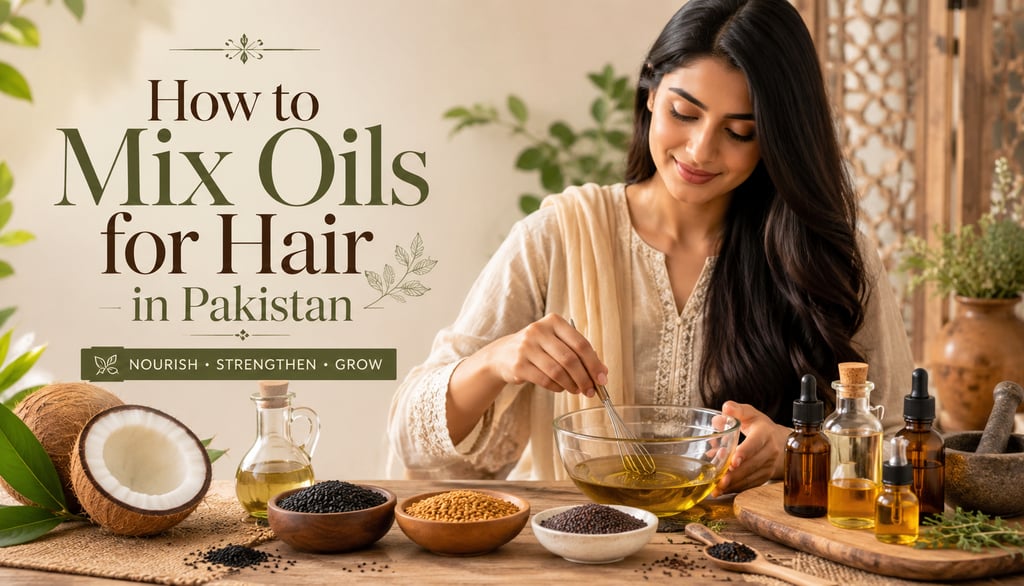

How to Mix Oils for Hair in Pakistan: The Complete DIY Guide With Ratios and Recipes
You already know oiling is one of the best things you can do for your hair, our daadis and nanis have been doing champi for generations. But if you have been pouring a single oil on your scalp and seeing no real change in your hair fall, dandruff, or dryness, the problem is not the habit. It is the formula. This guide walks you through exactly how to mix carrier oils and essential oils at safe ratios to build a custom blend for Pakistani hair, Pakistani water, and Pakistani weather.
Key Takeaways
Hair oil mixing combines carrier oils like castor, coconut, or kalonji with essential oils at safe dilution ratios to create a targeted formula for your specific hair concern.
The standard safe dilution ratio for essential oils in hair blends is 2%, which equals approximately 2 drops of essential oil per teaspoon (5ml) of carrier oil for adults with normal scalp sensitivity.
Pakistani hair faces unique stressors including hard water mineral buildup, heat, dust, and humidity, a single oil rarely addresses all of them, and a custom blend does.
Carrier oils form the base of any blend and should be chosen by hair type: castor for hair fall, coconut for moisture, kalonji for thinning, jojoba for oily scalps.
Homemade hair oil blends should be stored in dark glass bottles away from sunlight and heat, and used within 6 to 12 months to prevent rancidity.
Pakistani kitchen staples like kalonji, sarson, and coconut oil are excellent carrier bases and are available at Daraz, Naheed, and most local stores.
Patch-test any new essential oil on your inner wrist before applying a new blend to your scalp, even if you have used oils for years.
What Is the Difference Between a Carrier Oil and an Essential Oil for Hair?
A carrier oil is a plant-based oil used to dilute essential oils and deliver nutrients directly to the hair shaft and scalp common Pakistani examples include coconut oil, castor oil, kalonji oil for hair growth, and sweet almond oil. Carrier oils are safe to apply directly to skin and scalp without dilution. They form the bulk of any DIY blend and do the nutritional work: moisturising the shaft, softening the scalp, and reducing breakage.
Essential oils are a completely different category. An essential oil is a highly concentrated botanical extract distilled from plants, seeds, or flowers, with potent active compounds that target specific scalp conditions. Rosemary targets regrowth, tea tree addresses fungal dandruff, peppermint boosts scalp circulation, lavender calms irritation. Because essential oils are so concentrated, even one or two undiluted drops can cause burning, irritation, or an allergic reaction on the scalp.
Mixing hair oils means combining one or more carrier oils as your base, then adding essential oil drops at the correct dilution rate. The carrier delivers; the essential oil targets. Neither alone does what both do together.
Why Mixing Oils Is Especially Important for Pakistani Hair
Pakistani hair deals with a combination of stressors that most international haircare advice does not account for. Hard water is one of the most damaging. Tap water across Karachi, Lahore, and Islamabad carries high concentrations of calcium and magnesium, and these minerals coat the hair shaft over time, making it rough, slow to absorb oil, and prone to tangling and breakage. If your champi does not seem to absorb the way it used to, hair oil for hard water damage is a real and fixable problem, not a perception issue.
Then there is the heat. Summer temperatures across Punjab and Sindh regularly cross 40 degrees Celsius. That heat dries the scalp, triggers excess oil production in the sebaceous glands, and accelerates dandruff flare-ups. Karachi's humidity adds frizz and scalp sweat. Lahore's dry spring winds carry dust that settles on the scalp and blocks follicles. Islamabad's winters bring cold dryness of their own.
No single oil handles all of this at once. Coconut oil is excellent for moisture but too heavy for oily scalps in humid weather. Sarson ka tel warms the scalp effectively but overwhelms fine hair. Kalonji is powerful for hair fall but lighter in texture than castor. A custom blend lets you combine two or three oils that collectively address your actual climate and hair type. One oil makes you choose your priority. A blend does not have to.
For those addressing concern across both hair and beard, or navigating oiling routines as men, our guide on best hair oils for men in Pakistan covers the adjustments worth making.
What Is the Safe Carrier-to-Essential Oil Ratio for Hair Blends?
The standard safe dilution ratio for essential oils in a hair blend is 2%, which equals approximately 2 drops of essential oil per teaspoon (5ml) of carrier oil for adults with normal scalp sensitivity. Memorise this number before you open any essential oil bottle.
Three dilution levels cover most situations. At 1% dilution — 1 drop of essential oil per teaspoon of carrier — you have a blend suitable for sensitive scalps, reactive skin, or daily use. This is the rate to start with if you are using an essential oil for the first time. At 2% dilution — 2 drops per teaspoon — you have the standard adult-use rate for twice-to-three-times-weekly oiling. This is the rate used in every recipe below. At 3% to 5% dilution — 3 to 5 drops per teaspoon — you have a targeted treatment rate reserved for acute scalp conditions or once-a-week intensive sessions. Do not go above 5% on the scalp without professional guidance.
For a standard 30ml bottle (six teaspoons), 2% dilution means 12 drops of essential oil total. If you are using two essential oils, split those 12 drops between them. Do not add extra drops because one essential oil smells stronger than another. The dilution rate is about chemistry, not scent intensity.
One more rule worth following: do not blend more than two or three essential oils in your first batch. If a reaction occurs, fewer ingredients mean you can identify the cause.
Which Carrier Oils Are Best for Pakistani Hair Concerns?
Carrier oils are not interchangeable. Each has a different fatty acid profile, texture, and primary benefit. Picking the wrong base can make your blend counterproductive regardless of how good your essential oils are.
Coconut oil is the most accessible moisture-rich carrier in Pakistan. It penetrates the hair shaft more deeply than most oils, reducing protein loss and keeping strands soft. It works best for dry, damaged, or chemically treated hair. In humid weather or on fine oily scalps, it can be too heavy.
Castor oil is the standard for hair fall and thickness. Rich in ricinoleic acid, it improves scalp circulation and supports the hair growth cycle. Because castor oil is very thick on its own, it works best blended with a lighter oil in a 1:3 ratio, one part castor to three parts of a lighter carrier. Our full guide on castor oil for hair thickness covers the science behind why this works.
Kalonji oil (black seed oil) is a traditional desi powerhouse for thinning and shedding hair. It contains thymoquinone, a compound with documented anti-inflammatory and antioxidant properties relevant to scalp health. It blends well with castor and a lightweight base. Our dedicated guide on kalonji oil for hair growth covers the research in detail.
Sarson ka tel (mustard oil) has been used for scalp warming and dandruff control in Pakistani and Indian homes for centuries. It has antifungal properties and stimulates circulation. The strong smell and thick texture make most people blend it at no more than 25% of the total carrier mix.
Sweet almond oil is light, absorbs quickly, and adds shine without greasiness. It is a strong base for fine hair, oily scalps, or anyone who finds coconut and castor too heavy. Our guide on sweet almond oil for hair explains why it works so well as a carrier blend partner.
Jojoba oil is technically a liquid wax rather than an oil. It mimics the scalp's natural sebum more closely than any other carrier, making it the best base for oily scalp types. It regulates sebum production over time rather than adding more oil on top of existing oiliness.
Argan oil is the lightest carrier here. It coats the shaft and controls frizz in humid conditions, which is particularly useful for Karachi and coastal Pakistan. It does not penetrate as deeply as coconut, but for dry, heat-damaged ends it is difficult to beat. See our guide on argan oil for dry and frizzy hair for application-specific advice.
For beginners: blend one heavy carrier (castor or sarson) with one light carrier (almond, coconut, or jojoba) in a 1:3 ratio. Then add essential oils at 2%.
How Do You Mix Hair Oils Step by Step at Home?
Mixing hair oil at home takes about ten minutes once you have your ingredients. The process matters because wrong containers, wrong temperature, or skipping the patch test can ruin an otherwise good formula.
Step 1: Gather your equipment. You need a dark glass bottle (amber or cobalt blue, 30ml to 60ml), a small glass measuring bowl, a dropper or 1ml syringe for essential oils, and a label. Do not use plastic. Many essential oils degrade plastic and leach compounds into the blend.
Step 2: Measure your carrier oils. Pour your carriers into the measuring bowl in the correct proportion. For a 30ml batch of a 1:3 castor-to-almond blend, that is 7.5ml castor and 22.5ml almond. Use a syringe or measuring spoon, not approximate pours.
Step 3: Warm if needed. Castor oil in winter is very thick and hard to pour cleanly. Place the measuring bowl inside a larger bowl of hot water for one to two minutes. No direct heat, no microwave. Keep the temperature well below 40 degrees Celsius to protect the active compounds in your carriers.
Step 4: Add your essential oils. With the carrier oils poured into the glass bottle, add your essential oil drops one at a time and count carefully. For a 30ml bottle at 2% dilution, you want 12 total drops. If using two essential oils, split the drops between them (for example, 8 drops rosemary and 4 drops lavender).
Step 5: Seal and shake. Cap the bottle tightly and shake for 30 seconds. Essential oils disperse into carrier oils rather than dissolving permanently, so you need to shake the bottle before every single use, not just when you first make the batch.
Step 6: Label with the date. Write the mixing date on your label. Carrier oils go rancid, and without a date you have no way to track the 6 to 12 month window before the blend loses potency.
Step 7: Patch test before scalp use. Apply a few drops to your inner wrist and wait 24 hours. No redness, itching, or burning means the blend is safe to use on your scalp.
Five DIY Hair Oil Recipes for Pakistani Hair Concerns
These five blends address the most common Pakistani hair problems. Each is named for easy recall and sized for a 30ml bottle at 2% essential oil dilution.
The Baal Girna Blend, For Hair Fall
This blend uses castor oil for scalp circulation, kalonji oil for hair growth for follicle support, and rosemary essential oil for regrowth stimulation. A 2023 clinical comparison found rosemary oil as effective as 2% minoxidil for hair density improvement after six months of consistent twice-weekly use — Source: Skincare journal, 2023. To make it: 7.5ml castor oil, 7.5ml kalonji oil, 15ml sweet almond oil, and 12 drops rosemary essential oil. Our guide on rosemary oil for hair fall covers the mechanism behind this. Apply to scalp twice a week, massage for five minutes, and leave on for at least two hours or overnight.
The Khushki Blend, For Dandruff
Dandruff in Pakistan is usually fungal in origin and worsens with heat and scalp sweating. This blend uses coconut oil as the antifungal base, tea tree essential oil as the primary antifungal active, and neem oil for scalp health as a supporting antimicrobial carrier. To make it: 20ml coconut oil, 10ml neem oil, 8 drops tea tree essential oil, and 4 drops lavender essential oil. Lavender reduces the sharpness of tea tree and adds its own calming antibacterial effect. Apply directly to the scalp, leave on for one hour minimum, then shampoo out. Use twice a week during active flare-ups. For a broader look at oil choices for dandruff, see our guide on best hair oil for dandruff in Pakistan.
The Rutoba Blend, For Dry and Damaged Hair
The Rutoba Blend addresses the brittle, rough hair that Lahore's dry winds and hard water leave behind. It uses sweet almond oil for hair and argan oil for dry and frizzy hair as the carrier pair, with lavender essential oil for scalp calming and cell turnover support. To make it: 20ml sweet almond oil, 10ml argan oil, and 12 drops lavender essential oil. This blend works from roots to tips, not scalp only, because both almond and argan are light enough to condition the lengths without weighing them down. Use two to three times per week.
The Patla Baal Blend, For Thinning and Fine Hair
Fine hair needs stimulation without added weight. This blend uses castor oil for regrowth support, amla oil for thinning hair for shaft strengthening, and peppermint essential oil for scalp circulation. Peppermint contains menthol, which creates a cooling vasodilation effect on the scalp that draws blood flow toward the follicles. To make it: 10ml castor oil, 10ml amla oil, 10ml jojoba as the balancing carrier, and 12 drops peppermint essential oil. Apply to scalp only, not the lengths, castor on fine hair ends creates unnecessary weight and matting. Leave on for two hours and wash out. Use twice weekly.
The Chikna Sar Blend, For Oily Scalp
An oily scalp does not mean you should stop oiling. It means you need to oil smarter. This blend uses jojoba as the base because jojoba's sebum-like chemical structure signals the scalp to produce less of its own oil over time. Lemon essential oil regulates sebum and adds a mild astringent quality; tea tree addresses any fungal component driving the oiliness. To make it: 25ml jojoba oil, 5ml castor oil, 6 drops lemon essential oil, and 6 drops tea tree essential oil. One caution: lemon essential oil causes photosensitivity if you go into sunlight within 12 hours of application. Use this as an overnight treatment or apply in the evening. Once a week is sufficient.
How to Store, Apply, and Maximise Your Custom Hair Oil
Storage works on one rule: keep your blend cold, dark, and sealed. Store in a dark glass bottle inside a cool dry cabinet, not on your bathroom shelf where shower steam cycles the temperature and humidity daily. Light, heat, and air all accelerate rancidity in carrier oils.
Most blends based on coconut, almond, or jojoba stay potent for 6 to 12 months — Source: International Journal of Cosmetic Science, 2021. Blends containing kalonji or neem should be used within six months. Any blend that starts smelling sour, stale, or "off" has turned rancid. Discard it. Rancid oil on the scalp introduces oxidative stress to the follicle environment, which is the opposite of the intended benefit.
Application timing matters. The minimum effective contact time for a blend to work is one hour, but two to four hours produces better penetration, particularly for thick carriers like castor. Overnight oiling is the most effective option for most concerns. For the full breakdown of how to maximise overnight oiling without matting or breakage, see our guide on overnight hair oiling benefits.
The champi technique itself affects results. Scalp massage with the pads of the fingers, not the nails, in slow circular motions for five minutes increases blood flow and absorption. For detailed guidance on pressure points and massage sequence, see our guide on how to do a champi the right way.
What Mistakes Should You Avoid When Mixing Hair Oils at Home?
Using too much essential oil is the most common mistake. More drops do not produce faster results. They increase the risk of contact dermatitis, scalp irritation, and follicle damage. Stay within the 1% to 5% dilution range and start at 2% until you know how your scalp responds.
Skipping the patch test catches people even after years of oiling, because a new essential oil can trigger a reaction that familiar ones do not. Rosemary, peppermint, and tea tree in particular cause strong reactions in people with reactive skin. The patch test takes 24 hours and protects you from a week of irritation.
Mixing in plastic containers is a mistake because essential oils degrade certain plastics and pull chemical compounds from them into your blend. Use glass for measuring and storage.
Starting with old oils from the back of a kitchen cabinet undermines the blend before you add a single drop of essential oil. Smell your carriers first. Fresh oil smells neutral or mildly nutty. Sourness or a stale, crayon-like smell means the oil has already oxidised. Discard it and use a fresh bottle.
Not shaking before each use means your essential oil drops have settled and the first pour from the bottle is heavily concentrated while the last is barely active. Shake every time.
Where Can You Buy These Oils in Pakistan?
Most carrier oils are easy to source locally. Kalonji oil, coconut oil, and sarson ka tel are available at nearly every kiryana store. Castor oil is sold at medical stores and large supermarkets across the country. Naheed Supermarket and Imtiaz carry a solid range of beauty oils in Karachi. Patanjali outlets, present in most major cities, stock sweet almond oil, amla oil, and mustard oil reliably.
Essential oils require more care in sourcing. Look specifically for bottles labelled "100% pure essential oil" rather than "fragrance oil" or "perfume oil," which are synthetic and not suitable for scalp use. Daraz has a growing selection from reputable sellers. For purer, certified-grade options, several online stores in Pakistan import directly from suppliers and list certificates of analysis on request.
If sourcing, measuring, and blending across multiple ingredient types is more than you want to take on, Ollexo offers ready-made hair oil formulations that use these same desi ingredients, kalonji, amla, bhringraj, neem, in carefully tested ratios, without the guesswork. Ollexo is Pakistan's number one natural hair oil brand precisely because every formulation bridges the gap between traditional champi wisdom and modern ingredient standards. You get the benefit of a custom blend without the dropper, the dark glass bottle, or the careful counting.
Conclusion
Mixing your own hair oil is not complicated once you understand two categories of oils, the 2% dilution rule, and which carriers match your actual hair concern. Pakistani hair has needs that generic beauty advice misses, and a custom blend built around hard water, heat, dust, and humidity will outperform a single-ingredient champi over time.
Pick one of the five named blends above that matches your primary concern. Patch test. Mix in glass. Store it properly. Then give the blend four to six weeks of consistent twice-weekly use before you judge the results, because hair growth and scalp health work on monthly cycles, not weekly ones. If you want to skip the formulation process and start with a professionally blended product, Ollexo has you covered.
Written by Ali Raza Ali Raza is the CEO of Ollexo, Pakistan's leading natural hair and beauty oil brand. With over 10 years of experience in the oil industry, Ali shares practical insights on ingredients, formulation, and hair health tailored to Pakistani hair types, climate, and everyday consumer realities.
Disclaimer: This content has undergone thorough revisions, editing, and fact-checking by editors and subject matter experts to ensure accuracy