
How to Read Hair Oil Labels in Pakistan: Hidden Chemicals
"Herbal" on the front doesn't mean safe inside. Learn how to check the first 5 ingredients on local hair oils to protect your scalp from damage.
HAIR OIL
Written by Ali Raza, CEO of Ollexo, with over 10 years of experience in the oil industry. Ali brings hands-on knowledge of oil processing, ingredient sourcing, and product formulation to consumer education on hair and personal care products.
5/31/202611 min read
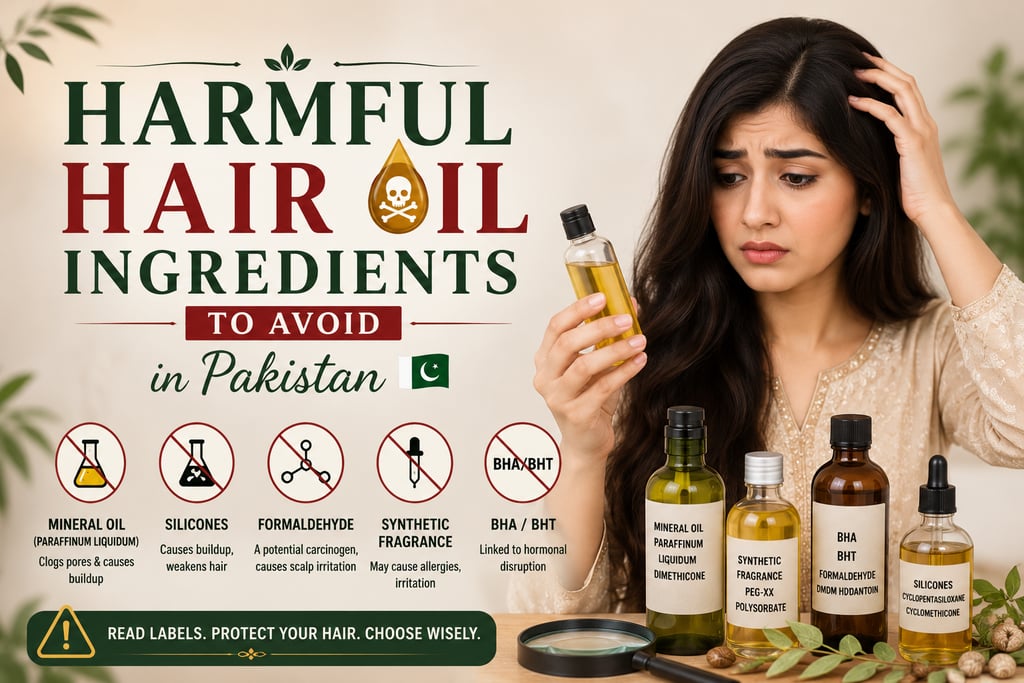
Harmful Hair Oil Ingredients to Avoid in Pakistan: The Complete Guide to Safer, Smarter Label Reading
Summarize this blog post with: ChatGPT | Perplexity | Claude | Grok
You've probably been oiling your hair your whole life, it's one of those rituals passed down from mothers and grandmothers, practically a cultural institution. But the bottle you've been massaging into your scalp every week might be doing more damage than the dryness you're trying to fix. This guide covers exactly which hair oil ingredients to avoid, what they hide behind on Pakistani labels, and which safe alternatives hold up in the heat and humidity most of us deal with every day.
Key Takeaways
Mineral oil (listed as paraffinum liquidum on labels) coats hair strands rather than penetrating them, creating shine without nourishing, and causing long-term scalp buildup.
Silicones like dimethicone are not acutely toxic, but non-water-soluble silicones accumulate on the scalp over time, weaken hair at the root, and create product dependency.
Pakistan's DRAP primarily regulates pharmaceuticals and medical devices, leaving hair oil labeling and ingredient restrictions in a grey zone with limited enforcement.
Parabens, synthetic fragrance (listed as "parfum"), and formaldehyde-releasing preservatives appear in many affordable Pakistani hair oils and carry documented health concerns.
Reading the first five ingredients on an INCI list is the single most practical way to evaluate whether a hair oil will benefit your hair or damage it.
Pure cold-pressed oils such as kalonji, coconut, and badam (almond) oil contain no hidden chemicals and are widely available across Pakistan's markets, pharmacies, and Daraz.
Apps like Think Dirty and EWG Skin Deep let you scan ingredient lists and receive safety ratings, even for products sold locally in Pakistan.
What Are Hair Oil Ingredients, and Why Does the Ingredient List Matter?
Hair oil ingredients are every substance in a product, listed on the packaging in descending order of concentration under a system called INCI — International Nomenclature of Cosmetic Ingredients. The first ingredient on the list is present in the highest amount. The last is present in the smallest trace.
Most Pakistani consumers skip this list entirely. The packaging is attractive, the price feels right, and the brand has been around for years, that combination feels like enough of a guarantee. It often isn't.
The word "natural" on a Pakistani hair oil label carries no legal weight. DRAP does not define or regulate what brands can call natural, herbal, or botanical. A product can contain 95% mineral oil and synthetic fragrance and still print "herbal formula" across the front. That disconnect between front-label claims and the actual ingredient list is the core problem this guide addresses.
Why Harmful Hair Oil Ingredients Are a Bigger Problem in Pakistan
Pakistan's Drug Regulatory Authority (DRAP) primarily governs pharmaceuticals and medical devices, leaving cosmetic and hair care products, including hair oils, in a regulatory grey zone where labeling standards, ingredient restrictions, and safety disclosures are not consistently enforced. This is not a fringe concern: a 2021 review published in the Journal of Cosmetic Dermatology found that markets with limited cosmetic oversight had significantly higher rates of undisclosed preservatives and allergens in personal care products compared to EU-regulated markets.
The problem compounds from a few directions at once.
The market carries a high volume of unbranded and Chinese-manufactured hair oils sold in bulk at general stores and on Daraz. These products rarely carry complete ingredient disclosures, and enforcement of labeling requirements at the point of sale is inconsistent at best.
Pakistani hair care culture also centers on heavy, frequent oiling, sometimes daily application left overnight under a dupatta or towel. That kind of extended scalp contact amplifies the absorption risk of any irritant or endocrine-disrupting ingredient in the formula. Hair fall causes in Pakistani women covers how this oiling pattern interacts with common hair loss triggers in more detail.
On top of that, ingredients that require disclosure or face outright restriction in EU and UK markets, including certain parabens and formaldehyde-releasing preservatives, remain freely usable in locally sold products here.
Mineral Oil in Hair Products: Shine That Costs You Moisture
Mineral oil in hair products, listed on ingredient labels as paraffinum liquidum or paraffinum perliquidum, is a petroleum-derived ingredient that coats the hair shaft rather than penetrating it, creating the appearance of shine without delivering moisture or nutrition to the hair fiber. It is a byproduct of petroleum refining, the same industry that produces petrol and diesel.
What Does "Paraffinum Liquidum" Mean on a Hair Oil Label?
Paraffinum liquidum is the INCI name for liquid mineral oil. You'll also see it listed as white mineral oil, paraffin oil, or simply petrolatum in some formulations. These are all variations of the same petroleum derivative. Cosmetic-grade mineral oil goes through refinement and is not the same as the crude industrial product, but refinement does not change its fundamental property of sitting on top of the hair rather than absorbing into the cortex.
The shine you see after applying a mineral oil-heavy product comes from light reflecting off that surface coating. Underneath, the hair shaft gets no hydration, no fatty acid replenishment, and no protein support. Over time, the coating accumulates on the scalp, trapping sebum and product residue, which can worsen oiliness, clog follicles, and contribute to itching.
How Mineral Oil Causes Scalp Buildup
Mineral oil does not rinse away with water. It requires a sulfate-based or clarifying shampoo to remove. Many consumers who use mineral oil-heavy oils then wash with a gentle shampoo do not remove the coating fully. The residue compounds with each application until the scalp carries a layer of oil, dead skin, and product that normal washing cannot shift.
A 2019 study in the International Journal of Trichology noted that scalp buildup from occlusive ingredients like mineral oil was a contributing factor in follicular inflammation in a subset of patients with diffuse hair thinning — Source: International Journal of Trichology, 2019.
Common Pakistani mass-market hair oils with a mineral oil base include many affordable options sold at Agha's, hypermarkets, and general stores. You can identify them by scanning for paraffinum liquidum in the top three ingredients on the label.
Silicone in Hair Oils: Short-Term Slip, Long-Term Buildup
Silicone ingredients in hair oil, such as dimethicone and cyclopentasiloxane, work by forming a waterproof film over the hair strand; while this reduces frizz and increases slip short-term, non-water-soluble silicones accumulate over time, block scalp pores, and require chelating or clarifying shampoos to remove.
Which Silicones Are the Worst?
Not all silicones behave the same way. Dimethicone carries the highest buildup risk, it is non-water-soluble and shows up most often in serums and smoothing oils. Cyclopentasiloxane (D5) is similarly non-water-soluble, shows up in lightweight hair oils, and the EU has restricted its use in wash-off cosmetics due to environmental persistence. Amodimethicone sits in the middle, partially water-soluble, with moderate buildup potential, common in conditioning treatments. On the safer end, PEG-8 dimethicone is water-soluble and carries a lower buildup risk, which is why some salon brands use it. Cyclomethicone is non-water-soluble but evaporates partially after application, placing it in the moderate-risk category despite appearing in finishing sprays.
Dimethicone and cyclopentasiloxane are the two to watch most. The European Chemicals Agency moved to restrict cyclopentasiloxane (D5) in wash-off cosmetics due to environmental persistence concerns, it does not break down easily in water treatment systems — Source: European Chemicals Agency, 2018. Pakistan carries no equivalent restriction.
The Dependency Cycle Silicones Create
Silicone dependency follows a predictable pattern. Hair feels smooth with the product in it. Stop using it, or even skip one wash, and the hair feels rough and brittle by comparison. That contrast reads as the silicone "working," but the mechanism is coating rather than conditioning. The hair's moisture levels were quietly declining underneath while the film kept things feeling manageable on the surface. Best sulfate-free shampoos available in Pakistan lists options that can break down silicone buildup without stripping the scalp.
Other Harmful Ingredients to Check for in Pakistani Hair Oils
Parabens (Methylparaben, Propylparaben)
Parabens, including methylparaben and propylparaben, are preservatives used in hair oils to extend shelf life; the European Union's Scientific Committee on Consumer Safety has placed restrictions on certain parabens due to their endocrine-disrupting potential, though they remain unrestricted in many markets including Pakistan. Research published in the Journal of Applied Toxicology found parabens in breast tissue samples at concentrations consistent with regular cosmetic use — Source: Journal of Applied Toxicology, 2004. The causal link to cancer remains scientifically contested, but the precautionary case for avoiding them in products with prolonged scalp contact is strong. For a full breakdown of the research, parabens in beauty products: what the research says covers both the supporting evidence and the legitimate criticisms.
Synthetic Fragrance (Listed as "Parfum")
Synthetic fragrance (listed as "parfum" on ingredient labels) can contain hundreds of undisclosed chemical compounds, including known allergens, phthalates, and sensitizers, none of which manufacturers are required to disclose individually in Pakistan. A single "parfum" entry can represent over 3,000 possible chemical combinations — Source: Environmental Working Group, 2020. For anyone with a sensitive scalp, contact dermatitis, or eczema, parfum is worth treating as a red flag.
DMDM Hydantoin and Formaldehyde Releasers
DMDM hydantoin is a formaldehyde-releasing preservative found in some hair oils and serums; it works by slowly releasing small amounts of formaldehyde to prevent microbial growth, and has been linked to scalp sensitization, contact dermatitis, and allergic reactions with repeated exposure. Other formaldehyde-releasers to watch for: imidazolidinyl urea, diazolidinyl urea, and quaternium-15. The US FDA flagged DMDM hydantoin in its ongoing assessment of hair straightening products in 2022 — Source: US FDA, 2022.
Alcohol (SD Alcohol, Denatured Alcohol)
Denatured alcohol and SD alcohol appear in lightweight "hair serum oils", products that combine an oil phase with a water-soluble carrier. Both dry out the hair shaft on contact. A small amount in the formula is usually harmless. When it appears in the first five ingredients, it's a meaningful percentage of the product and will contribute to dryness over time.
DEA and TEA (Diethanolamine, Triethanolamine)
DEA and TEA appear in some hair oil formulations as emulsifiers. The International Agency for Research on Cancer classifies DEA as possibly carcinogenic to humans (Group 2B) based on animal studies — Source: IARC Monographs, 1999. EU regulators have restricted DEA in cosmetics. Pakistan has no equivalent restriction.
How to Read a Pakistani Hair Oil Ingredient Label: A Practical Walkthrough
Reading an ingredient label takes about 90 seconds once you know the pattern. Here's the process:
Flip the bottle over and find the ingredient list. On Pakistani products, it may be printed small on a sticker or folded insert. Some unbranded oils carry no list at all, that absence is itself a red flag.
Read the first five ingredients. These form the bulk of the product. If mineral oil (paraffinum liquidum) or a non-water-soluble silicone (dimethicone, cyclopentasiloxane) appears here, the product is predominantly that ingredient.
Search any unfamiliar INCI name. Type it into EWG Skin Deep or the Think Dirty app. Both return hazard ratings with source citations.
Check for "parfum" or "fragrance." One entry covers dozens of undisclosed compounds. For scalp-sensitive users, this single word is worth avoiding.
Look for preservative flags. DMDM hydantoin, methylparaben, propylparaben, and imidazolidinyl urea are the most common.
The Think Dirty app and the EWG Skin Deep database both cover products sold outside North America if you enter ingredient names manually. A guide on EWG Skin Deep database: how to use it walks through the process for products not yet in their system.
Pakistani Hair Oil Brands and What to Look for on the Label
This section is not a brand attack. Several mass-market Pakistani hair oils have loyal users and long histories. The concern is ingredient transparency, not brand reputation.
Affordable local hair oils in Pakistan most often use mineral oil as the base carrier. This keeps costs down and gives the product a familiar slip and shine. The issue arises when mineral oil dominates the first two or three ingredients and there is no meaningful plant oil content to compensate.
Imported oils from China, often sold unbranded in bulk or under house-brand labels on Daraz, frequently carry no INCI list at all. For these products, there is no label to read, and no way to assess what you're applying.
When buying any hair oil in Pakistan, prioritise products that:
List a recognisable plant oil (cocos nucifera for coconut, argania spinosa for argan, nigella sativa for kalonji) in the first three ingredients
Carry a full INCI ingredient list (not just marketing claims)
Disclose the country of manufacture
Safe Hair Oil Ingredients That Hold Up Under the Science
Pure cold-pressed plant oils provide fatty acids, antioxidants, and vitamins that penetrate the hair shaft or nourish the scalp, benefits that petroleum-derived mineral oil cannot replicate. These are the oils with genuine evidence behind them:
Kalonji (Nigella sativa / Black Seed Oil): A 2017 randomised controlled trial in the Journal of Dermatology and Dermatologic Surgery found that topical black seed oil reduced hair loss and increased hair density in participants over three months — Source: Journal of Dermatology and Dermatologic Surgery, 2017. Available at pharmacies across Pakistan and on Daraz in cold-pressed form. Kalonji oil benefits for hair covers the clinical evidence.
Coconut oil (Cocos nucifera): Lauric acid in coconut oil penetrates the hair shaft more than most other oils, reducing protein loss during washing. A 2003 study in the Journal of Cosmetic Science confirmed this penetration advantage over mineral oil and sunflower oil — Source: Journal of Cosmetic Science, 2003.
Almond oil (Prunus amygdalus dulcis): Rich in oleic and linoleic acids. Absorbs without heavy residue, suitable for Pakistan's humid climate.
Castor oil (Ricinus communis): High ricinoleic acid content supports scalp circulation and has mild antimicrobial properties. Best used diluted with a lighter carrier oil.
Argan oil (Argania spinosa): High in vitamin E and oleic acid. Cold-pressed argan has strong evidence for reducing frizz and improving hair elasticity, argan oil for hair: benefits, uses, and what to look for on labels covers the label markers for genuine vs adulterated argan.
For the distinction between refined and cold-pressed versions of these oils, cold-pressed vs refined oil: what's the difference breaks down what processing removes and why it matters.
A cost-effective alternative to commercial products is blending your own. DIY hair oil recipe with natural ingredients covers base ratios and fragrance-free additions.
What to Do If You've Already Been Using a Harmful Hair Oil
The scalp can recover from sustained mineral oil or silicone use, but the process takes a few weeks and feels worse before it gets better.
Start with a clarifying wash, not your regular gentle shampoo, which probably won't cut through mineral oil or silicone residue. A proper anti-residue shampoo once a week for three to four weeks does the job. Neutrogena Anti-Residue is available at most Pakistani pharmacies. Generic clarifying options on Daraz are fine too.
Between washes, massage a small amount of diluted kalonji or coconut oil into the scalp. This isn't about loading product back in, it's about keeping the follicle area from drying out completely while the scalp adjusts.
The rougher part: for the first two to three weeks after stopping silicone-heavy products, hair will feel worse than before you started. Drier, more frizzy, harder to comb. This happens because the silicone coating was doing the job that your hair's own moisture levels were supposed to handle, and those levels were quietly declining underneath. It takes time to rebalance. Knowing this in advance makes the transition much easier to stick with.
If the shedding stays above roughly 100 hairs per day past week six, or if you notice scalp inflammation or scaling that isn't clearing, see a dermatologist rather than continuing to experiment alone. PMDC-registered dermatologists in Karachi, Lahore, and Islamabad see cosmetic scalp concerns as a routine part of their practice. How to do a scalp detox at home covers the full process for self-managed recovery.
What's Next: Building a Habit of Label Literacy
Reading ingredient labels is a skill that compounds. The first time you check a product on EWG Skin Deep, it takes ten minutes. By the fifth product, it takes thirty seconds and you already know what paraffinum liquidum looks like. A few practical habits to build from here:
Download the Think Dirty app before your next pharmacy or Daraz purchase.
Check the INCI list before buying any new hair oil, not just expensive ones, affordable oils carry the same risks.
Share the shortlist of red-flag ingredient names (paraffinum liquidum, dimethicone, DMDM hydantoin, propylparaben, parfum) with family members who oil regularly.
Transition to one pure cold-pressed oil as your primary hair oil. Start with coconut or almond oil if kalonji's scent is too strong for daily use.
Conclusion: What You Put on Your Scalp Matters More Than the Label Claims
The gap between the front-of-bottle claim and the actual ingredient list in Pakistani hair oils is wider than most consumers expect. Mineral oil passes for shine. Silicones pass for softness. Synthetic fragrance passes for premium. None of these deliver what the oiling ritual was supposed to do in the first place.
Reading labels is not difficult once you know what you're looking for. Five or six INCI names, one app, and the habit of flipping the bottle before you buy, that combination changes what you bring home from Daraz, the pharmacy, or the general store. The kalonji and badam oils your grandmother used didn't come with ingredient lists because they didn't need them. Getting back to that kind of simplicity, even if it's through a commercially bottled cold-pressed oil, is a reasonable goal.
Best natural oils for hair growth in Pakistan is a good next step if you want a reviewed shortlist of clean carrier oils suited to Pakistani hair types and the summer heat that makes many heavy oils difficult to use.
Written by Ali Raza, CEO of Ollexo, with over 10 years of experience in the oil industry. Ali brings hands-on knowledge of oil processing, ingredient sourcing, and product formulation to consumer education on hair and personal care products.
Reviewed by the Ollexo Editorial Team, reviewed for factual accuracy, ingredient science, and market relevance to Pakistani consumers.