
Hair Oil for Newly Married Women: Hair Fall After Wedding
Is your hair falling a few months after your wedding? It is usually from stress, and it gets better. See which oils help, what to eat, and a 4-week plan.
HAIR OIL
Written by Ali Raza CEO of Ollexo | Over 10 years of experience in the oil industry. Ali shares practical insights, industry trends, and hands-on lessons from leading Ollexo, a Pakistani natural hair oil brand.
5/30/202616 min read
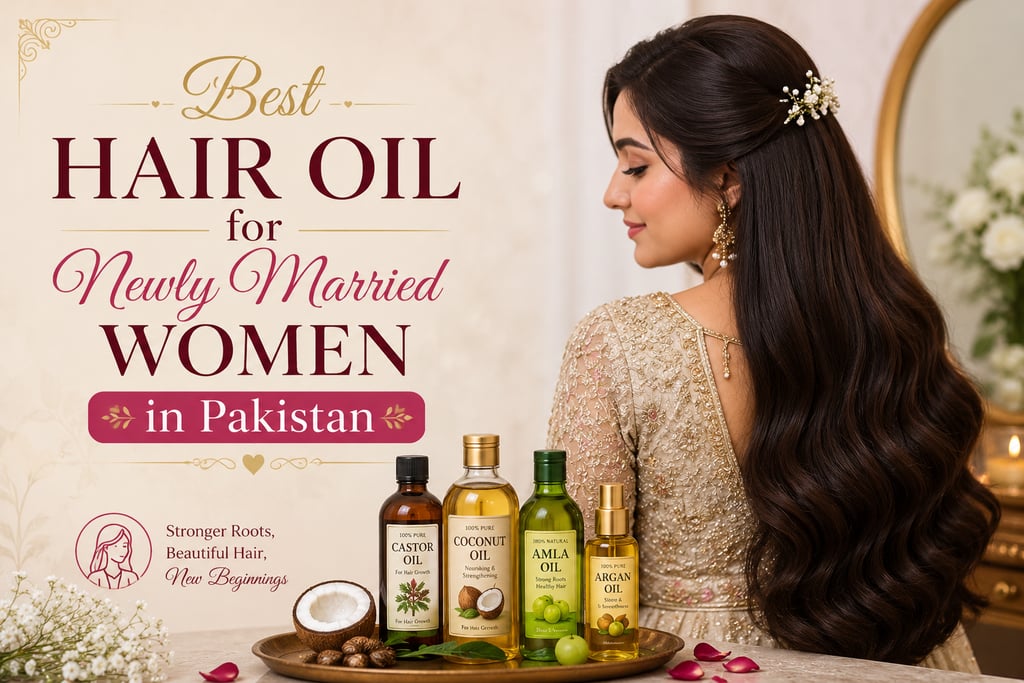
Hair Fall After Marriage in Pakistan: Why It Happens and Which Oils Help
Summarize this blog post with: ChatGPT | Perplexity | Claude | Grok
You oiled your hair faithfully growing up, kept your routine, and walked into your wedding with thick, healthy baal. So finding clumps on your pillow a few weeks later hit differently. What most newly married women in Pakistan don't know is that post-marriage hair fall has a specific medical name and a specific biological cause, and it has nothing to do with the shampoo you switched to. Below: why shedding often starts two to three months after the wedding, which oils help slow it, what to eat, and a simple 4-week plan for a new home, new water and a new routine.
For a ranked list of hair fall oils for every cause, see the best hair oil for hair fall in Pakistan. For all hair types and budgets, see best hair oils in Pakistan 2026. This page covers one specific trigger: the shedding that often starts a few weeks after the wedding.
Key Takeaways
Post-marriage hair fall in Pakistani women is a medically recognized condition called telogen effluvium, triggered by the physical and emotional stress of adjusting to a new life. It is temporary and reversible.
Cortisol, the stress hormone, disrupts the hair growth cycle by pushing follicles into a resting phase. Visible shedding often appears 6 to 12 weeks after the wedding, not immediately.
Key triggers specific to newly married Pakistani women include dietary changes, hard water exposure in a new home, disrupted sleep, pre-wedding chemical treatments, and emotional adjustment stress, often hitting simultaneously.
Hair oils rich in kalonji (black seed), castor oil, bhringraj, and rosemary oil reduce stress-related hair shedding by improving scalp circulation and delivering nutrients to weakened follicles.
Ollexo Hair Growth Oil is our own ready-made blend for stress-related shedding, available on ollexo.pk and Daraz.
A consistent oiling routine of 2 to 3 times per week, combined with iron-rich diet adjustments, shows visible improvement within 4 to 8 weeks for most women.
Most cases of post-marriage hair fall resolve within 3 to 6 months with consistent scalp care and basic stress management.
What Is Post-Marriage Hair Fall and Is It Normal in Pakistan?
Post-marriage hair fall is a form of telogen effluvium, a stress-triggered disruption of the hair growth cycle in which elevated cortisol levels push hair follicles prematurely into their resting phase, causing visible shedding typically 6 to 12 weeks after a major life event such as marriage. The condition is well-documented in dermatology and is far more common among Pakistani women than most people realize.
To understand why it happens, you need to know the basic hair growth cycle. Each strand moves through three phases: anagen (active growth, lasting 2 to 6 years), catagen (a brief transition phase), and telogen (resting, lasting 2 to 3 months). Under normal conditions, roughly 85 to 90% of your hair stays in anagen at any given time. Under significant stress, cortisol disrupts this balance. It pushes far more follicles than usual into telogen simultaneously. About three months later, those follicles shed at once. That's the clump you find on your comb.
Research published in the Journal of Health and Rehabilitation Research identified stress, poor diet, and inadequate hair care as the three primary contributors to hair loss in the Pakistani population, with the majority of affected patients being women under 30. — Source: Journal of Health and Rehabilitation Research, 2022.
The word "normal" matters here. Yes, post-marriage hair fall is common. No, you don't have to simply wait it out. It is a physiological response to stress, and it responds well to consistent care. If you're a new bride losing hair right now, your body is processing one of the most significant life transitions it will go through.
Why Does Hair Fall Suddenly Increase After Marriage? (The Real Causes)
Post-marriage hair fall in Pakistani women is triggered by a combination of factors unique to their context: adjusting to a new household, dietary changes, exposure to different water quality, disrupted sleep, and pre-wedding chemical hair treatments. These factors accumulate into a physical stress load that temporarily halts hair growth.
Most international articles on this topic describe vague "lifestyle stress." The experience of a newly married Pakistani woman is far more specific. She may have moved cities. She may have left her parents' home in Lahore to a new household in Karachi, where the water is harder, the climate is different, and she is learning to manage relationships with people she barely knows yet. Her previous hair care routine, including the weekly champi from her mother and the oils her sisters used, has been disrupted. Her diet has shifted from her mother's kitchen to new household cooking patterns.
Emotional and Psychological Stress
Adjusting to naya ghar carries real psychological weight. New family dynamics, new household roles, new expectations from in-laws, and the pressure to establish yourself in a completely new environment. All of this raises cortisol levels directly. Studies show that women under significant emotional stress experience hair shedding at 2 to 3 times the normal rate. — Source: International Journal of Dermatology, 2021. This is not metaphorical stress. It's measurable hormonal output with a measurable effect on follicles.
Dietary Changes After Moving Homes
A bride who moves into her in-laws' household often faces a shift in daily eating. Iron and protein, the two nutrients most critical for hair follicle function — are frequently the first casualties. Less daal, different portions, new cooking habits. Iron-deficiency anaemia is already widespread among Pakistani women, with estimates placing 40 to 50% of women of reproductive age in deficiency range. — Source: Pakistan Medical and Research Council, 2023. When iron drops, hair growth slows or stops.
Hard Water Exposure in a New Home
Hard water, meaning water high in calcium and magnesium, is a real hair problem in cities like Karachi and across much of Punjab. If you've moved from a soft-water area, your hair is now coated in mineral deposits every time you wash it. These deposits block scalp pores, weaken the hair shaft, and make follicles more vulnerable to shedding. Hard water alone won't cause telogen effluvium, but it accelerates and worsens whatever shedding is already happening.
Pre-Wedding Chemical Treatments
Most Pakistani brides go through significant chemical processing in the months before the wedding: smoothening, bleaching, keratin treatments, and repeat heat styling across multiple functions. These treatments deplete the scalp's natural oils and weaken the hair shaft physically. By the time the wedding season ends, the hair is already compromised. Telogen effluvium then lands on an already-stressed scalp.
Sleep Disruption During the Adjustment Period
The post-wedding period often involves weeks of disrupted sleep: travel, honeymoon, settling into a new routine. Sleep is when the body repairs and regenerates at the cellular level, including hair follicles. Even 4 to 6 weeks of consistently disrupted sleep measurably reduces growth hormone secretion, which directly affects the hair growth cycle. — Source: Journal of Clinical Sleep Medicine, 2020.
What Is Telogen Effluvium and Why Does It Affect New Brides?
Telogen effluvium is the second most common form of hair loss seen by dermatologists worldwide. It produces diffuse shedding across the whole scalp, rather than patches or a receding hairline. The condition occurs when a significant stressor, physical or emotional, triggers a mass shift of hair follicles from the active growth phase into the resting phase.
The Hair Growth Cycle, Explained Simply
Your scalp holds roughly 100,000 hair follicles, each operating on its own independent cycle. Under normal conditions, you shed 50 to 100 hairs per day. In telogen effluvium, 30 to 40% of follicles enter the resting phase simultaneously instead of the normal 10 to 15%. Three months after the triggering event, those follicles all shed at once.
This is why brides notice alarming clumps in their comb not during the wedding, but 2 to 3 months afterward, when things have mostly settled down. The shedding is a delayed echo of a stress event that already passed. Your body processed the stress weeks ago. You're seeing the result now.
How Cortisol Disrupts Hair Growth
Cortisol is the body's primary stress hormone. When chronically elevated, it signals hair follicles to exit their growth phase early. It also reduces blood flow to the scalp, since the body prioritizes organs during stress periods — and suppresses the production of hormones that support the anagen phase. Research confirms that women with elevated cortisol levels have measurably shorter anagen phases and higher daily shedding counts. — Source: Skin Pharmacology and Physiology, 2021.
Telogen effluvium is self-limiting: once the stressor reduces, follicles return to anagen. The difficulty for newly married Pakistani women is that the stressor doesn't reduce quickly. It stretches across months of household adjustment. This is why active intervention (oiling, diet correction, stress management) matters more than waiting.
How Does Stress Cause Hair Loss After Marriage in Pakistani Women?
Stress causes hair loss through two parallel pathways: hormonal and circulatory. Both are addressable.
The hormonal pathway is primary. Chronically elevated cortisol suppresses estrogen and IGF-1, both needed to keep follicles in anagen. Stress also tends to elevate DHT (dihydrotestosterone) levels, which physically shrinks hair follicles over time. This is why prolonged stress produces hair that grows back finer and shorter. The follicles have become smaller.
The circulatory pathway works alongside the hormonal one. Under stress, blood flow redirects toward core organs. The scalp, distant from the heart, receives less circulation. Follicles without adequate blood flow lack the oxygen, iron, and vitamins they need. This is exactly the mechanism a good scalp massage with oil addresses. It temporarily improves local circulation, partially counteracting the stress-driven reduction.
Does Changing Homes and Water Cause Hair Fall After Marriage?
Changing homes and water supply is a real contributor to post-marriage hair fall in Pakistan. It amplifies existing stress-related shedding rather than causing telogen effluvium by itself. Hard water physically damages the hair shaft and blocks scalp pores, making follicles more vulnerable during the same period when they're already under hormonal stress from the life transition.
Pakistan's groundwater is high in calcium and magnesium across most urban centres. When you wash your hair in hard water, these minerals deposit on the hair shaft and form a film on your scalp. This mineral buildup:
Blocks sebum production and limits scalp breathing
Makes hair brittle and prone to breakage
Reduces shampoo effectiveness, which leads to overwashing
Increases friction between hair strands and causes mechanical breakage
A clarifying rinse once a month (diluted apple cider vinegar works) reduces mineral buildup significantly. Applying oil before washing also creates a protective barrier on the shaft, limiting how much mineral residue penetrates.
Can a Hair Oil Actually Help Stress-Related Hair Loss?
Yes, with important context. A hair oil cannot override a severe hormonal imbalance or replace treatment for significant alopecia. For telogen effluvium triggered by lifestyle stress, which is what most post-marriage hair fall is, a well-formulated hair oil addresses the condition through three real mechanisms.
Scalp massage during oiling improves blood circulation. A 4-minute scalp massage performed daily increases scalp thickness and is associated with improved hair density over 24 weeks. — Source: Eplasty Journal, 2016. Circulation delivers nutrients and oxygen to stressed follicles. The massage is arguably the most important part of any oiling routine. The oil is partly a medium for it.
Key oil ingredients inhibit DHT accumulation on the scalp. Kalonji oil contains thymoquinone, which demonstrates DHT-inhibiting properties in clinical studies. Rosemary oil produced results comparable to 2% minoxidil in one controlled trial, with fewer side effects. — Source: Skinmed Journal, 2015. DHT shrinks follicles; reducing its accumulation on the scalp preserves follicle size.
Fatty acids in the oil penetrate the hair shaft and feed the follicle. Castor oil's ricinoleic acid, bhringraj's alkaloids, and argan oil's oleic acid all penetrate the scalp and deliver nutrients directly to follicle cells. This is functional nutrition for the follicle, not surface-level conditioning.
For newly married women, the combination of improved circulation, DHT inhibition, and direct follicle nourishment creates a meaningful intervention during the 3 to 6 month window when telogen effluvium is most active.
Which Hair Oil Ingredients Are Best for Post-Marriage Hair Loss in Pakistan?
The most evidence-supported natural oils for stress-related hair fall in women are kalonji (black seed) oil, castor oil, bhringraj oil, rosemary oil, argan oil, and amla oil. Together, they improve scalp blood circulation, inhibit excess DHT, and deliver fatty acids and vitamins directly to weakened hair follicles.
Is Kalonji Oil Effective for Stress-Related Hair Fall?
Kalonji oil is pressed from Nigella sativa seeds and contains thymoquinone, a compound with anti-inflammatory and DHT-inhibiting properties. For post-marriage hair fall, its anti-inflammatory action on the scalp is particularly relevant: stress causes real scalp inflammation that most women don't realize they have. A clinical study found a kalonji-based lotion reduced hair loss in women by 76% over 3 months. — Source: Journal of Dermatology and Dermatological Surgery, 2016. Kalonji is also familiar and trusted in Pakistani households, which makes it practical to use consistently.
How to use: Warm 1 to 2 teaspoons. Massage into the scalp for 5 minutes. Leave for at least 30 minutes before washing. Use twice per week.
Castor Oil for Hair Regrowth After Marriage
Castor oil's ricinoleic acid content (close to 90%) makes it one of the most effective oils for improving scalp circulation. It also has antifungal and antibacterial properties that protect the scalp environment when stress has weakened its natural defenses. Because castor oil is thick, it works best blended with a lighter oil like coconut or sweet almond.
How to use: Mix castor oil with equal parts coconut oil. Warm the blend. Apply to the scalp and hair with focus on areas of heaviest thinning. Leave overnight, wash out in the morning.
Bhringraj Oil for Stress Hair Loss
Bhringraj (Eclipta prostrata) is used in Ayurvedic hair care because it works. Its active compounds (ecliptine and wedelolactone) stimulate follicle cells and have produced hair regrowth in animal studies comparable to minoxidil 2%. — Source: Archives of Dermatological Research, 2009. For post-marriage hair fall, bhringraj is particularly relevant because it specifically targets follicles that have prematurely entered the telogen phase, precisely what stress triggers.
How to use: Apply 30 minutes before washing. Warm the oil slightly and pair with a firm scalp massage.
Rosemary Oil for Hair Fall in Pakistan
Rosemary oil improves scalp circulation by dilating blood vessels near the surface. This directly addresses one of the main stress pathways described earlier: reduced blood flow to the scalp. A 2015 clinical trial published in Skinmed Journal found rosemary oil as effective as 2% minoxidil at stimulating hair regrowth, with less scalp itching. That's one of the stronger evidence bases for any natural hair treatment. Rosemary essential oil must always be diluted before use, since full concentration irritates skin.
How to use: Mix 2 to 3 drops of rosemary essential oil into 1 teaspoon of carrier oil before applying.
Argan Oil for Damaged Post-Wedding Hair
Argan oil is a repair oil, not a growth oil. After months of pre-wedding heat styling, bleaching, and chemical treatments, the hair shaft is physically damaged. Argan oil's high oleic acid and vitamin E content repairs the cuticle layer, reduces breakage, and restores moisture balance. Less mechanical breakage means less perceived hair fall, even before regrowth begins.
How to use: A few drops applied to the mid-lengths and ends after washing, while hair is still damp.
Amla Oil for Scalp Strengthening
Amla (Indian gooseberry) oil is high in Vitamin C and tannins. For post-marriage hair fall, its main contribution is as a scalp tonic: it reduces oxidative stress that accumulates in hair follicles during periods of prolonged emotional stress. Use it blended with other oils rather than alone.
Which Is the Best Hair Oil for Newly Married Women Available in Pakistan in 2026?
Full disclosure: Ollexo is my company, so read this pick in that light. Ollexo Hair Growth Oil is our ready-to-use blend, made for Pakistani water and climate. Available on ollexo.pk.
Feature Ollexo Hair Growth And Nourishing Oil, availability at ollexo.pk, Daraz Pakistan Best For Post-marriage hair fall, stress-related shedding, new brides Usage Frequency 2 to 3 times per week Formulation Multi-oil blend, ready to use Formulated For Pakistani hard water and climate conditions
Most Pakistani women dealing with post-marriage hair fall need multiple oil types: kalonji for DHT inhibition, castor for circulation, bhringraj for follicle stimulation. Blending them correctly at home takes time and precise measurement. Ollexo Premium Hair Growth Oil gives you a ready-made multi-oil blend in one bottle, without the setup.
How to Use Hair Oil for Maximum Results After Marriage?
A consistent oiling routine of 2 to 3 times per week, combined with iron-rich diet changes, typically shows visible improvement within 4 to 8 weeks. Most cases of post-marriage telogen effluvium resolve within 3 to 6 months when this routine is maintained.
The Oiling Method That Works
Step 1: Warm the oil. Cold oil stays on the scalp surface. Warm oil penetrates the follicle and absorbs better. Place the bottle in warm water for 3 to 5 minutes. Test on your wrist before applying to your scalp.
Step 2: Section and apply. Part your hair into 4 to 6 sections. Apply oil directly to the scalp along each part using your fingertips. Work section by section to cover the scalp, not just the hair length.
Step 3: Massage for 5 minutes. Use circular motions with your fingertips, not your nails. Work from the nape upward. This step drives the most benefit. The massage itself improves circulation regardless of which oil you use.
Step 4: Leave it in. One hour minimum for basic results. Overnight, covered with a soft cotton dupatta or silk scarf, produces better absorption.
Step 5: Wash it out correctly. Apply shampoo before wetting your hair. This breaks down the oil more effectively than applying shampoo to wet hair. Then rinse, then shampoo once more. Castor-heavy blends usually need two washes.
Weekly Schedule
Day Activity Sunday night Oil overnight, wash Monday morning Wednesday 1-hour oil treatment before evening wash Friday Rest, let scalp breathe
Tips for Hijab and Dupatta Wearers
If you wear hijab or dupatta daily, your scalp gets less air circulation and more friction than uncovered hair. Oil a minimum of twice per week. Wash thoroughly each time, since oil residue under hijab creates humidity that can cause dandruff. On oil days, choose a breathable cotton hijab over synthetic fabric.
DIY Option: Mixing Your Own Blend
A basic home blend: 2 tablespoons castor oil, 2 tablespoons coconut oil, 1 tablespoon kalonji oil, 3 drops rosemary essential oil. This covers the core mechanisms, though without the precise ratios or quality control of a commercial formula.
What Foods Should Newly Married Pakistani Women Eat to Stop Hair Fall?
Diet is the second pillar of post-marriage hair recovery, after oiling. Hair follicles rank among the fastest-dividing cells in the body, which makes them acutely sensitive to nutritional gaps. Three nutrients have the strongest clinical evidence for hair health: iron, protein, and biotin.
Iron-Rich Pakistani Foods for Hair Growth
Iron deficiency is the most common nutritional cause of hair loss in women globally. Pakistani women are disproportionately affected. Traditional Pakistani cooking is, fortunately, rich in high-iron foods:
Daal (lentils): one of the most accessible plant-based iron sources available
Palak (spinach): pair with lemon juice; the Vitamin C increases iron absorption
Eggs: a complete protein source; 2 eggs daily is clinically meaningful for hair health
Kaleji (liver): the most bioavailable source of iron and B12; once per week is enough
Chana (chickpeas): high in both iron and zinc, both critical for follicle function
Protein for Follicle Repair
Hair is made of keratin, a protein. When your diet is protein-deficient, the body deprioritizes hair follicle production. They are not an essential organ. Aim for at least 50 to 60 grams of protein daily. Daal gosht, eggs, dahi (yoghurt), and murghi (chicken) are your most practical options.
Biotin and B Vitamins
Biotin deficiency directly causes hair thinning and brittle nails. It's found in eggs, almonds, and leafy greens. If your diet is inconsistent, a basic B-complex supplement, available at any Pakistani pharmacy without a prescription, covers the gap affordably.
What Other Hair Care Habits Must Newly Married Pakistani Women Change?
Beyond oiling and diet, a few specific habits determine how quickly post-marriage hair fall resolves.
Stop heat styling for 4 to 6 weeks. Your hair has gone through months of heat for shaadi functions. Air-dry when possible. When heat is unavoidable, apply argan oil to the hair shaft first.
Switch to a softer towel technique. Wet hair breaks more easily than dry hair. Rubbing with a terry cloth towel snaps strands that telogen effluvium has already weakened. Pat dry, or wrap in a cotton T-shirt.
Avoid tight hairstyles. Pulling hair into a tight bun or juda daily creates traction alopecia, a separate hair loss mechanism. During recovery, keep styles loose.
Sleep on a satin or silk pillowcase. Cotton pillowcases create friction that breaks vulnerable strands overnight. A satin case reduces this mechanical damage.
Drink water consistently. Dehydration affects scalp oil production and hair shaft hydration. Eight to ten glasses daily is the target. In Karachi or Multan heat, go higher.
How Long Does Post-Marriage Hair Fall Last, and When Will It Stop?
In most cases, post-marriage hair fall caused by telogen effluvium resolves within 3 to 6 months when the underlying stress is managed and a consistent scalp care routine (including regular oiling 2 to 3 times per week) is maintained.
Here's a realistic timeline:
Timeframe What to Expect Weeks 1 to 4 (oiling started) Scalp feels nourished; daily shed count may appear unchanged initially Weeks 4 to 8 Shedding begins to slow; scalp becomes less inflamed or itchy Months 2 to 3 Visible reduction in shed count; new baby hairs appear at the hairline Months 3 to 6 Hair density improves noticeably; full recovery for most women
Normal daily shedding is 50 to 100 hairs. If you are consistently shedding more than 150 to 200 hairs per day, if shedding is worsening after 8 weeks of consistent treatment, or if you notice bald patches rather than diffuse thinning, see a dermatologist rather than continuing to self-treat.
Frequently Asked Questions
When should I start oiling my hair before my wedding?
Start two to three months before the wedding if you can. Oil the scalp two or three times a week, cut back on heat styling and new chemical treatments, and get any trim done four to six weeks before the main events. Avoid switching to a brand-new oil in the final two weeks in case your scalp reacts.
Should I oil my hair during wedding week?
Keep it light. Oil your scalp the night before a wash day, then shampoo well, because leftover oil can make blow-dries and updos slip or look flat. Skip oil on the day you're getting styled. Between functions, a few drops of a light oil such as argan on dry ends helps with heat damage without looking greasy.
Is hair fall after marriage the same as postpartum hair loss?
Both are usually telogen effluvium, a temporary shedding phase, but the trigger is different. After marriage it is mostly stress, diet, sleep and water changes. After delivery it is the sharp drop in pregnancy hormones, often with low iron, and you also need breastfeeding-safe oils. If shedding began after childbirth, read our postpartum guide instead.
When Should You See a Doctor for Hair Fall After Marriage?
See a dermatologist if any of the following apply:
Hair fall is worsening after 3 months of consistent oiling and diet improvement
You notice bald patches or a receding hairline (these suggest conditions beyond telogen effluvium)
Hair fall comes with weight changes, irregular periods, extreme fatigue, or scalp pain
You suspect a thyroid issue, since thyroid dysfunction causes hair loss that does not resolve with oiling alone
Hair shows no signs of regrowth after 6 months of consistent treatment
A dermatologist can order a blood panel covering ferritin, thyroid hormones, B12, and zinc. These results identify the precise deficiency driving the shedding and change the treatment path entirely. Don't wait past 6 months if the situation isn't improving on its own.
What's Next: Your 4-Week Post-Marriage Hair Recovery Plan
Week 1: Start oiling. Begin with Ollexo Hair Growth And Nourishing Oil three times this week. Prioritize the scalp massage technique. Wash hair no more than three times this week, since overwashing strips the scalp oil you're trying to rebuild.
Week 2: Fix the diet gaps. Add one iron-rich meal per day: daal at lunch, eggs at breakfast, or both. Start a B-complex supplement if your diet has been inconsistent. Eight glasses of water daily, minimum.
Week 3: Remove heat. No heat styling. Air-dry only. If your current shampoo contains sulfates, switch to a gentler formula, since sulfates strip the scalp oil layer you are actively rebuilding.
Week 4: Assess. Count your daily shed by collecting fallen hairs after combing. If you were shedding 200 or more per day in Week 1, you should be noticeably closer to 100 to 150 by Week 4. Continue the routine. Results compound over months, not days.
Order Ollexo Hair Growth And Nourishing Oil at ollexo.pk
Conclusion
Post-marriage hair fall is real, it is common, and it ends. Every year, Pakistani brides go through exactly this: finding their hair on the comb weeks after the happiest day of their lives. It is the body's delayed response to one of the most demanding transitions a person goes through. It is not a sign something has permanently gone wrong.
The biology is uncomplicated. Stress spikes cortisol. Cortisol pushes follicles into rest. Three months later, those follicles shed. Then follicles recover. New hair grows back. The 3 to 6 month timeline is predictable and manageable, but it requires consistency, not a single-use fix.
Oil 2 to 3 times a week. Eat your iron. Sleep enough. Keep heat tools away for a few months. The baby hairs will come. The shedding will slow. You walked into your marriage with beautiful baal. You walked into your marriage with beautiful hair, and for most women it comes back.
Related guides