Coconut vs Mustard Oil for Hair in Pakistan: Which Is Better?
Coconut Oil vs Mustard Oil for Hair in Pakistan - Compare growth, hair fall & scalp type for summer heat to pick the best oil today.
HAIR OIL
Written by Ali Raza, CEO of Ollexo, with over 10 years of experience in the oil industry. Ali is passionate about sharing practical insights, industry trends, and real-world lessons from years of leadership and hands-on experience in Pakistan's natural oils sector.
5/8/202615 min read
Coconut Oil vs Mustard Oil for Hair in Pakistan: The Complete Summer Guide for Every City and Hair Type
Every Pakistani home has at least one of them: a bottle of nariyal tel on one shelf, sarson ka tel somewhere nearby, both backed by decades of family conviction about which one is right. What most people do not realize is that the oil that worked beautifully in January can actively work against your scalp in July, because Pakistani summers do not just change the weather, they change how every oil behaves on your hair. This guide breaks down exactly how coconut oil and mustard oil perform under Pakistan's heat and humidity, which one suits your city and hair type, and what to do when neither feels like the complete answer.
Key Takeaways
Coconut oil suits thin, protein-deficient, or chemically treated hair in Pakistani summers because its lightweight molecules penetrate the hair shaft without sitting heavily on the scalp in heat.
Mustard oil is better suited to thick, dry, or slow-growth hair, and its circulation-stimulating properties make it popular for hair fall, though its weight and scent become harder to manage in humidity.
Pakistan's climate varies sharply by city. Karachi's coastal humidity favors lighter oils; Lahore and Multan's dry summer heat can tolerate heavier oils for short overnight sessions.
Neither oil performs perfectly alone in Pakistani summer conditions. Coconut oil can cause scalp buildup under sweat; mustard oil can feel excessively greasy and turn rancid faster in high heat.
Blended multi-herb hair oils that combine both oils' strengths outperform single-oil options for year-round Pakistani use, delivering penetration and circulation benefits without the individual drawbacks.
The amount of oil matters as much as the type. Summer oiling should use less product, for shorter durations, with thorough washing to prevent pore clogging in heat.
Your city, scalp condition, and hair texture, not family tradition alone, should drive your oil choice in 2026.
What Is Hair Oiling and Why Do Pakistanis Do It Differently?
Hair oiling, or champi, is a deeply cultural practice in Pakistan that goes far beyond simple moisturization, it is a generational ritual passed down through mothers and grandmothers, tied to everything from Friday routines to wedding preparation. In Pakistani households, champi is less about following a product label and more about following family memory. That is both its strength and, in summer, its limitation.
The difference between how Pakistanis oil their hair and how the rest of the world does it comes down to frequency, duration, and oil volume. Most Pakistani women apply oil generously, leave it overnight, and wash it the following morning, a method that works exceptionally well in winter but becomes problematic when July arrives. In winter, the same oil that nourishes the scalp quietly overnight will, in July's humidity, mix with sweat, block hair follicles, and create the exact scalp buildup that causes hair fall and itching.
Understanding this seasonal shift is the starting point for any honest discussion of coconut oil versus mustard oil for Pakistani hair. The comparison is not just about which oil is chemically superior. It is about which oil behaves better on a sweating scalp in Karachi in August, or under the punishing dry heat of a Lahore afternoon in June.
Why Does Hair Oil Choice Matter More in Pakistani Summer Than in Winter?
Oil choice matters more in Pakistani summer because heat and humidity fundamentally change how oils interact with the scalp, the hair shaft, and sweat. In winter, most oils sit relatively stable on the hair and scalp, absorbing slowly without interference. In summer, everything accelerates, sebum production increases, sweat mixes with applied oil, and heavier oils can oxidize faster in high temperatures, sometimes turning rancid before they are washed out.
Pakistan's climate is not a single environment. It is at least three distinct weather systems operating simultaneously.
Karachi sits on the Arabian Sea coast and experiences year-round humidity between 60 and 85 percent, making it one of the most challenging environments for hair oiling. Oils applied in coastal humidity tend to sit on the scalp rather than absorb, because the air already contains so much moisture that the scalp's natural oil-absorption mechanism slows.
Lahore and Multan experience a different challenge: extreme dry heat from April through June, followed by the monsoon humidity of July and August. The dry-heat phase allows heavier oils to penetrate reasonably well but the transition into monsoon can catch oiling habits off guard. Many women who oiled comfortably in May find the same routine causing itching and dandruff by the end of July.
Islamabad and the northern regions experience a milder but still humid monsoon season, with cooler nights that allow for somewhat more forgiving oiling routines compared to the plains.
A 2023 survey of dermatological complaints in Pakistani urban centers found that scalp folliculitis, an infection of hair follicles often linked to pore clogging, peaks between June and September, the exact window when heavy oiling intersects with high humidity, Source: Pakistan Journal of Medical Sciences, 2023. This is why summer oil selection is not a cosmetic preference. It is a scalp health decision.
What Is Coconut Oil for Hair (Nariyal Tel), Properties, Benefits, and Pakistani Use Cases
Coconut oil is a lightweight, lauric-acid-rich oil that penetrates the hair shaft rather than simply coating it, making it one of the few natural oils scientifically shown to reduce protein loss in hair. A landmark study published in the Journal of Cosmetic Science found that coconut oil was the only common hair oil to measurably reduce protein loss during both pre-wash and post-wash applications, Source: Journal of Cosmetic Science, 2003. This distinction matters enormously for Pakistani women whose hair is frequently subjected to hard water, heat styling, and chemical treatments.
In Pakistan, nariyal tel has a stronger presence in coastal and urban areas. Karachi, Hyderabad, and urban Lahore households tend to use it more readily than rural Punjab or Sindh, where sarson ka tel dominates by generational habit. Part of coconut oil's urban popularity comes from its cleaner scent, its pale color that does not stain dupattas as visibly, and its association with modern hair care content circulating on social media.
What Makes Coconut Oil Good for Pakistani Hair in Summer?
Coconut oil's molecular weight is low enough that it partially absorbs into the hair cortex rather than sitting entirely on the surface, which means it provides internal conditioning without loading the scalp with an additional surface layer that sweat can trap. For thin-haired women in Karachi who sweat heavily during summer afternoons, this makes coconut oil the more forgiving choice.
For protein-deficient or chemically treated hair, a growing category as salon services become more accessible across Pakistani cities, coconut oil offers the additional benefit of reducing the mechanical damage that occurs during washing and combing. This is particularly relevant for younger urban women in their 20s and 30s who straighten or color their hair regularly. For best hair oils in Pakistan suited to chemically treated hair, penetrating oils like coconut are consistently recommended over surface-coating alternatives.
What Are the Limitations of Coconut Oil in Pakistani Humidity?
Coconut oil has one critical limitation in Karachi-level humidity: it can solidify and reliquefy repeatedly as temperatures fluctuate, and in high-sweat conditions, it forms a surface film on the scalp that traps heat and bacteria. Women with naturally oily scalps who apply coconut oil and then spend time outdoors in humid conditions sometimes find that the oil and sweat combination creates a dense residue that is difficult to wash out completely, especially in hard water areas.
Coconut oil also provides relatively minimal benefit for scalp circulation. It conditions and protects the hair shaft well, but it does not stimulate blood flow to the follicles the way warming oils do. For women experiencing hair fall linked to poor scalp circulation rather than protein loss, coconut oil alone may not be enough.
What Is Mustard Oil for Hair (Sarson Ka Tel), Properties, Benefits, and Pakistani Use Cases
Mustard oil is a heavy, warming oil with circulation-stimulating properties that has been used in Pakistani and South Asian hair care for generations, particularly in Punjab where it is valued for promoting hair thickness and reducing scalp dryess. Its primary active compound, erucic acid, gives mustard oil its characteristic pungency and its warming sensation on the scalp, a sensation that many Pakistani women, especially in rural areas, associate directly with the feeling of the oil "working."
Sarson ka tel carries genuine cultural weight that no imported or branded oil has been able to dislodge in rural Pakistan. In villages across Punjab and Sindh, it is common to see mothers massaging mustard oil into children's hair as a weekly ritual, with a confidence in the oil's effectiveness rooted not in chemistry but in lived generational experience. For mustard oil for hair growth benefits that are both cultural and clinically documented, its capacity to stimulate scalp circulation is the most consistently supported claim.
What Makes Mustard Oil Effective for Hair Fall and Scalp Dryness?
Mustard oil stimulates scalp blood circulation more aggressively than most other plant oils, largely due to its erucic acid content and the mild thermal effect it produces on the scalp. Improved blood flow to the follicles can support hair growth in cases where thinning is linked to poor circulation rather than hormonal or nutritional deficiency. For Pakistani men in their 20s and 30s noticing early thinning, increasingly common in polluted urban centers like Lahore and Karachi, a short-session mustard oil champi two or three times a week has genuine traditional and anecdotal support.
Mustard oil also has natural antifungal properties, which makes it useful for dandruff-prone scalps, particularly the dry dandruff that appears in Lahore and Islamabad winters. For women dealing with kalonji oil for hair and looking for complementary scalp treatments, mustard oil and kalonji are among the most historically paired ingredients in Pakistani hair care.
What Are the Limitations of Mustard Oil in Pakistani Summer?
Mustard oil's weight, pungency, and tendency to oxidize faster in heat make it a difficult oil to use during Pakistan's peak summer months, especially in high-humidity cities. The oil's strong smell, tolerable in winter when you stay indoors and wash it out the next morning, becomes genuinely unpleasant when it mixes with summer sweat. More practically, mustard oil applied overnight in Karachi's July humidity can feel rancid by morning.
The oil's thickness also works against it in summer. Where coconut oil partially absorbs, mustard oil sits primarily on the scalp surface, which means that in warm weather, it stays on top of the skin rather than soaking in. This is fine for a short fifteen-minute champi but becomes a scalp hygiene problem when left on for eight hours in sweating conditions.
Coconut Oil vs Mustard Oil for Hair in Pakistani Summer: A Side-by-Side Comparison
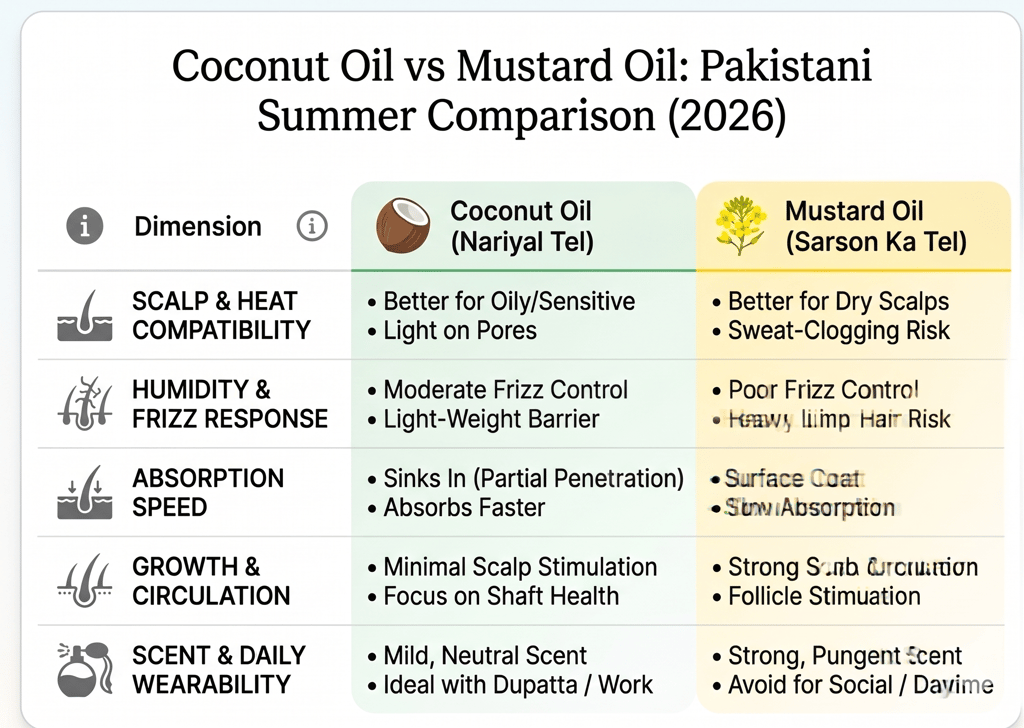
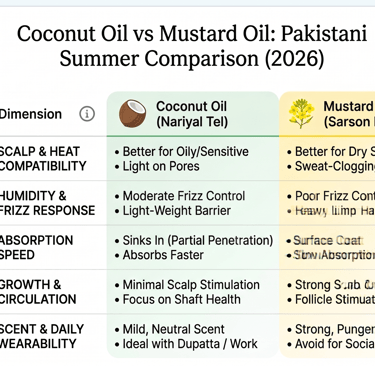
The table below compares both oils across the five dimensions that matter most for Pakistani climate conditions in 2026.
Scalp Compatibility in Heat: Which Oil Is Easier on Pores?
In high-heat conditions, coconut oil is the more pore-friendly option because its molecular structure allows partial absorption before sweat has a chance to trap it on the surface. On a sweating scalp, any oil that sits entirely on the surface becomes a barrier that prevents natural temperature regulation. Coconut oil, by partially absorbing, reduces this risk compared to mustard oil.
For women with naturally oily scalps, common in Pakistan's urban heat, mustard oil can tip an already sebum-heavy scalp into congestion territory. For dry scalps, however, mustard oil's surface-coating action is actually beneficial: it seals in moisture without the scalp producing enough sebum to create buildup.
How Each Oil Reacts to Humidity and Frizz
Frizz in Pakistani monsoon conditions is caused by the hair shaft absorbing excess moisture from humid air, causing the cuticle layer to lift. Both oils can create a surface seal that reduces this moisture absorption, but coconut oil's partial penetration of the cuticle makes it slightly more effective at frizz reduction than mustard oil, which only coats the outside. For coconut oil for frizzy hair in Pakistan, the penetration benefit is what separates it from heavier alternatives during monsoon season.
That said, neither oil is a complete frizz solution. Women in Karachi dealing with extreme frizz during the July-August monsoon period will find that both oils provide temporary relief but cannot replicate the effect of purpose-formulated anti-frizz treatments.
Hair Growth and Scalp Circulation: Which Oil Actually Delivers?
For hair fall caused by poor scalp circulation, mustard oil outperforms coconut oil because its warming properties actively stimulate blood flow to follicles, while coconut oil's primary benefit is to the hair shaft rather than the scalp. A 2021 review of plant-based hair growth treatments confirmed that erucic-acid-rich oils showed measurable scalp-stimulation effects, Source: International Journal of Trichology, 2021.
For hair fall caused by protein loss, breakage, or chemical damage, coconut oil is the more targeted choice. The distinction matters: if your hair fall solutions in Pakistan are about protecting existing strands, use coconut. If they are about stimulating new growth at the follicle level, mustard has the edge.
When to Use Coconut Oil and When to Use Mustard Oil: A City and Hair Type Guide
The choice between coconut oil and mustard oil depends less on which is universally better and more on where you live, what your scalp produces naturally, and what season you are in. Below is practical guidance organized by Pakistani city and hair condition.
Which Oil Suits Karachi Residents?
Karachi's year-round coastal humidity makes coconut oil the safer daily choice for most residents. The city's moisture-heavy air means heavy oils stay on the scalp surface far longer than in drier inland cities. For Karachi residents, coconut oil applied in a light quantity for thirty to sixty minutes before washing is more practical than an overnight mustard oil application. Women with very dry scalps in Karachi who miss mustard oil's deep conditioning can use it once a week during cooler months, from November through February, and switch to coconut oil for the remaining nine months.
Which Oil Suits Lahore and Multan Residents?
Lahore and Multan's two-phase summer, dry heat in April to June, humid monsoon in July to September, requires a flexible approach. During the dry heat phase, mustard oil can be used for overnight sessions without the same humidity-related drawbacks that Karachi residents face. The dry air helps the oil absorb more effectively and reduces the rancidity risk. Once the monsoon hits in July, switching to coconut oil or reducing mustard oil sessions to under thirty minutes is advisable.
For men in Lahore experiencing hair thinning linked to heat stress and urban pollution, mustard oil champi two to three times per week during the dry summer months has the most traditional and anecdotal support. For hair oil for hair fall in Pakistan during summer, the timing of application matters, apply at night and wash out thoroughly by morning.
Which Oil Suits Islamabad Residents?
Islamabad's milder summer temperatures and lower baseline humidity compared to Karachi make it one of the most forgiving cities for hair oiling. Both oils can be used year-round with appropriate adjustments. Mustard oil remains practical through June, coconut oil takes priority during the July-August monsoon period, and the transition back to mustard is reasonable by October.
Can You Mix Coconut Oil and Mustard Oil Together for Pakistani Summer Hair Care?
Mixing coconut oil and mustard oil is a traditional practice in many Pakistani households and, when done correctly, produces a blend that partially addresses the limitations of each oil used alone. A common ratio used across rural Punjab is one part coconut to two parts mustard in winter, and two parts coconut to one part mustard in summer, a ratio shift that intuitively reduces weight and smell during warmer months.
The benefit of a homemade blend is that coconut oil's faster absorption helps carry a portion of the mustard oil's compounds deeper into the scalp area, producing a mild combined effect: some hair shaft protection from the coconut component and some scalp stimulation from the mustard component. The limitation is that a home blend does not include the additional herbal extracts, amla, bhringraj, kalonji, brahmi, that significantly enhance the individual benefits of both base oils.
Blended multi-herb hair oils that combine coconut oil, mustard oil, and plant extracts such as kalonji, amla, and bhringraj are formulated to deliver the benefits of both base oils without the individual drawbacks of using either alone in Pakistan's summer conditions. For readers interested in herbal enhancement, kalonji oil for hair is a well-documented complementary ingredient that amplifies mustard oil's scalp-stimulating properties while adding antifungal benefit. Similarly, rosemary oil for hair growth has been increasingly added to Pakistani hair oil blends for its clinically supported follicle stimulation, with a 2023 study finding it comparable to 2% minoxidil in promoting hair density, Source: Skinmed Journal, 2023.
What Are the Best Blended Hair Oils for Pakistani Conditions?
The best blended hair oils for Pakistani conditions in 2026 combine a lightweight carrier base with scalp-stimulating and conditioning herbs, rather than relying on a single heavy base oil. When evaluating blended options, whether commercial or homemade, look for formulas that include at least one penetrating carrier (coconut, almond, or argan), at least one scalp-stimulating component (mustard, castor, or rosemary), and at least one traditional herbal extract (amla, bhringraj, or kalonji).
For readers exploring herbal hair oils in Pakistan, the shift toward multi-ingredient formulas reflects a practical recognition that no single oil addresses all the demands of Pakistan's varied climate. The most effective champi routine in 2026 is less about picking one oil and more about choosing a formula that combines what both oils do best.
Practical Application Tips for Summer Hair Oiling in Pakistan
The single most common mistake Pakistani women make with summer hair oiling is applying the same amount and duration they use in winter. In summer, less oil, applied for less time, produces better results than the generous overnight champi that works well from October through March.
How Much Oil to Use in Summer
In summer, use half the volume you would apply in winter. A general guideline: for shoulder-length hair, one to two teaspoons of oil is sufficient for a thirty-to-sixty-minute pre-wash session. For a proper scalp massage, a small amount worked thoroughly into the scalp with fingertip pressure is more effective than a large amount poured on top. The goal is scalp stimulation and light conditioning, not saturation.
For women who prefer overnight oiling and cannot break the habit, reduce the volume by 60 percent from your winter application, tie the hair loosely rather than tightly (to allow air circulation at the scalp), and switch to a cotton pillowcase that absorbs excess oil rather than a synthetic one that traps it. For guidance on how often to oil hair in summer, two sessions per week is the upper limit most dermatologists recommend for humid Pakistani cities.
Overnight vs Short-Session Oiling in Pakistani Summer Heat
Short-session oiling, thirty to sixty minutes before washing, is more appropriate than overnight oiling for most Pakistani summer conditions. In Karachi particularly, an overnight oil session in July and August almost guarantees scalp discomfort by morning: the combination of heat, humidity, sweat, and oil creates the precise conditions for follicle congestion and scalp irritation.
Short sessions deliver adequate conditioning without the extended buildup risk. If your hair is extremely dry or damaged and you feel overnight oiling is essential, use it exclusively in the dry-heat months, April through mid-June, before the monsoon humidity arrives.
How to Wash Oil Out in Pakistani Hard Water
Hard water, common across Lahore, Faisalabad, and most of inland Pakistan, makes oil removal significantly more difficult because the mineral content in the water reacts with soap to reduce lather. To remove oil effectively in hard water, apply shampoo directly to dry oiled hair before adding water. This pre-wash application of shampoo breaks down the oil before water reduces its effectiveness. A second shampoo pass with water added normally completes the removal.
For hair oiling tips for Pakistani women dealing with persistent oil residue after washing, apple cider vinegar diluted in water as a final rinse can help strip mineral buildup and remaining oil without stripping natural moisture. Use it once a week at most during summer.
What to Try Next
If you are switching your summer oiling routine based on this guide, start with one change at a time rather than overhauling everything simultaneously. The most impactful first step for most Pakistani women is reducing oil volume and duration, this single adjustment resolves the majority of summer scalp complaints before you even consider changing oil type.
For those in Karachi and other humid cities who want to continue with a single-oil routine, shift from mustard to coconut oil for the duration of the June through September period. For Lahore residents, adjust your routine at the monsoon transition rather than changing oils for the entire summer. For everyone dealing with hair fall, consider whether your issue is scalp-circulation-related (where mustard has the edge) or damage-related (where coconut is more relevant) before committing to a specific oil.
Readers interested in exploring almond oil for hair in summer as a third lightweight option will find it particularly useful for women who find both coconut and mustard oil too heavy for Karachi's peak humidity months, almond oil sits between the two in weight and absorption speed. For castor oil for thick hair in Pakistan, it remains one of the most supported traditional options for women with coarse hair seeking density rather than lightweight conditioning.
Finally, buy hair oil online in Pakistan from platforms like Daraz or direct brand websites to access blended formulations that may not be available in local markets, particularly if you are looking for herbal-infused or multi-oil combinations suitable for Pakistani summer conditions.
Conclusion
Both coconut oil and mustard oil have earned their place in Pakistani hair care, one through science, one through centuries of tradition, and both through genuine results in the right conditions. The honest answer to "which one is better for Pakistani summer" is: it depends on your city, your scalp type, and how you apply it. Coconut oil is better for thin, damaged, or protein-depleted hair in humid coastal cities. Mustard oil is better for thick, dry hair or scalps struggling with poor circulation, particularly in the dry-heat phase of inland summers.
What neither oil does perfectly on its own is cover the full range of demands that Pakistani summer places on hair and scalp simultaneously. That gap is what makes blended, multi-herb formulas the most practical direction for 2026, not because tradition is wrong, but because the best of both oils, properly combined, outperforms either one used alone. Start with the seasonal adjustments this guide recommends, experiment with a light home blend, and let your scalp's actual response, not family conviction alone, guide your final choice.
Written by Ali Raza, CEO of Ollexo, with over 10 years of experience in the oil industry. Ali is passionate about sharing practical insights, industry trends, and real-world lessons from years of leadership and hands-on experience in Pakistan's natural oils sector.
Reviewed by the Ollexo Editorial Team, a panel of hair care specialists and content strategists with expertise in Pakistani consumer hair care, climate-based formulation, and SEO content accuracy.